WhatsApp’s three new CVEs: IP leak, SQL injection and the VCEK chain
Three official WhatsApp CVEs published on November 20, 2026: ad-reply IP leak, order details SQL injection and the Meta AI certificate chain. Scores, versions and exploitation status.
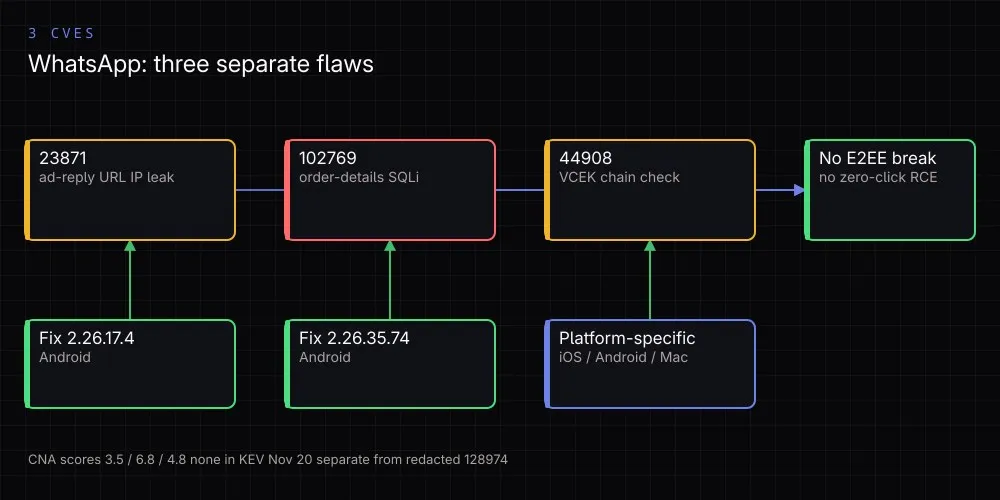
On November 20, 2026, WhatsApp published three security advisories on the same day. All three have official CVE records, vendor advisories and NVD entries, so version ranges and scores are concrete. They are entirely separate from CVE-2026-128974, the November 18 claim about a still-redacted official record.
What the three have in common: none breaks end-to-end encryption (E2EE), and none is a “zero-click account takeover.” One is a low-impact IP leak with a possible link to a scam campaign, one is an SQL injection leading to local file deletion plus a one-bit side channel, and one is a certificate-validation error in the client trust chain for Meta’s confidential computing backend.
Quick summary
| CVE | Class / impact | CVSS 3.1 (CNA) | Affected versions | Exploitation status |
|---|---|---|---|---|
| CVE-2026-23871 | Incomplete ad-reply URL validation, IP leak | 3.5 Low, AV:N/AC:L/PR:L/UI:R/S:U/C:L/I:N/A:N |
Android and Business Android 2.20.198.3 ≤ version < 2.26.17.4 | May have been abused with spam messages; scale unknown |
| CVE-2026-102769 | SQL injection, local file deletion, one-bit side channel | 6.8 Medium, AV:N/AC:L/PR:L/UI:R/S:U/C:L/I:H/A:L/E:F/RL:O/RC:C |
Android and Business Android 2.22.3.7 ≤ version < 2.26.35.74 | No evidence of exploitation in the wild |
| CVE-2026-44908 | Certificate chain validation error (CWE-296), VCEK | 4.8 Medium, AV:N/AC:H/PR:H/UI:R/S:U/C:H/I:L/A:N |
Different lower bounds for iOS, Android, Business and Mac Desktop | Transparency ledger confirms no exploitation |
All three NVD records are in Received state, so the table uses CNA (Facebook / Meta) scores rather than an NVD re-score. As of November 20, 2026, none of the three CVEs appears in the CISA KEV catalog, catalog version 2026.11.20.
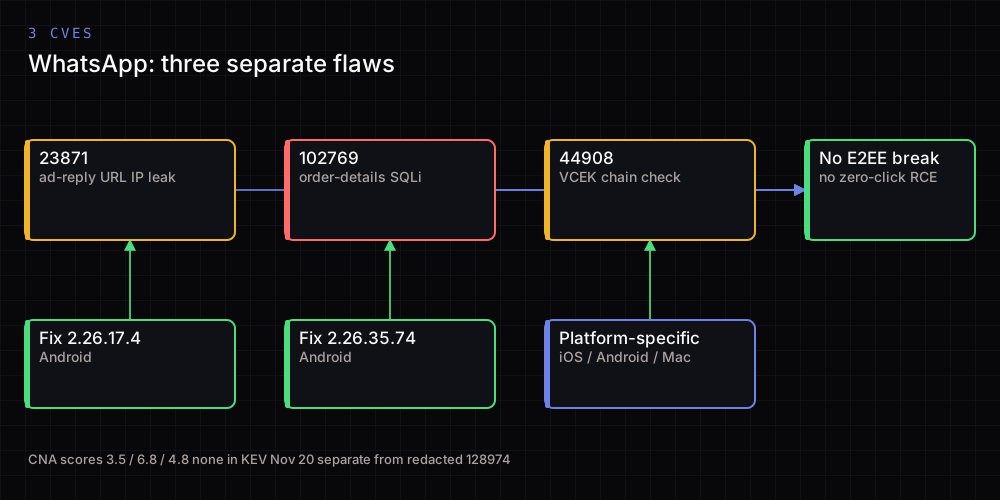
1. CVE-2026-23871: ad replies can expose an IP address
According to the official advisory, external URLs used in replies to Click to WhatsApp ads are insufficiently validated. If an attacker sends media from an attacker-controlled URL when a crafted ad-reply message is rendered and displayed in a message thread, the target device can reveal its IP information to the attacker.
Affected products are WhatsApp for Android and WhatsApp Business for Android, from 2.20.198.3 up to but not including 2.26.17.4. The fixed version is 2.26.17.4. WhatsApp’s own security team found the issue. The vector’s PR:L and UI:R indicate some attacker privilege and user interaction are required.
The advisory also says the issue “may have been abused in conjunction with specific spam messages.” A WhatsApp spokesperson told SecurityWeek: “Our team found this issue while disrupting a scam campaign, and we believe a scammer was using it to make their scam message seem more credible.”
That turns a limited abuse suspicion into an official statement. WhatsApp did not disclose how many users were affected or whether the campaign succeeded. The leaked data is IP information only — no message content, account access or device control.
2. CVE-2026-102769: SQL injection via an “order details” message
This issue triggers when a recipient taps a specially crafted order details message sent from an unofficial client. The SQL injection can delete locally stored WhatsApp files. Separately and more narrowly, if the user is online when the message arrives, one bit of information about the chat database requested by the attacker can leak through an induced-crash delivery-receipt timing side channel.
The affected range is 2.22.3.7 ≤ version < 2.26.35.74, fixed in 2.26.35.74. Both WhatsApp and WhatsApp Business for Android are affected. The vendor score is 6.8 Medium; the temporal fields E:F/RL:O/RC:C in the vector indicate functional exploit availability, official fix and a confirmed report. They do not change the base impact, but they are not an empty claim either.
The distinction matters: file deletion is the I:H impact, while confidentiality impact is C:L and one bit. That does not support a “whole chat database leaked” headline. According to WhatsApp and SecurityWeek, an external researcher reported the bug through Meta’s bug bounty program, and the company says it has seen no evidence of exploitation in the wild.
3. CVE-2026-44908: the VCEK certificate and the Meta AI trust chain
This bug is not about message processing. It affects the remote-attestation verifier WhatsApp clients use to establish trust with Meta AI’s confidential computing backend. Improper following of the certificate chain could let someone positioned within Meta infrastructure bypass the hardware root of trust by presenting clients with a VCEK certificate signed by a key other than the hardware manufacturer’s.
VCEK (Versioned Chip Endorsement Key) is a chip-specific key that proves the authenticity and patch level of AMD SEV-SNP confidential VMs. Meta’s Private Processing technical whitepaper describes the chain VCEK → ASK → ARK, where the client treats the hardware manufacturer’s root key as a hardcoded trust anchor.
The key detail in the vendor advisory is the prerequisite: any such VCEK certificate would first have to be published to the third-party binary transparency ledger used by WhatsApp Private Processing. WhatsApp reports that every published VCEK certificate in the ledger chains to the hardware root of trust, and describes this as confirming no exploitation.
Affected versions differ by platform: iOS before 2.26.24.72; Business iOS and Mac Desktop before 2.26.23.72; Android before 2.26.23.74; Business Android before 2.26.23.70. There is no single fixed version number for all platforms. The scope is Meta AI’s server-side trust model, not a break in E2EE message encryption.
4. Keep this separate from the redacted record
These three CVEs are not the same story as CVE-2026-128974, published November 18, 2026. For 128974, the MITRE and NVD description fields still say temporary redacted, vendor and product are tbc, and the cck.dat / Noise static-key claims come from secondary sources rather than the official record.
This week’s three issues are the opposite: published advisory text, a CNA score, an affected version range and a known fixed version. A headline saying “WhatsApp’s three new CVEs” refers to these three official records, not to the redacted 128974 record.
There is no technical overlap either. The 128974 claim is about local key storage; these three are URL validation, SQL query construction and certificate chain validation bugs.
5. Exploitation and KEV status
| CVE | Official exploitation statement | KEV |
|---|---|---|
| 23871 | “May have been abused in conjunction with specific spam messages”; spokesperson refers to a scam campaign | No |
| 102769 | “We have not seen evidence of exploitation in the wild” | No |
| 44908 | Transparency ledger records confirm no exploitation | No |
“Listed in KEV” cannot be said about any of these three. CISA’s November 20, 2026 catalog (version 2026.11.20) contains none of the three CVE IDs. The reverse inference is also wrong: absence from KEV does not prove a bug was never abused; it means CISA’s evidence threshold was not met.
6. What to do
- Update Android apps. The lower bounds are 2.26.17.4 for 23871 and 2.26.35.74 for 102769; keep store updates enabled.
- Check every platform separately. For 44908, iOS, Android, Business and Mac have different fixed builds; do not search for one universal version.
- Treat ad-reply spam carefully. Report unsolicited messages that load media from unknown sources; an IP leak leaves no visible trace.
- Review unofficial client use. The 102769 trigger is an order-details message from a non-official client.
- Do not publish misleading headlines. “E2EE broken” and “zero-click RCE” have no basis in these advisories.
- Inventory in enterprise environments. Knowing which WhatsApp version runs where is what makes fix verification possible.
7. What not to write
- “WhatsApp E2EE is broken” — no advisory says that.
- “All three are actively exploited” — only 23871 has a limited spam-abuse suspicion; there is no evidence for the others.
- “CVE-2026-102769 leaked the entire chat database” — the impact is a one-bit side channel plus local file deletion.
- “The VCEK certificate was stolen” — ledger records show the opposite; the chain held.
- “Added to CISA KEV” — none of the three is in the November 20 catalog.
- “Same as CVE-2026-128974” — a redacted record, different mechanism, different evidence.
Status
As of November 20, 2026, fixed versions exist for all three issues. The highest score is 6.8 Medium, and the most concrete abuse signal is the 3.5 Low IP leak. The story should therefore lead with versions and exploitation status rather than a “critical WhatsApp flaw” label.
From this series
- WhatsApp iOS flaw: the cleartext Noise key claim in cck.dat
- Why does everything become 2shell?
- Ruby2Shell: case-conversion overflow
Sources
- WhatsApp Security Advisories 2026
- NVD: CVE-2026-23871
- NVD: CVE-2026-102769
- NVD: CVE-2026-44908
- CVE Program: CVE-2026-102769
- SecurityWeek: WhatsApp Fixes Flaw Uncovered While Disrupting Scam Campaign
- The Hacker News: WhatsApp Patches 3 Security Flaws
- Meta: Private Processing for WhatsApp technical whitepaper
- CISA Known Exploited Vulnerabilities Catalog