WhatsApp iOS flaw: the cleartext Noise key claim in cck.dat
CVE-2026-128974 is published, but the official record is still redacted. Separating the Noise key, cck.dat and account-impersonation claims from verified data.
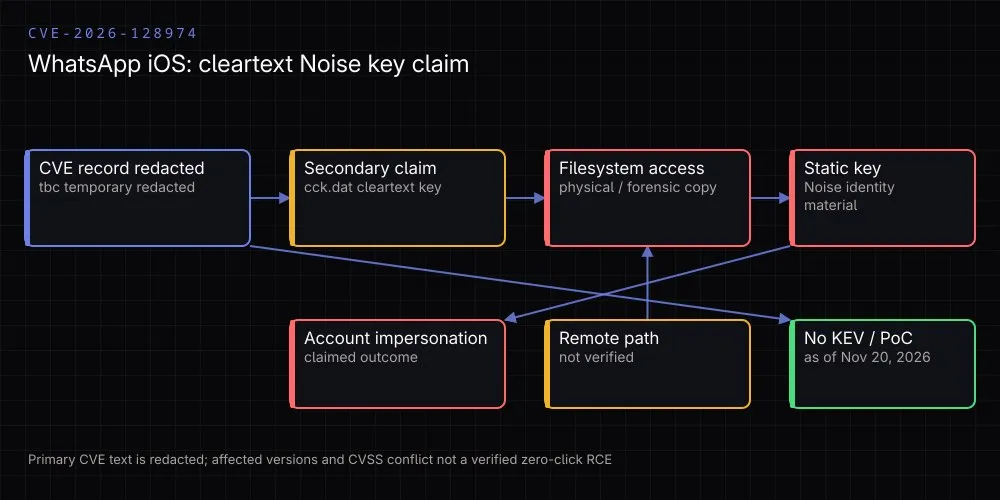
On November 18, 2026, CVE-2026-128974 was published. Secondary databases immediately used phrases like “WhatsApp for iOS,” “Noise static private key,” “cck.dat” and “account impersonation.” Those phrases get attention — but as of November 20, the main MITRE and NVD records still say temporary redacted, with vendor and product listed as tbc.
So there are two layers here: verified record metadata, and a consistent but unverified technical claim. This post keeps them apart.
Quick summary
| Field | Verified | Claim / caveat |
|---|---|---|
| ID | CVE-2026-128974, CNA: ENISA |
GHSA-8mw7-v289-xwcx appears in secondary sources |
| Official text | MITRE/NVD: temporary redacted, vendor/product tbc |
cck.dat and Noise key details are secondary |
| Dates | CVE reserved Nov 13, published Nov 18, updated Nov 19 | — |
| CISA SSVC | Exploitation: none; Automatable: no; Technical Impact: total | No CISA KEV entry |
| Score | No NVD base score; Rapid7 CVSS 4.0 5.4 | OffSeq says 8.5, VulDB 3.3; conflicting |
| Affected version | Not in the official record | VulDB claims “up to 26.43.75”; unverified |
| Fixed version | Not in the official record | Some secondary sources say “no fix yet”; unclear |
| PoC / exploitation | No confirmed public PoC; no reported exploitation | Aggregators also report no exploit |
1. What does the official record actually say?
Reading the MITRE and NVD APIs directly gives a clear table:
- CNA: ENISA
- CVE state: PUBLISHED
- Reserved: November 13, 2026
- Published: November 18, 2026
- Last updated: November 19, 2026
- Description:
temporary redacted - Affected product:
tbc - Reference:
https://euvd.eu - NVD status:
Received, meaning NVD analysis is not complete
The CISA ADP entry adds the only concrete technical-impact assessment: Exploitation: none, Automatable: no, Technical Impact: total. In plain terms: no observed exploitation, no automated attack, but high impact if the claim is confirmed. It is not in KEV.
Headlines saying “WhatsApp remotely compromised” or “E2EE broken” are therefore not supported by the sources.
2. The scenario described by secondary sources
Rapid7, VulDB, OffSeq and InfraStack repeat a version of this claim:
WhatsApp Messenger for iOS stores the Noise protocol static private key in cleartext inside the app’s shared container file
cck.dat. An attacker who obtains a full filesystem extraction or an equivalent copy of app data can recover this long-term authentication material and impersonate the victim’s account.
The critical precondition in that scenario is local / physical access. Rapid7’s CVSS 4.0 vector also says AV:P — physical attack vector. OffSeq publishes 8.5 with the same vector and a “Medium” label; VulDB’s structured field says 3.3. Three sources, three scores for the same claim.
The accurate reading is:
- There is no claim of remotely triggered RCE.
- There is no zero-click message or call chain claim.
- The attacker must first obtain device data or a copy of the app container.
- “Account impersonation” is a serious claimed impact, but the mechanism is not described in the official record.
3. Why the Noise static key matters
Noise/Signal-family protocols use two kinds of keys together:
- Ephemeral keys are generated per session and provide forward secrecy.
- The static key is the user’s long-term identity material; it carries the “you are you” authentication.
If a static private key is recovered, an attacker can potentially present themselves as the victim in the protocol handshake. That is more fundamental than reading one message: it is an account impersonation problem.
At the same time, recovering a static key does not automatically decrypt every past message. Message encryption depends on session and ratchet keys. Saying “E2EE is over” would go beyond the claim.
On iOS, a key like this is expected to live in Keychain / Secure Enclave with hardware-backed access controls. If the cck.dat plaintext claim is correct, the problem is not the cryptography algorithm — it is key storage architecture.
4. Reading the score conflict
| Source | Score | Note |
|---|---|---|
| NVD | No base score | Record is Received; CNA description is redacted |
| Rapid7 | CVSS 4.0 5.4 Medium | AV:P, physical access required |
| OffSeq | CVSS 4.0 8.5 Medium | Same vector; score/label look inconsistent |
| VulDB | 3.3 Low (structured field) | “Local access required”, no exploit |
These differences do not make the issue unimportant; they explain why headlines sound so different. A physical-access key exposure and a remote zero-click RCE are not in the same risk category.
In enterprise environments, risk is multiplied by the likelihood of device compromise. A lost or seized iPhone, a badly configured MDM profile or a device that allows forensic copies all raise that multiplier.
5. A verified neighboring case: CVE-2026-23866
There is also a verified WhatsApp iOS issue from the same period: CVE-2026-23866. According to Meta’s CVE record:
- Published: May 1, 2026
- Class: CWE-940, Improper Verification of Source of a Communication Channel
- Impact: incomplete validation in AI rich response messages for Instagram Reels could trigger processing of media from an arbitrary URL on another user’s device, including OS-controlled custom URL scheme handlers
- Affected iOS: 2.25.8.0 ≤ version < 2.26.15.72
- Affected Android: 2.25.8.0 ≤ version < 2.26.7.10
- CVSS: 3.1 / 4.3 Medium,
AV:N/AC:L/PR:L/UI:N/S:U/C:L/I:N/A:N - Exploitation: Meta reported no evidence of exploitation in the wild
That is a genuine iOS message-processing bug, but it should not be mixed with the Noise key / cck.dat / account-impersonation claim. One is a verified, low-to-medium URL-processing flaw; the other is a serious claim sitting on top of a redacted record.
6. What to do
- Watch the official record. When the redaction is lifted, version and fix details may become clear.
- Keep WhatsApp updated. “No fix” in a secondary database is a point-in-time observation; check the App Store version and the official advisory.
- Reduce physical access. Device lock, a strong passcode, lost-device procedures and MDM policies directly reduce this class of risk.
- Encrypt backups. Copying app data can be quieter than stealing the physical device.
- Prepare incident response for high-risk users. If a forensic copy was taken, close sessions, re-verify the account and wait for official guidance.
- Do not install unofficial “patches.” Profiles, certificates or sideloaded packages circulated before a fixed version is confirmed add new risk.
7. What not to write
- “WhatsApp E2EE is broken” — not verified.
- “Remote zero-click account takeover” — sources describe physical access.
- “It is in KEV and actively exploited” — CISA SSVC says exploitation
none; no KEV entry. - “CVSS 8.5 Critical” — OffSeq’s own label says Medium and the sources conflict.
- “Android and WhatsApp Business are affected” — the official record names no product for CVE-2026-128974; the claim is iOS-specific.
- “It is the same as CVE-2026-23866” — different CVE, different class, different attack model.
Status
As of November 20, 2026, we have a serious claim, a redacted official record and conflicting scores. That is why the headline is phrased as a claim: “the cleartext Noise key claim in cck.dat.” When the official record opens up, this post should be updated. Until then, calling it confirmed would be premature.