VMware vCenter zero-day: from SRP key disclosure to [email protected]
CVE-2026-123890 is fixed in VMSA-2026-0009.1. A breakdown of the SRP-6a session key disclosure ARMORY CASTLE exploited from early September 2026, through SAML signing key theft.
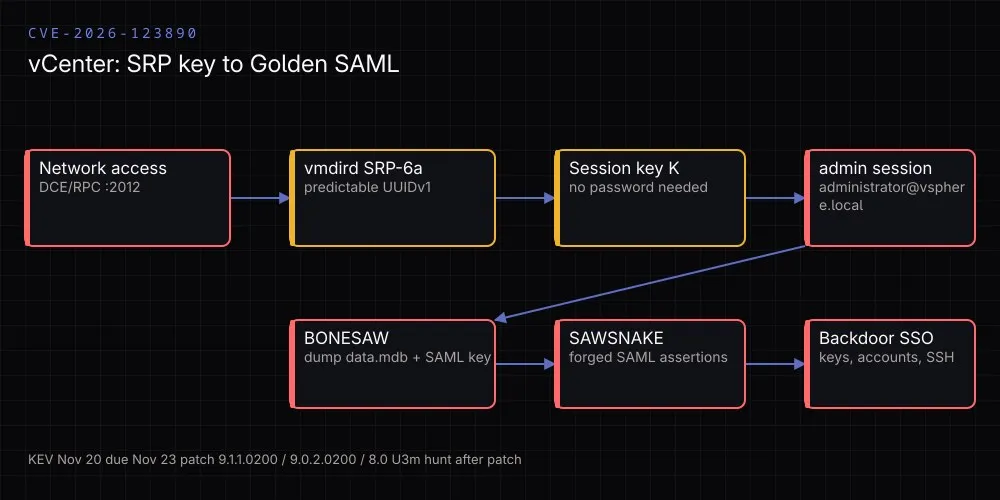
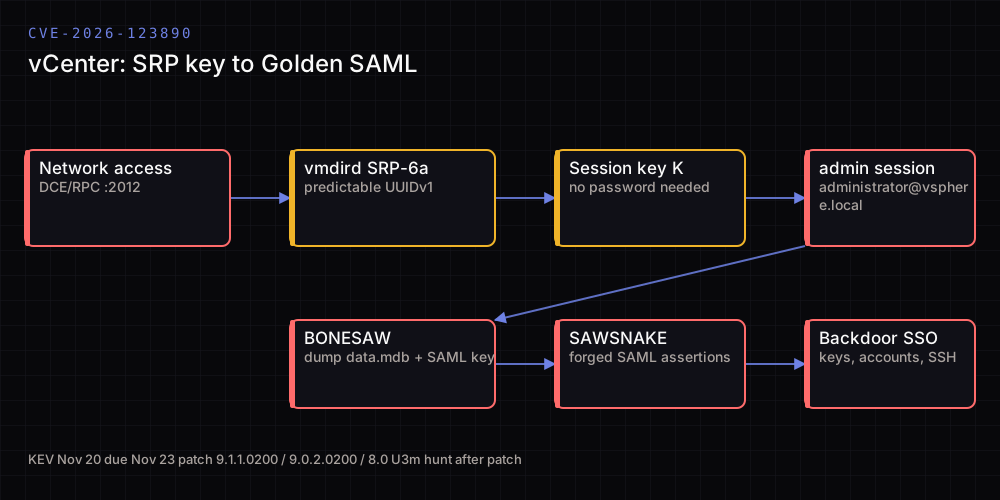
On November 19, 2026, Broadcom published VMSA-2026-0009.1 for CVE-2026-123890, updating the advisory on November 20. The official description is an authentication bypass in the VMware Directory Service (vmdird), rated CVSS 3.1 9.8. The same day, the Google Threat Intelligence Group and Mandiant disclosed that the suspected PRC-nexus actor ARMORY CASTLE had exploited it as a zero-day since early September 2026.
The score is not the only thing that matters. An attacker who does not know the password can obtain the session key, authenticate as [email protected], and then take the directory database, the SAML signing key and an SSO administrator account. As of November 20, the CVE is also in the CISA KEV catalog.
Quick summary
| Field | Verified information |
|---|---|
| ID | CVE-2026-123890, CNA: VMware; advisory VMSA-2026-0009.1 |
| Score | CVSS 3.1 9.8, AV:N/AC:L/PR:N/UI:N/S:U/C:H/I:H/A:H |
| Class | CWE-288, Authentication Bypass Using an Alternate Path or Channel |
| Prerequisites | Network access; no authentication, no user interaction |
| Mechanism | DCE/RPC over TCP/2012, vmdird SRP-6a session key disclosure |
| Fixed in | 9.1.1.0200 / 9.0.2.0200 / 8.0 U3m; VCF 5.x: 5.2.5 |
| vCenter 7.0 | General support ended October 2, 2025; patch only via extended support |
| Workaround | None; the Broadcom FAQ confirms this explicitly |
| Exploitation | Mandiant/GTIG: since early September 2026; Broadcom’s advisory is silent |
| CISA KEV | Yes, added November 20, 2026; BOD 26-04 due date November 23 |
1. What do the record and advisory say?
VMware’s CVE record and VMSA-2026-0009.1 are consistent:
- Published: November 19, 2026; updated: November 20, 2026.
- Impact: authentication bypass in the VMware Directory Service; a malicious actor with network access gains unauthorized access.
- Score: CVSS 3.1 base 9.8, vector
AV:N/AC:L/PR:N/UI:N/S:U/C:H/I:H/A:H. - CWE: 288, authentication bypass using an alternate path or channel.
- Workaround: none. The FAQ says organizations must assess their own compensating controls, but Broadcom lists no official workaround.
- Response matrix: vCenter 9.1.x → 9.1.1.0200, 9.0.x → 9.0.2.0200, 8.0 → 8.0 U3m, VCF 5.x → 5.2.5; KB463116 covers Telco Cloud Platform/Infrastructure.
- vCenter 7.0: present in the advisory matrix; general support has ended, so a patch requires an extended support contract.
Two FAQ answers prevent common misreadings: this is not a VM escape (no code execution on an ESX host from a VM), and the flaw is present whether or not Enhanced Linked Mode is enabled. “We don’t use ELM” is not a defense.
2. How does the SRP-6a session key leak?
The GTIG/Mandiant technical account makes Broadcom’s general “unauthorized access” wording concrete:
- The attacker reaches the TCP/2012 DCE/RPC interface. During reconnaissance Mandiant scanned for that port alongside 9080 and 5480.
- The
vmdirdservice’srpc_srp_verifierinterface generates predictable UUIDv1 timestamps during SRP-6a authentication. - The weakness yields the SRP session’s shared key (K) without the password.
- With that key, the attacker establishes an authenticated session as
[email protected].
This is not a scope error but full compromise of the management plane: the session means arbitrary commands and file access on vCenter. Google’s published BONESAW hunting rule uses the /storage/db/vmware-vmdir/data.mdb path and the SRP interface UUIDs as signatures.
3. The chain after BONESAW
Mandiant reports a Golang utility named BONESAW. It automates not just the initial flaw but the whole sequence:
- Exfiltration of the LMDB database
data.mdbthrough thevmdirdbcpRPC interface. - Extraction of the STS (Security Token Service) SAML private RSA signing key.
- Creation of a backdoor machine account via
vmdirand an SSO administrator account. - A second utility, SAWSNAKE, forges SAML 2.0 assertions using IdP signing keys and obtains an administrative session cookie — Golden SAML behavior that bypasses MFA and impersonates any user.
- SSH enabled through the VAMI API; the vCenter master symmetric key and PostgreSQL password stolen; SSH disabled again afterward.
- On ESXi hosts, root
authorized_keysmodified and files pulled from guest VM disks.
That sequence is why patching alone is insufficient: the patch closes the hole but does not remove accounts, stolen signing keys or forged tokens the attacker already created.
4. Do not confuse it with CVE-2026-59309
The Broadcom FAQ calls CVE-2026-123890 “a new and distinct issue.” The differences:
| CVE-2026-59309 | CVE-2026-123890 | |
|---|---|---|
| Published | July 29, 2026 | November 19, 2026 |
| Interface | LDAP, TCP 389/636 | DCE/RPC, TCP 2012 |
| Flaw | Malformed authorization tokens bypass LDAP authentication | Predictable UUIDv1 leaks the SRP-6a session key |
Mandiant saw BONESAW work against a vCenter already patched for 59309, so “we applied the July patch” is not a defense here. The BONESAW binary carries a July 13, 2026 build timestamp, though Google cautions that Go build metadata can be altered.
5. Exploitation status, KEV and PoC
- Exploitation: GTIG/Mandiant report exploitation against a vCenter in early September 2026 and say they investigated multiple incidents. Broadcom’s advisory does not mention exploitation; that is a difference in disclosure practice, not a contradiction.
- Attribution: ARMORY CASTLE, formerly tracked as UNC5221 and also called Warp Panda in secondary reporting, is described as a suspected PRC-nexus espionage actor.
- Initial access: the chain begins with the BeyondTrust Remote Support zero-day CVE-2026-102764, disclosed October 15, 2026, followed by lateral movement to internal Linux appliances.
- CISA KEV: in catalog version 2026.11.20, CVE-2026-123890 is listed — added November 20, 2026, BOD 26-04 due date November 23, forensic triage “Yes”. CISA ADP SSVC fields read
Exploitation: active,Automatable: yes,Technical Impact: total. - PoC: no public exploit code was verified as of November 20. PoC code does exist for the related CVE-2026-59309.
6. What to do
- Inventory every vCenter, including embedded or vendor-installed instances. Check versions in the vSphere Client Summary tab or with PowerCLI
$global:DefaultVIServer.Build. - Apply the fixed releases: 9.1.1.0200, 9.0.2.0200, 8.0 U3m; for VCF 5.x use KB88287 asynchronous patching plus SDDC Manager 5.2.5. Use the extended support channel for vCenter 7.0.
- Treat patching as step one. Hunt for new SSO administrator accounts, SSH changes made through VAMI, ESXi root SSH keys and sessions from unusual internal addresses.
- Rotate exposed material. Assume the SAML signing key and vCenter master key may have been stolen; review federation trust relationships and local credentials.
- Narrow the management plane. Allow TCP 2012, 9080 and 5480 only from approved admin stations and block outbound internet traffic from vCenter.
- Close the entry point too. The BeyondTrust Remote Support zero-day starts the chain; patch remote-support appliances as well.
7. What not to write
- “VM escape” — the Broadcom FAQ says no; the impact is the vCenter management plane and the hosts it manages.
- “Same as CVE-2026-59309” — different port, different flaw, different CVE; the older patch does not close this one.
- “Not in CISA KEV” — it was added on November 20, 2026, with a November 23 BOD 26-04 deadline.
- “Broadcom confirmed exploitation” — the advisory remains silent; the exploitation data comes from Mandiant/GTIG.
- “Only ELM users are affected” — the FAQ says the opposite.
- “The patch is enough, we’re clean” — post-compromise accounts, keys and tokens need separate investigation.
- “Public PoC available” — not verified for 123890; the PoC is for the neighboring CVE-2026-59309.
Status
As of November 20, 2026, this is a patched zero-day that was exploited for more than two months. The fix, exploitation evidence and KEV entry landed in the same week. Patching is mandatory, but Mandiant’s findings make retrospective hunting mandatory too.
From this series
- Why does everything become 2shell?
- The WhatsApp iOS Noise key claim
- Ruby2Shell: case-conversion overflow