SonicWall Gen 6 warning: no critical CVE patches after support ends
SonicWall urges immediate retirement of Gen 6 firewalls running SonicOS 6.x. CISA KEV-listed CVE-2026-19868 and what unsupported edge devices mean.
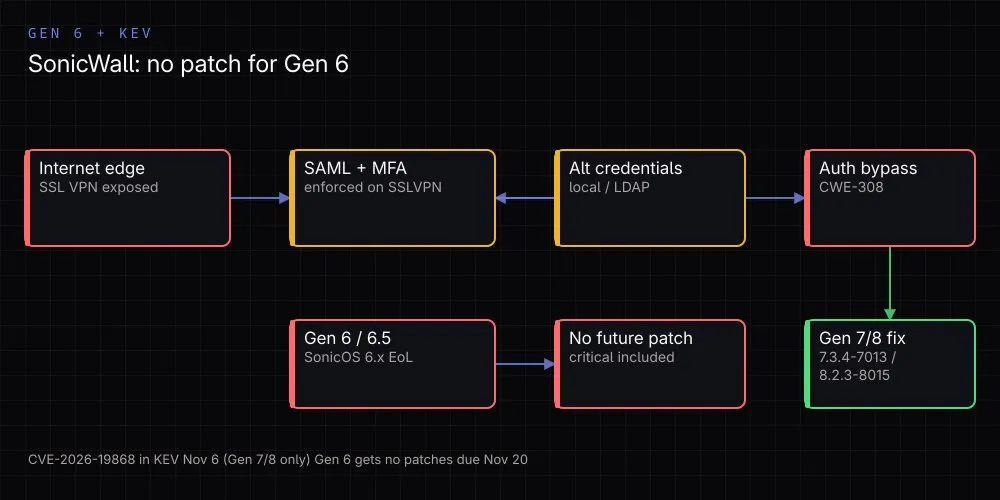
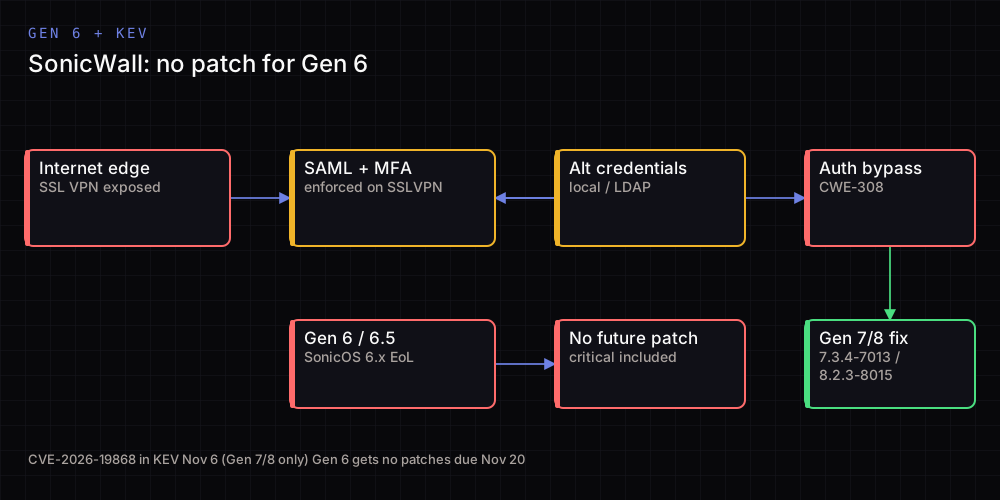
In a product advisory published on November 18, 2026, SonicWall urged customers to replace every Generation 6 (Gen 6 / 6.5) firewall running SonicOS 6.x. The reason is not just device age: Gen 6 receives no security patches at all; a newly found vulnerability will not get a fix even if it is rated Critical.
The warning lands in the same week as CVE-2026-19868, added to CISA’s KEV catalog on November 6. That SSL VPN flaw officially affects Gen 7 and Gen 8 releases; Gen 6 is not in its affected-version list. SonicWall’s broader point is still direct: an unsupported device will have no patch for the next critical flaw either.
Quick summary
| Field | Status |
|---|---|
| Gen 6 advisory | November 18, 2026, SonicWall Product Advisory |
| Scope | All Gen 6 / 6.5 firewalls on SonicOS 6.x, including Gen 6 NSv virtual appliances |
| Patch policy | No new security patches, including Critical; support cannot be purchased or renewed |
| Target platform | Gen 8 running SonicOS 8 |
| CVE-2026-19868 | SonicOS SSLVPN, CWE-308, SAML and SAML-enforced MFA bypass |
| CVSS | 7.1 High, source: SonicWall CVE record (corroborated in secondary reporting) |
| Prerequisites | Valid credentials for an alternate auth method; SAML enabled for SSL VPN logins |
| CISA KEV | Added 2026-11-06, due 2026-11-20, ransomware use Unknown, forensic triage No |
| Official workaround | None; the vendor fix is a firmware upgrade |
1. What SonicWall actually says
The advisory is unusually blunt: “An end-of-life firewall that is still running is not a firewall that can still be secured.” SonicWall expects internet-facing Gen 6 firewalls to be actively targeted and says they should be treated as high-risk exposures.
It cites three trends: edge devices and VPNs are a frequent target in breaches that start with an exploited vulnerability; the window between disclosure and confirmed exploitation is shrinking; and attackers use automation and AI to scan for unsupported devices and build exploits faster.
The sharpest line is about future flaws: when a vulnerability spans multiple generations, supported firewalls get a fix and Gen 6 does not, while the public advisory effectively tells attackers where to look. SonicWall points to CVE-2024-40766 in 2024 as precedent — it affected Gen 5, Gen 6 and early Gen 7, and supported platforms received a fix.
2. Models in scope
The advisory covers every Gen 6 and Gen 6.5 firewall running SonicOS 6.x. Listed models and end-of-support dates:
- October 1, 2026: TZ350, TZ350W, TZ500, TZ500W, SOHO 250, SOHO 250W; NSA 4600, NSA 5600, NSA 6600; NSa 4650, NSa 5650, NSa 6650.
- August 1, 2026: TZ400, TZ400W, TZ600, TZ600P, NSA 3600; NSa 3650.
- May 1, 2026: NSa 2650.
- April 16, 2026: SOHO, SOHO W, TZ300P, NSa 9250, NSa 9450, NSa 9650; NSv 10 through NSv 1600 virtual appliances.
- February 20, 2026: SuperMassive 9200, 9400, 9600, 9800; NSsp 12800, NSsp 12400.
- January 23, 2025: TZ300, TZ300W.
- March 8, 2024: NSA 2600.
All of these dates are in the past as of November 20, 2026. A model name alone may not identify the generation — an NSa can be Gen 6.5 or Gen 7 — so check firmware (6.x means in scope) and inventory. Virtual NSv appliances should not be overlooked.
3. CVE-2026-19868: bypassing SAML and MFA
CVE-2026-19868 is an authentication-enforcement failure in the SonicOS SSLVPN service, classified as CWE-308, “Use of Single-Factor Authentication.” A user holding valid credentials for an alternate authentication method can bypass SAML authentication controls and SAML-enforced multi-factor authentication.
This is not unauthenticated RCE. Two conditions matter: SAML must be enabled for SSL VPN logins, and the attacker needs valid credentials for another method such as a local account or LDAP. Moving VPN logins to SAML is specifically meant to force every login through the identity provider and its MFA prompt, so the bypass removes a meaningful barrier.
SonicWall lists Gen 7 versions 7.3.3-7015 and earlier and Gen 8 versions 8.2.2-8015 and earlier as affected. Fixed releases are 7.3.4-7013 and 8.2.3-8015. Only SSL VPN configurations using SAML are affected.
The vendor’s workaround field is None. Some secondary reports describe disabling alternate LDAP, RADIUS or TACACS+ servers as a temporary measure, but that is not a vendor-approved substitute for firmware remediation and may have operational consequences.
4. What the KEV entry says exactly
CISA added the flaw to the KEV catalog on November 6, 2026. The fields are:
| Field | Value |
|---|---|
| CVE | CVE-2026-19868 |
| Product | SonicWall SonicOS SSLVPN |
| Date Added | 2026-11-06 |
| Due Date | 2026-11-20 |
| Known Ransomware Campaign Use | Unknown |
| Forensic Triage | No |
| CWE | CWE-308 |
CISA based the addition on “evidence of active exploitation.” SonicWall’s PSIRT wording is more cautious: it investigated a report indicating “potential exploitation.” These are not the same statement; KEV is a risk-prioritization decision for federal agencies, while the vendor keeps its language measured.
Ransomware use is Unknown — neither confirmed nor ruled out. Forensic Triage is No, meaning no extra forensic-triage requirement under BOD 26-04 for covered federal agencies. Those fields are not a legal deadline for the private sector.
5. What to do
- Inventory and retire Gen 6 appliances. Include spares and branch units across all Gen 6 / 6.5 devices.
- Prioritize internet-facing and remote-access units. SSL VPN and WAN management exposure come first.
- Migrate to Gen 8. Use SonicOS 8 on supported hardware; supported settings can be imported in-product or through the NSM Migration App.
- Apply the CVE-2026-19868 firmware. 7.3.4-7013 or later for Gen 7; 8.2.3-8015 or later for Gen 8.
- Reduce exposure before replacement. Disable WAN management (HTTPS, SSH, SNMP), disable SSL VPN or restrict it to known source addresses.
- Tighten remaining accounts. Enforce MFA on every remote-access and admin account and reset local passwords.
- Turn off unused services and interfaces, and monitor logs. Unusual logins, configuration changes and traffic shifts are early signals.
- Do a compromise assessment after patching. A patch does not erase past access; compare SSL VPN sessions with identity-provider logs.
6. What not to write
- “CVE-2026-19868 affects Gen 6 too” — the official version list covers Gen 7 and Gen 8.
- “A critical patch was released for Gen 6” — SonicWall explicitly says no.
- “No credentials needed” — valid credentials for an alternate method are required.
- “Confirmed ransomware use” — the KEV field is Unknown.
- “There is an official workaround” — the vendor workaround field is None.
- “The KEV due date is a legal deadline for everyone” — BOD 26-04 applies to FCEB agencies.
Status
November 20, 2026 is both the CISA KEV due date for CVE-2026-19868 and the day SonicWall’s Gen 6 warning is in focus. Supported appliances have an urgent patch; unsupported ones have only one durable answer — replacement. “Waiting for a patch” is not an option for Gen 6.
From this series
- WhatsApp iOS flaw: the cleartext Noise key claim in cck.dat
- Why does everything become 2shell?
- Ruby2Shell: case-conversion overflow
Sources
- SonicWall: Product Advisory - Retire Unsupported Gen 6 Firewalls
- SonicWall PSIRT: SNWLID-2026-0014
- CISA: Adds One Known Exploited Vulnerability to Catalog
- CISA KEV Catalog
- The Hacker News: SonicWall Warns Gen 6 Firewalls Won’t Get Security Patches
- BleepingComputer: SonicWall warns of new SSL-VPN MFA bypass flaw