KVM guest-to-host escape: CVE-2026-99312 and 127 GB of host memory
An AMD nested-virtualization flaw let a guest VM reach host memory. CVE-2026-99312 explained: root cause, fixed kernels and the conflicting severity scores.
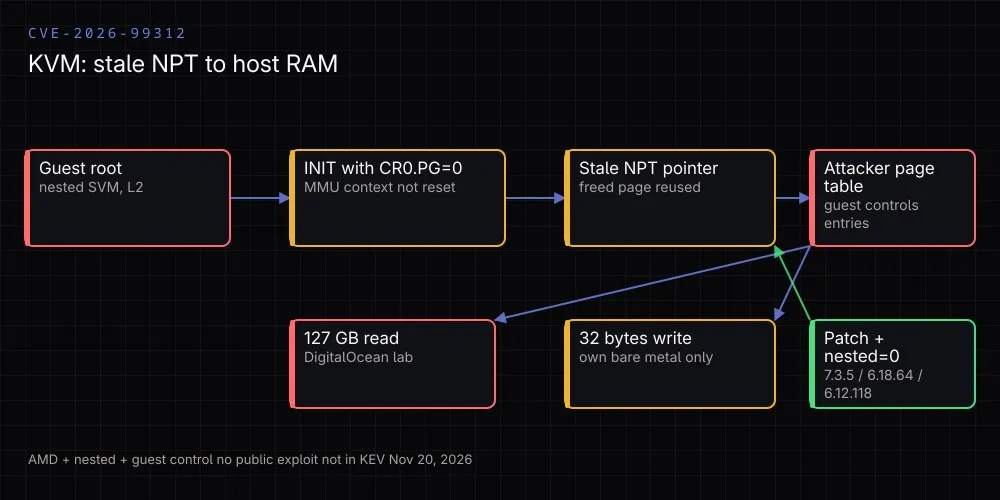
On November 18, 2026, the Linux kernel CVE record for CVE-2026-99312 was published under the title “KVM: x86: Unconditionally reset MMU context when emulating INIT.” What Terra Security researcher Oren Yomtov found is more than a use-after-free: under the right conditions a guest virtual machine can read and write host memory, breaking the guest-to-host boundary.
On a DigitalOcean Droplet, roughly 127 GB of host RAM was mapped read-only, and the first data returned was the host kernel version banner. The write primitive was demonstrated with 32 chosen bytes on the researchers’ own bare-metal AMD server, with no other customers attached. As of November 20, the CVE is not in CISA KEV and there is no public exploit or detection guidance.
Quick summary
| Field | Verified information |
|---|---|
| ID | CVE-2026-99312, CNA: Linux; record published November 18, 2026 |
| Root cause | INIT emulated while L2 has CR0.PG=0 skips MMU reset; stale NPT pointer |
| Affected | AMD KVM hosts with nested virtualization enabled (nested SVM) |
| Not affected | Intel KVM hosts; hosts with nested virtualization off |
| Prerequisite | Control of a guest VM; not triggerable over the network |
| Demonstrated impact | ~127 GB read on DigitalOcean; 32-byte write on the researchers’ bare-metal host |
| Score | Kernel CNA: 8.8; Red Hat page: preliminary 7.8 (AC:H) |
| Fixed in | 7.4-rc2 (Nov 9), stable 7.3.5 and LTS 6.18.64 / 6.12.118 (Nov 17) |
| Mitigation | nested=0 for kvm_amd |
| Exploitation / KEV | No reports outside research; not in KEV |
1. Root cause: stale MMU context after INIT
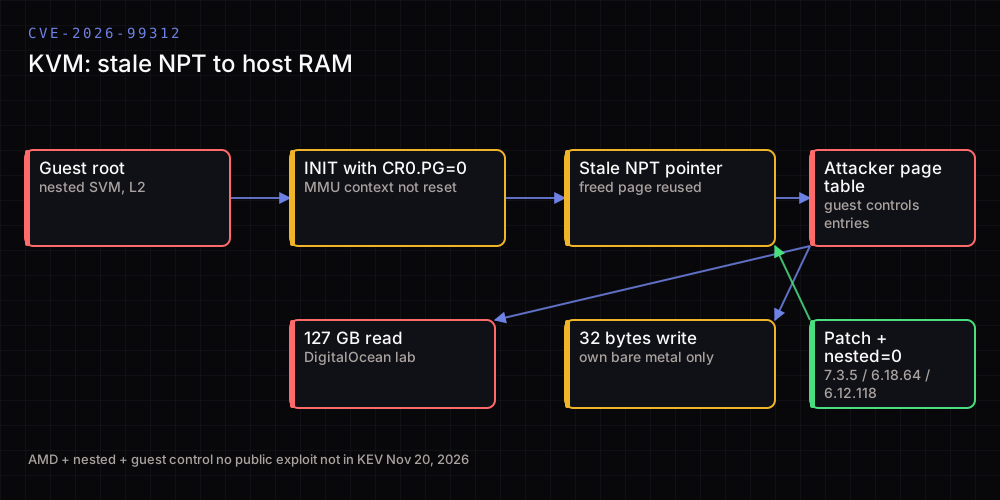
The kernel CVE announcement title gives the exact location. KVM’s MMU page role encodes guest_mode (L2). If an INIT is emulated while L2 is running with CR0.PG=0, KVM returns to L1 without resetting the MMU context and keeps running with a stale one.
The announcement makes a critical point: the bug affects nested SVM only, i.e. AMD. On VMX (Intel), INIT is an unconditional intercept, so emulating INIT while L2 is active is impossible. The affected file is arch/x86/kvm/x86.c.
This is not new. The issue entered 6.1 in 2022 and was backported to 5.15.81 and 6.0.11. According to Terra, the underlying cause is that the 2022 fix for CVE-2022-3344 switched the CPU back to the outer VM’s control block but missed the page-table pointer — so a security fix became its own bug for almost four years.
2. How 127 GB was read and 32 bytes were written
Terra’s explanation centers on the nCR3 field of the VMCB each virtual CPU keeps. That field holds the host address of the guest’s nested page table (NPT) top-level page:
- When INIT stops L2, KVM skips refreshing L1’s NPT pointer; it now names a page the kernel has freed.
- The kernel reuses that page as a new bottom-level NPT page for the guest. The CPU still reads the stale pointer as the top level.
- The CPU mistakes a bottom-level entry for a second-level table address and uses a page from the guest’s own memory (Page A) as the table. Every entry in Page A is attacker-controlled.
- The rest of the table is written by the attacker, and entries can point at any host physical page.
On a DigitalOcean Droplet, that table was aimed at about 127 GB of host RAM, read-only; the first value read was the host kernel version banner. The write test was not run on shared production: on their own bare-metal AMD server, the researchers mapped a host kernel page writable and used a witness module loaded into the host kernel to confirm that 32 chosen bytes changed. Terra does not claim host code execution.
3. Prerequisites and unaffected systems
- The attacker needs control of a guest VM; both tests started with root inside the guest. The CNA vector describes an unprivileged host-side user with
/dev/kvmaccess (PR:L) instead. - The trigger is not a network message (
AV:L), so “remote RCE” is the wrong label. - The host must be AMD with nested virtualization enabled for
kvm_amd. Red Hat states that Intel-based KVM deployments and standard environments without nested AMD virtualization are not affected. - Many cloud providers Terra surveyed were not exposed because they had not enabled nested virtualization on AMD.
These conditions rule out “every KVM host is affected” headlines. The test is twofold: CPU vendor and the nested parameter.
4. Fix and deployment status
Terra’s timeline and the kernel record agree:
- October 21, 2026: reported to KVM maintainers.
- November 2: fix merged to mainline.
- November 9: first tagged in
v7.4-rc2. - November 17: released in stable
7.3.5and long-term6.18.64and6.12.118. - November 18: CVE published.
DigitalOcean says it validated the issue on its own hosts, treated it as critical and prepared a live patch; for Droplet customers it says “No action needed on your part.” According to secondary sources, most distributions had not shipped a stable package by November 20, so operators of their own hosts still need a kernel update and reboot.
5. Conflicting scores and exploitation status
| Source | Score | Note |
|---|---|---|
| Linux CNA | CVSS 3.1 8.8, AV:L/AC:L/PR:L/UI:N/S:C/C:H/I:H/A:H |
High confidentiality, integrity and availability impact |
| Red Hat (live page) | Preliminary 7.8, AV:L/AC:H/PR:L/UI:N/S:C/C:H/I:H/A:H |
AC:H; C/I/A still High |
| Secondary press claim | 5.6 Moderate, DoS-only | Does not match the live Red Hat page; unverified |
| DigitalOcean | Critical for its own environment | Shared-host risk |
Red Hat’s live CVE page shows a preliminary score of 7.8 with AC:H, listing confidentiality and integrity impact as High. Several secondary outlets instead report Red Hat as 5.6 Moderate and “DoS-only.” That claim is not supported by the primary page and should be labeled secondary/unverified if repeated.
Exploitation: no reports outside research and no public exploit. EUVD lists CISA KEV and EU KEV as “Not listed,” and the 2026.11.20 KEV catalog contains no CVE-2026-99312 entry. Neither Terra nor DigitalOcean published IoCs or detection guidance for past attempts.
6. What to do
- Inventory hosts. Find AMD KVM hosts with
nested=1:cat /sys/module/kvm_amd/parameters/nested. - Update and reboot the host kernel. Use 7.3.5, 6.18.64, 6.12.118 or later; verify the running kernel with
uname -runtil a distribution package arrives. Updating guests does not fix this. - Disable nested virtualization while waiting. Put
options kvm_amd nested=0in the module configuration; Red Hat says all VMs must be shut down first and a reboot makes it persistent. - Warn tenants. Turning nested virtualization off directly affects users who run VMs inside their VMs.
- Cloud customers need no action. The fix is in the host kernel; DigitalOcean says it closed the fleet with a live patch.
- Measure exposure, not compromise. With no IoCs available, answer “which hosts were exposed” before “were we exploited.”
7. What not to write
- “Remotely triggerable RCE” — the vector is
AV:L; no network message triggers it. - “Intel hosts affected too” — the bug exists only in nested SVM.
- “Arbitrary host code execution achieved” — the demonstrated effect is reading and controlled writing, not code execution.
- “DigitalOcean wrote into a shared production host” — the write test ran only on the researchers’ own bare-metal server.
- “It is in KEV and actively exploited” — no KEV entry in the November 20, 2026 catalog; no exploitation reports.
- “Red Hat says 5.6 DoS-only” — the live page says 7.8 with High C/I/A; 5.6 is a secondary report.
- “Update your guests” — the fix belongs in the host kernel.
Status
As of November 20, 2026, this is a hypervisor boundary bug with upstream fixes available. The technical evidence is strong, but the write stage was shown in a controlled setup, and there is no exploitation or detection data. The score argument should not obscure the real prerequisites: AMD plus nested plus guest control.
From this series
- Why does everything become 2shell?
- The WhatsApp iOS Noise key claim
- Ruby2Shell: case-conversion overflow
Sources
- CVE Record: CVE-2026-99312
- Linux CVE announcement: KVM: x86: Unconditionally reset MMU context when emulating INIT
- Terra Security: KVM Guest-to-Host Escape
- DigitalOcean: Virtualization, Responsible Disclosure, and CVE-2026-99312
- Red Hat CVE: CVE-2026-99312
- EUVD-2026-128497: exploitation status
- CISA Known Exploited Vulnerabilities Catalog
- The Hacker News: score reporting (secondary)