IBM Guardium Data Protection: CVE-2026-84236 unauthenticated RCE
An insecure deserialization flaw in IBM Guardium 12.2 SharePoint Tap. CVE-2026-84236, the 12.2.4 fix and a verified breakdown of the 14-CVE bulletin.
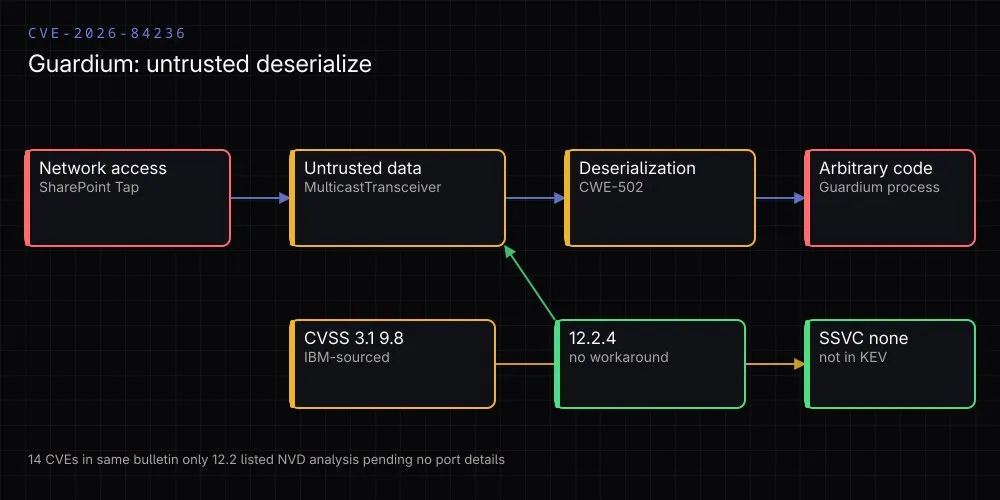
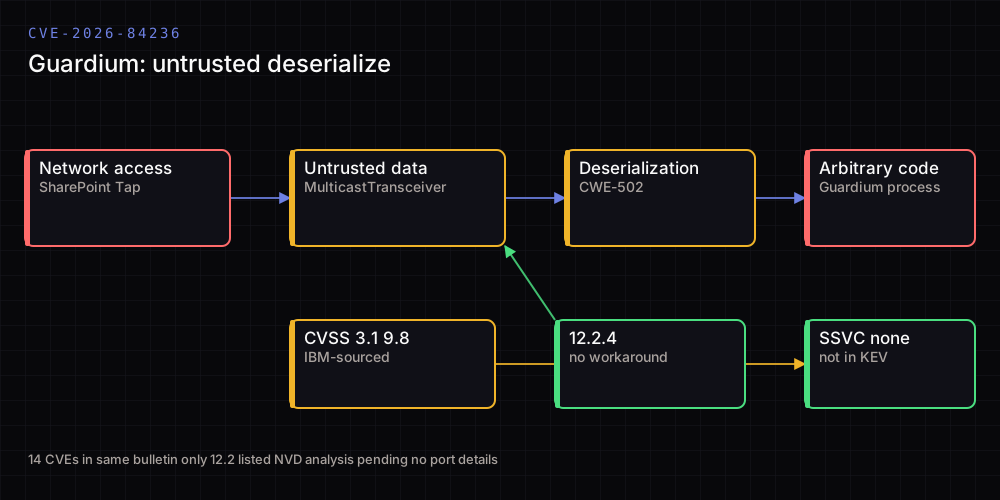
On November 19, 2026, IBM published a multi-vulnerability security bulletin for Guardium Data Protection. It lists 14 CVEs, including CVE-2026-84236: insecure deserialization (CWE-502) in the SharePoint Tap MulticastTransceiver component. According to IBM, an unauthenticated remote attacker can exploit it to execute arbitrary code on the affected system. The score is IBM-sourced CVSS 3.1 base 9.8.
Quick summary
| Field | Verified | Claim / caveat |
|---|---|---|
| ID | CVE-2026-84236, CNA: IBM PSIRT, CWE-502 |
— |
| Bulletin | IBM Security Bulletin, Nov 19, 2026, initial publication | — |
| Component | SharePoint Tap MulticastTransceiver |
No service/port details in the bulletin |
| Affected | Guardium Data Protection 12.2 (metadata: Linux) | Other version branches not listed |
| Fixed | 12.2.4; Fix Central SqlGuard_12.0p7240_GPU_Oct_2026_V12.2.4_FC |
— |
| Score | IBM: CVSS 3.1 9.8 Critical | NVD marks the score Secondary (source IBM); analysis pending |
| Vector | CVSS:3.1/AV:N/AC:L/PR:N/UI:N/S:U/C:H/I:H/A:H |
No account or user interaction required |
| Prerequisite | Network reachability to the affected service | — |
| Exploitation | CISA SSVC: exploitation: none; not in KEV |
The bulletin itself contains no exploitation statement |
| Workaround | None (bulletin’s Workarounds section) | Network restriction is general hardening, not an IBM workaround |
| Flaw count | 14 CVEs counted in the bulletin | Three are critical and account-free |
1. What does the official bulletin say?
IBM’s Security Bulletin (November 19, 2026, initial publication) gives these fields for CVE-2026-84236:
- Description: “IBM Security Guardium Data Protection is vulnerable to insecure deserialization in the SharePoint Tap MulticastTransceiver component. An unauthenticated remote attacker could exploit this vulnerability to execute arbitrary code on the affected system.”
- CWE: CWE-502, Deserialization of Untrusted Data
- CVSS Source: IBM
- CVSS Base score: 9.8
- CVSS Vector:
(CVSS:3.1/AV:N/AC:L/PR:N/UI:N/S:U/C:H/I:H/A:H) - Affected: IBM Guardium Data Protection, version 12.2
- Fix: 12.2.4
- Workarounds and Mitigations: None
The NVD record was created November 19, 2026, updated November 20 and is still Awaiting Analysis. It was submitted by IBM PSIRT ([email protected]) and the CVSS metric is type: Secondary. So 9.8 is IBM’s own score; there is no independent NVD analysis yet. The CPE entries cover 12.2 and 12.2.0.
The bulletin itself contains no sentence saying “we have seen no exploitation.” Secondary sources report that IBM said so, but that cannot be attributed to the primary bulletin. What is verified is the CISA SSVC entry saying exploitation: none.
2. Why deserialization becomes code execution
Deserialization converts serialized data back into objects. When untrusted data enters that process, fields inside the data are interpreted during object construction. If the application does not validate the input and does not restrict the set of allowed types, an attacker can steer which classes and callback methods run inside the process.
IBM’s description points exactly at this class: the SharePoint Tap MulticastTransceiver component deserializes data received from SharePoint monitoring without sufficient validation, allowing a remote unauthenticated attacker to execute arbitrary code.
The bulletin does not say which protocol, port or serialization mechanism is involved. Details like “if port X is open” or “gadget chain Y is used” are therefore unverified. The only reliable inference for exposure assessment is that the relevant component must be network-reachable.
3. Attack prerequisites
The vector says AV:N/AC:L/PR:N/UI:N:
- AV:N — over the network; no local access to the victim machine.
- AC:L — low attack complexity.
- PR:N — the attacker does not need a valid account.
- UI:N — no user interaction.
- C:H/I:H/A:H — high impact on confidentiality, integrity and availability. The vector says
S:U(scope unchanged), so impact is contained to the Guardium process; there is no separate high sub-system impact score.
The practical prerequisite is network reachability to the service that receives SharePoint Tap data. Guardium is typically deployed for database and SharePoint monitoring, so collector services reachable from broad internal network segments raise the risk. That is a general deployment observation, not a condition written in IBM’s bulletin.
4. The 14 flaws and the three critical ones
We counted 14 distinct CVEs in the bulletin’s Vulnerability Details section. The aggregators’ “14 flaws” claim matches the primary bulletin. They are not all equivalent:
| CVE | Score | Type | Prerequisite |
|---|---|---|---|
| CVE-2026-84236 | 9.8 | Untrusted deserialization (SharePoint Tap) | No account |
| CVE-2026-87977 | 9.8 | SQL injection (edge-controller) | No account |
| CVE-2026-82339 | 9.1 | Missing authentication (SharePoint S-TAP RelayService) | No account |
| CVE-2026-82342 | 8.1 | PROXY protocol v1 stack overflow | No account, high complexity |
| CVE-2026-84273 | 8.1 | Path traversal (datasource) | Authenticated |
| CVE-2026-84087 | 7.8 | Local privilege escalation (SUID podman_wrapper) |
Local, low privilege |
The three critical entries share the “no account” property, but their impacts differ: 84236 is code execution, 87977 is access to or modification of sensitive database information, and 82339 is forged audit-event injection plus access to the active monitoring policy. The rest of the bulletin covers third-party components such as undici and lower-impact flaws.
When saying “14 flaws,” note that not all are Guardium-specific code bugs: IBM also lists vulnerabilities in components shipped with the product.
5. Exploitation status and KEV
- CISA SSVC: the NVD entry says
exploitation: none,automatable: yes,technicalImpact: total. - CISA KEV: as of November 20, 2026, CVE-2026-84236 is not listed.
- Primary bulletin: contains no statement about exploitation or a PoC.
- Secondary sources: Kyberkit, SecurityOnline and DailySecurityReview say “no exploitation, no PoC” — these are secondary and unverified.
So there is no primary evidence for “actively exploited,” and saying “IBM officially confirmed no exploitation” would go beyond the bulletin. The precise statement: SSVC exploitation is none, it is not in KEV, and the primary bulletin makes no exploitation claim.
6. What to do
- Upgrade to 12.2.4. The Fix Central package ID IBM lists is
SqlGuard_12.0p7240_GPU_Oct_2026_V12.2.4_FC. - Plan for all 14 CVEs. Closing only 84236 leaves the SQL injection and missing-authentication flaws from the same bulletin open.
- Restrict SharePoint Tap services. Limit S-TAP and collector interfaces to the servers and management networks that need them. This is general network hardening, not an IBM workaround for this CVE.
- Review audit records. CVE-2026-82339 allows forged audit events, so validate audit integrity separately.
- Ask your provider if managed. If a service provider runs Guardium for you, get written confirmation of 12.2.4 status.
- Do not wait for a workaround. The bulletin’s Workarounds and Mitigations section explicitly says “None.”
7. What not to write
- “Actively exploited” — SSVC says
none; not in KEV. - “IBM officially confirmed no exploitation” — no such statement in the primary bulletin.
- “Only 84236 was patched” — the bulletin covers 14 CVEs.
- “NVD rated it 9.8” — the score is IBM-sourced and NVD analysis is pending; 9.8 is correct, but attribute it to IBM.
- “There is a workaround” — the bulletin says
None. - “All versions are affected” — the bulletin lists only 12.2.
- “The victim must click something” — the vector says
UI:N. - “Code execution also affects subsequent systems” — the vector says
S:U.
Status
As of November 20, 2026, this is a strongly vendor-verified flaw whose NVD analysis is not finished. Component, class, score, vector, affected version and fix are clear. What remains uncertain: the absence of a primary exploitation statement, and the lack of technical detail about the attack surface in the bulletin.
From this series
- Why does everything become 2shell?
- Ruby2Shell: case-conversion overflow
- The WhatsApp iOS Noise key claim
Sources
- IBM Security Bulletin: Guardium Data Protection multiple vulnerabilities
- IBM Security Bulletin (alternate URL)
- NVD API: CVE-2026-84236
- NVD: CVE-2026-84236
- CVE.org record: CVE-2026-84236
- CWE-502: Deserialization of Untrusted Data
- IBM Fix Central: 12.2.4 package
- CISA Known Exploited Vulnerabilities Catalog
- Kyberkit analysis (secondary)