Cisco Expressway root RCE: first exploitation after the PoC
CVE-2026-76466 lets unauthenticated attackers run commands as root on clustered Cisco Expressway devices. F6's first in-the-wild case, IoCs and CISA KEV status.
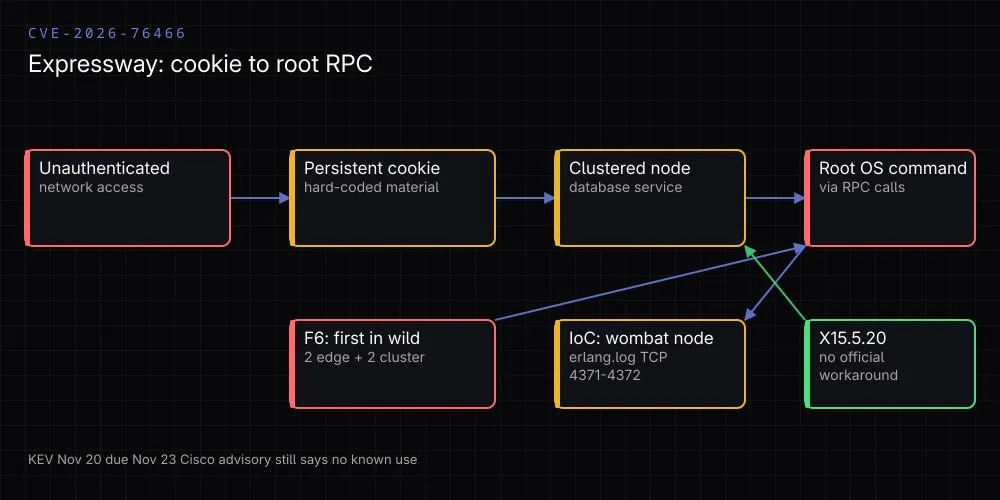
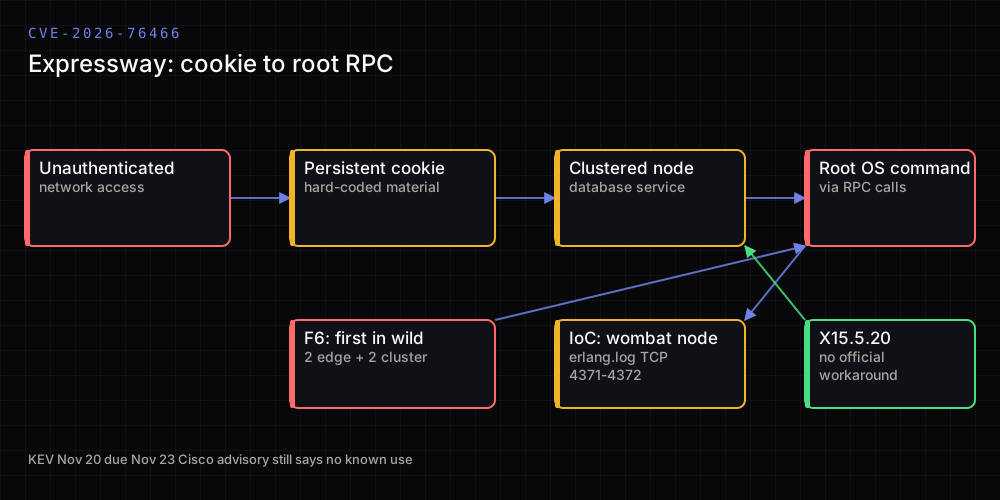
Cisco published advisory cisco-sa-vcs-static-cred-hr7EWZ8t for CVE-2026-76466 on October 21, 2026. The flaw allows an unauthenticated remote attacker to run operating-system commands as root on clustered Expressway-C and Expressway-E devices; CVSS 3.1 is 9.8 and there are no workarounds.
On November 18, 2026, Russian security firm F6 reported the first in-the-wild exploitation shortly after a public PoC appeared. Cisco’s advisory still says it is unaware of malicious use, while as of November 20 the CVE is in CISA KEV. This post keeps vendor wording and field evidence separate.
Quick summary
| Field | Verified information |
|---|---|
| ID | CVE-2026-76466, advisory cisco-sa-vcs-static-cred-hr7EWZ8t, bug CSCww27732 |
| Score | CVSS 3.1 9.8, AV:N/AC:L/PR:N/UI:N/S:U/C:H/I:H/A:H |
| Class | CWE-798, Use of Hard-coded Credentials |
| Affected | Clustered Expressway-C / Expressway-E only; virtual and appliance |
| Prerequisites | Network access plus possession of persistent cookies |
| Impact | Database-service RPC calls execute arbitrary OS commands as root |
| Workaround | None; Cisco recommends upgrading to X15.5.20 |
| Older releases | No fixed X14 or earlier release; migration required |
| Exploitation | F6: first in-the-wild case November 18, 2026; Cisco advisory unchanged |
| CISA KEV | Yes, added November 20, 2026; BOD 26-04 due date November 23 |
1. What does Cisco’s advisory say?
The advisory, dated October 21, 2026 and marked “Version 1.0: Final,” says:
- A flaw in the database service feature lets an unauthenticated remote attacker with network access execute arbitrary OS commands as root.
- Root cause is the use of persistent cookies. In addition, client certificates are insufficiently validated when TLS Verify Mode is set to Enabled for clustering — effectively no certificate validation.
- An attacker possessing the cookies can connect to the database service and invoke specific RPC commands; those commands run as root on the device OS.
- Affected products are Expressway Core (Expressway-C) and Expressway Edge (Expressway-E), virtual and appliance versions, only when configured in a cluster.
- Fixed software: first fixed release for X15.5.3 and earlier is X15.5.20; X14 and earlier have no fixed release and must migrate to a supported one.
- No workarounds. Cisco explicitly says it does not treat workarounds or mitigations as a substitute for the fixed software.
- The “Exploitation and Public Announcements” section still says PSIRT is unaware of public announcements or malicious use.
The issue was reported by Stefan Aleksic of Jane Street. Cisco notes the fix is also part of its October 2026 Expressway hardening release.
2. Why clustered systems only?
A cluster replicates registrations and call state between Expressway nodes, so its database service must be reachable between them. That same design lets an edge node reach core nodes over the cluster link.
Secondary analyses of the public PoC describe an Erlang distribution mechanism with a static node identity and cookie. F6’s published indicator shows that identity as [email protected]: successful exploitation leaves a nodeup,'[email protected]' entry in the device’s erlang.log. The cookie value and the RPC chain over TCP 4372 appear in secondary sources; Cisco’s advisory confirms neither detail and does not explain how the cookies are obtained.
A standalone Expressway is outside the advisory’s vulnerable set. “There is an internet-facing Expressway” is also not sufficient on its own; cluster status and reachability of the database service must both hold.
3. The attack chain F6 observed
F6’s November 18, 2026 press release summarizes the first case at a Russian organization:
- The attackers first compromised two internet-facing Expressway X15.5.3 devices.
- Through one of them they reached two cluster nodes on the internal network — four devices in total.
- After gaining root they prepared tooling for lateral movement: custom Python scripts to scan networks, find SMB resources, interact with SQL Server and WinRM, and search GitLab repositories for credentials.
- The scripts were modified during the attack. F6 says characteristic comments and bug-fix descriptions in the source indicate use of an AI assistant — an inference, not an attribution.
- F6 did not attribute the activity to a known threat actor.
The claim that the PoC appeared on GitHub on November 5, 2026 comes from secondary sources. F6 only says the attack happened shortly after the PoC became public; the primary report gives no exact PoC date.
4. Exploitation status and KEV
| Source | Position |
|---|---|
| Cisco PSIRT (Oct 21 advisory) | No known malicious use; advisory not revised |
| F6 (Nov 18) | First in-the-wild case; Russian organization; X15.5.3 devices |
| CISA KEV (Nov 20 catalog) | Listed; added Nov 20, due Nov 23, forensic triage “Yes” |
| CISA ADP SSVC | Exploitation: active, Automatable: yes, Technical Impact: total |
So “Cisco confirmed exploitation” would be wrong — the vendor advisory is silent. “Not in KEV” is also no longer correct: CISA added the CVE under BOD 26-04 on November 20, 2026 and requires forensic triage.
5. IoCs and detection
F6’s defanged indicators:
- IP addresses:
66.179.31[.]32and18.130.47[.]116 nodeup,'[email protected]'entry inerlang.logon Expressway devices- Paths:
/mnt/harddisk/i{0-9}{4}[a-zA-Z]?/*.py
F6 recommends limiting TCP 4371–4372 connections to trusted cluster-node IPs if patching must wait. That is not an official Cisco workaround, only a temporary exposure reduction. A nodeup entry should be corroborated with other logs and artifacts; on its own it is not definitive proof of compromise.
6. What to do
- Upgrade every cluster node. X15.5.3 and earlier go to X15.5.20; X14 and earlier have no fixed release, so plan a migration to a supported branch.
- Do not leave one node behind. An unpatched node stays reachable over the cluster link even if its peers are fixed.
- Hunt for exploitation traces. Look for the
wombatnode entry in Erlang logs, the listed IPs and suspicious Python files. If found, start incident response rather than only patching. - Restrict cluster ports. Keep TCP 4371–4372 limited to cluster peers until the upgrade is complete; this is exposure reduction, not a workaround.
- Remove management and cluster interfaces from the internet. Expressway is an edge product, but its database service is a management plane.
- Document the response. The KEV due date is November 23, 2026, with BOD 26-04 and forensic-triage requirements covering inventory and evidence collection.
7. What not to write
- “Standalone Expressway is affected” — the advisory lists clustered devices only.
- “Cisco confirmed active exploitation” — the advisory still says no known malicious use.
- “Not in CISA KEV” — it was added on November 20, 2026, with a November 23 deadline.
- “There is a workaround, just close the ports” — Cisco says none; the port restriction is F6’s advice.
- “F6 attributed the attack to a known APT” — F6 made no attribution.
- “AI-written malware was proven” — F6 only says the code comments point to an AI assistant.
- “The PoC was published on November 5” — secondary claim; F6 says only “shortly after.”
Status
As of November 20, 2026, this is a root RCE seen in the wild after a PoC, with a gap between the vendor’s unchanged wording and field evidence. The fix exists, the KEV entry exists, but Cisco’s advisory still reads as it did on October 21. The safe reading: exploitation evidence from F6, remediation facts from Cisco, prioritization from KEV.
From this series
- Why does everything become 2shell?
- The WhatsApp iOS Noise key claim
- Ruby2Shell: case-conversion overflow