ASUS Control Center Express: CVSS 10 hard-coded key
CVE-2026-114202 lets a remote attacker gain administrator access through a hard-coded key in ASUS Control Center Express. Vendor bulletin, fixed version and the unverified PoC claim separated.
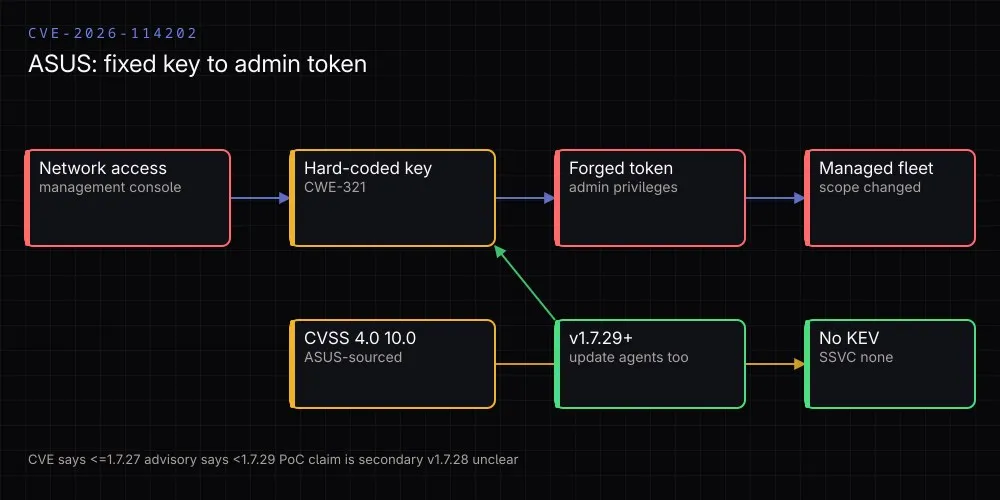
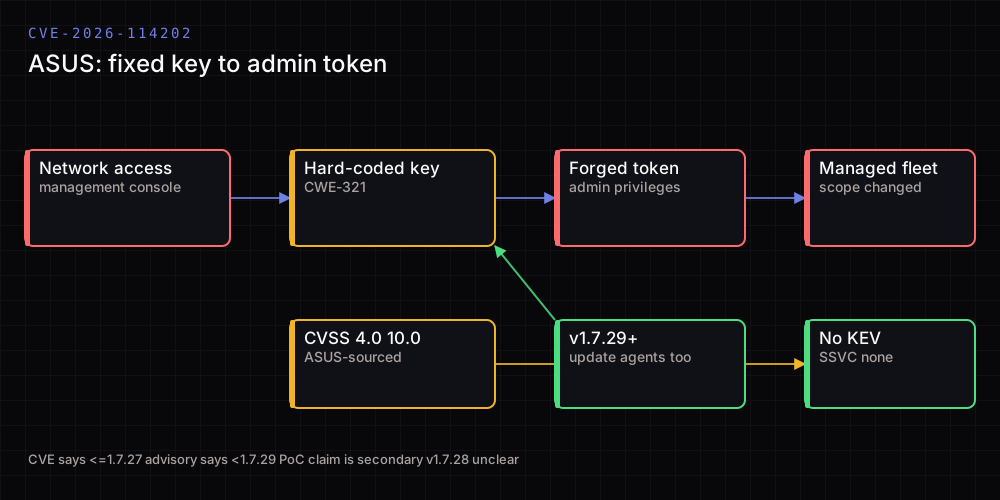
On November 18, 2026, CVE-2026-114202 was published. ASUS’s own CVE record and security bulletin say Control Center Express uses a hard-coded cryptographic key, allowing a remote attacker to forge an authentication token and gain administrator privileges. The score is CVSS 4.0 base 10.0. That makes the “maximum score” headlines accurate about the claim — but the record is still Received, and a few details do not line up exactly between the bulletin and the CVE.
Quick summary
| Field | Verified | Claim / caveat |
|---|---|---|
| ID | CVE-2026-114202, CNA: ASUS, CWE-321 |
— |
| Description | Hard-coded key; forged token gives admin access | Token signing details are not in the bulletin |
| Affected | CVE record: Control Center Express ≤ v1.7.27 | ASUS bulletin: “versions earlier than v1.7.29” |
| Fixed | ASUS bulletin: v1.7.29 or later + client agent update | v1.7.28 status is unclear between the two records |
| Score | ASUS/CVE: CVSS 4.0 10.0 Critical | No v3.1 score at NVD; NVD marks score as “Secondary” |
| Vector | AV:N/AC:L/AT:N/PR:N/UI:N/VC:H/VI:H/VA:H/SC:H/SI:H/SA:H |
No privileges, no user interaction |
| Prerequisite | Network access to the management console | — |
| Exploitation | CISA SSVC: exploitation: none; not in KEV |
CSIRT Toscana claims a PoC exists; secondary/unverified |
| Workaround | None listed in the ASUS bulletin | Network restriction is general hardening |
1. What does the official record actually say?
Reading the NVD API record directly:
- CNA: ASUS
- Published: November 18, 2026; last modified: November 18, 2026
- NVD status:
Received— NVD analysis is not complete - Weakness: CWE-321, Use of Hard-coded Cryptographic Key
- Description: “Use of Hard-coded Cryptographic Key in ASUS Control Center Express allows a remote user to gain administrative privileges via a forged authentication token.”
- Affected product: ASUS Control Center Express,
through v1.7.27 - Reference:
https://www.asus.com/security-advisory
So “authentication bypass leading to administrator access” is not an aggregator interpretation — it is the substance of the vendor’s own record. The bulletin adds that the update covers the management console and the clients it manages.
The score source matters too: the CVSS 4.0 metric in NVD is type: Secondary with ASUS as the source. In other words, 10.0 is ASUS’s score, not an independent NVD analysis. There is no v3.1 score in the record, so a “CVSS 3.1 10.0” headline has no source behind it.
2. The ASUS bulletin and the fixed version
ASUS’s security bulletin (November 18, 2026) gives these steps:
- Download and install Control Center Express v1.7.29 or later from the official download page.
- Select the target devices in the device list.
- Go to Select Function → Client Agent Updater to update the client agents.
- Verify that the agent version shows the updated version.
The last step matters: the issue affects not just the console but the chain of agents it manages. Updating the console while leaving agents old can leave managed endpoints in a poorly configured state.
There is one discrepancy: the CVE record marks affected versions as “≤ v1.7.27,” while the ASUS bulletin says “all versions earlier than v1.7.29.” The status of v1.7.28 is unclear between these two primary records. The practical outcome is unchanged: target 1.7.29.
3. Attack model and prerequisites
Breaking down the CVSS vector shows how easily the flaw can be triggered:
AV:N— network vector; no physical or local access to the victim is needed.AC:L— low attack complexity.AT:N— no additional attack requirements.PR:N— no privileges required; the attacker is not an existing user.UI:N— no user interaction; the victim does not have to click a link.VC:H/VI:H/VA:H— high impact on confidentiality, integrity and availability of the vulnerable system.SC:H/SI:H/SA:H— high impact on subsequent systems too, consistent with a management console that controls downstream devices.
In short, the prerequisite is network reachability to the management interface. Knowing the hard-coded key lets an attacker sign a token that looks valid and enter the console as an administrator. The bulletin does not say which algorithm signs the token or where the key is stored, so details like “the key is identical everywhere and lives in file X” should be treated as unverified.
4. Reading CVSS 10.0 correctly
10.0 is the top of the CVSS 4.0 scale. Two halves of the score should be read together:
- Exploitability is fully open: network, low complexity, no privileges, no interaction.
- Impact is fully open: high C/I/A for both the console and the systems it manages.
Together they describe a “full compromise of the management plane” scenario. ASUS Control Center Express is a central console used by IT admins to manage fleets of PCs remotely, so administrator access is a door to the managed fleet, not just one server. The S:H (scope changed) field reflects that.
At the same time, 10.0 does not mean “actively exploited right now.” A score is a theoretical measure of impact and exploitability; exploitation status is a separate field.
5. Two sibling flaws in the same bulletin
ASUS published three CVEs at once. All are Critical, but their prerequisites differ:
| CVE | CVSS 4.0 | Notable vector | Prerequisite |
|---|---|---|---|
| CVE-2026-114202 | 10.0 | PR:N, AT:N |
None — remote admin access |
| CVE-2026-114204 | 9.0 | PR:L, AT:P |
Low-privileged user + a recent session |
| CVE-2026-114205 | 9.4 | PR:L, AT:N |
Low-privileged user creating an admin account |
CVE-2026-114204 is also key-related, but the attacker must impersonate the session token of a recently logged-in account. CVE-2026-114205 is an authorization flaw: a low-privileged user can create an administrator account. The three headlines should not be mixed up; 114202 has the broadest access.
6. Exploitation status and the PoC claim
The CISA SSVC entry in the NVD record says exploitation: none, automatable: yes, technicalImpact: total. In plain terms: no observed exploitation, but an automatable flaw with total impact if confirmed. As of November 20, 2026, this CVE is not in CISA KEV.
Italy’s CSIRT (CSIRT Toscana, November 19) wrote that a PoC for CVE-2026-114202 is available online. That is a secondary-source claim; there is no verified PoC link in the primary ASUS bulletin or the NVD record. “A PoC exists” and “exploited in the wild” are not the same thing, and there is no evidence for the latter.
The ASUS bulletin has no separate workaround section for these flaws. The only official action published is version upgrade plus agent update.
7. What to do
- Upgrade the console to v1.7.29 or later. This is the only official fix ASUS has published.
- Update the client agents too. Do not skip Select Function → Client Agent Updater, and verify the agent version.
- Do not expose the management interface to the internet. Limiting network access to trusted management segments is the most useful interim mitigation; it is general hardening, not a CVE-specific ASUS workaround.
- Review administrator sessions. Unexpected logins, newly created admin accounts and unusual token use should trigger incident response.
- Inventory agents. Even with an updated console, find endpoints still running old agents.
- Do not panic over an unverified PoC. Applying the fix is more valuable than debating an unconfirmed claim.
8. What not to write
- “Actively exploited” — CISA SSVC says
exploitation: none; no KEV entry. - “CVSS 3.1 10.0” — the record only has CVSS 4.0, sourced from ASUS.
- “It only affects desktop users” — the flaw is in the central management console;
S:Hputs subsequent systems in scope. - “The victim must click a link” — the vector says
UI:N. - “v1.7.28 is definitely unaffected” — the bulletin says “earlier than v1.7.29”; it is not clear.
- “No fixed version is known” — the ASUS bulletin names v1.7.29 explicitly.
- “All three flaws have the same prerequisites” — 114204 and 114205 carry privilege/session conditions.
Status
As of November 20, 2026, this is a well-verified vendor-recorded flaw whose NVD analysis is still incomplete. Score, vector, bulletin and fixed version are clear; what remains uncertain is the status of v1.7.28 and the accuracy of the PoC claim. That is why the headline uses the vendor’s own score: CVSS 10.0.
From this series
- Why does everything become 2shell?
- Ruby2Shell: case-conversion overflow
- The WhatsApp iOS Noise key claim