Spring Security SpEL injection: CVE-2026-59273
Spring Security ELRequestMatcher evaluates SpEL in an unrestricted context, enabling remote code execution. Affected versions, fixes, and a check of the "50 flaws" claim.
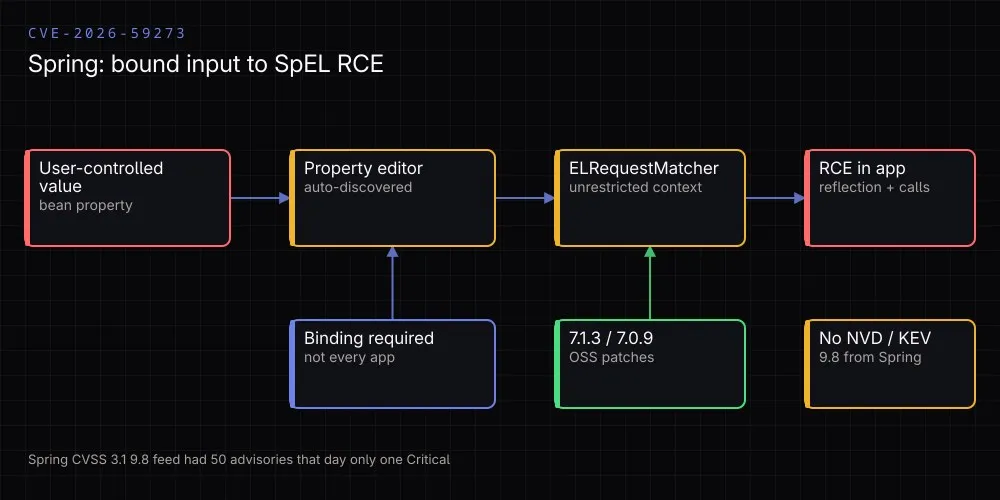
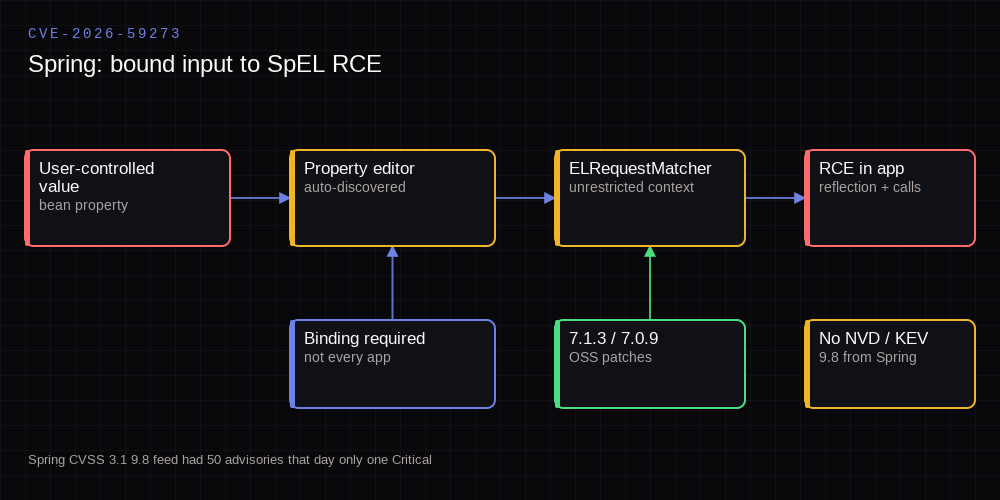
On November 19, 2026, Spring published a Critical advisory for Spring Security: CVE-2026-59273. The ELRequestMatcher class evaluates SpEL expressions in an unrestricted context that grants full reflection, type references and arbitrary method invocation, rather than a context limited to its documented request-matching operations. Because Spring Framework’s data binding auto-discovers a property editor for this type by naming convention, an application that binds external input to a bean property of this matcher type can have that input evaluated as SpEL. The result: remote code execution.
Quick summary
| Field | Verified | Claim / caveat |
|---|---|---|
| ID | CVE-2026-59273, Spring Security, CWE-94/95/470 references |
— |
| Published | November 19, 2026, Spring advisory | — |
| Component | ELRequestMatcher (Spring Security) |
— |
| Affected | 7.1.0–7.1.2, 7.0.0–7.0.8, 6.5.0–6.5.12, 6.4.0–6.4.19, 5.8.0–5.8.28, 5.7.26 and earlier | — |
| Fixed | OSS: 7.1.3, 7.0.9; others enterprise-only | 6.5/6.4/5.8/5.7 patches need commercial support |
| Score | Spring-linked CVSS 3.1 vector 9.8 | No NVD record; a secondary source says CVSS 4.0 9.3 |
| Vector | AV:N/AC:L/PR:N/UI:N/S:U/C:H/I:H/A:H |
Only apps meeting the binding precondition are exposed |
| Prerequisite | Attacker-controlled input bound to an ELRequestMatcher-typed bean property |
Not every Spring app is affected |
| Exploitation | Spring advisory says nothing about exploitation; not in KEV | Secondary sources report no known exploit/PoC |
| “50 flaws” | Spring’s advisory feed has 50 entries dated Nov 19 | Feed may be capped at 50; exact total is feed-based |
1. What does the official advisory say?
Spring’s security page is explicit:
- Title: “Spring Security ELRequestMatcher allows Remote Code Execution via unrestricted SpEL evaluation”
- Severity: CRITICAL; date: November 19, 2026
- Problem:
ELRequestMatcherevaluates a SpEL expression in an unrestricted context granting full reflection, type references and arbitrary method invocation. - Trigger: Spring Framework data binding auto-discovers a property editor for the type by naming convention. In an application that binds external input to a bean property of that type, the input is evaluated as SpEL.
- Impact: an attacker controlling such input can achieve remote code execution in the application’s process.
- History: November 19, 2026 — initial report published.
Spring also states “No further mitigation steps are necessary” — no configuration change is recommended beyond patching. That holds for affected versions.
2. Why SpEL and ELRequestMatcher are dangerous
SpEL (Spring Expression Language) is an expression language used across the Spring ecosystem for configuration and conditional logic. Its power is what makes it risky: an expression can reference types, invoke methods via reflection and traverse an object graph.
Safe use keeps expression evaluation inside a restricted context (such as SimpleEvaluationContext) that allows only the operations actually needed. According to Spring’s advisory, ELRequestMatcher does not do this: instead of a context limited to its documented request-matching operations, it uses an unrestricted one.
The second layer is automatic data binding. Spring Framework looks for a property editor by the naming convention of a bean property’s type. If an application binds external input to a property of type ELRequestMatcher, a plain text value supplied by an attacker is interpreted as an expression. The attacker does not need a special “SpEL parameter” — the binding itself turns the value into code.
Together these are a classic eval-injection scenario: input is evaluated as code rather than treated as data. The advisory’s CWE references agree: CWE-94 (code injection), CWE-95 (eval injection), CWE-470 (unsafe reflection).
3. Which applications are actually affected?
The key point: not every Spring application is affected. The advisory’s scenario requires all of the following:
- The application uses an affected Spring Security version.
- It binds externally controlled input to a bean property of type
ELRequestMatcher. - That binding happens through Spring Framework’s automatic property-editor discovery.
Applications that do not bind external input to an ELRequestMatcher-typed property are not exposed through this particular RCE path. An audit should look for exactly that: an ELRequestMatcher-typed field in configuration or bean definitions, and whether user-controlled values reach it.
The AV:N/PR:N/UI:N vector says that when the condition is met, the attack is remote, unauthenticated and requires no interaction. But the vector already assumes the binding precondition, so a 9.8 score does not mean the same real-world risk for every deployment.
4. Affected and fixed versions
| Line | Affected | Fixed | Availability |
|---|---|---|---|
| 7.1.x | 7.1.0–7.1.2 | 7.1.3 (also 7.1.2.1) | OSS / enterprise |
| 7.0.x | 7.0.0–7.0.8 | 7.0.9 (also 7.0.8.1) | OSS / enterprise |
| 6.5.x | 6.5.0–6.5.12 | 6.5.13 | Enterprise Support Only |
| 6.4.x | 6.4.0–6.4.19 | 6.4.20 | Enterprise Support Only |
| 5.8.x | 5.8.0–5.8.28 | 5.8.29 | Enterprise Support Only |
| 5.7.x | 5.7.26 and earlier | 5.7.27 | Enterprise Support Only |
The most important operational detail: only 7.1.3 and 7.0.9 are released as open source. Patches for older lines are available only to enterprise support subscribers. If you are on an old line, “cannot download the patch” is a real constraint: either enter support or move to a supported generation.
5. Where does CVSS 9.8 come from?
Instead of printing a number, the Spring advisory links to NVD’s CVSS 3.1 calculator with AV:N/AC:L/PR:N/UI:N/S:U/C:H/I:H/A:H. That vector produces 9.8. So the score comes from Spring’s own published vector.
Two caveats:
- As of November 20, 2026, the NVD API returns no record for CVE-2026-59273 (
totalResults: 0). Saying “NVD rated it 9.8” is therefore incorrect; the score is Spring-sourced. - A secondary database (Cybersecurity Help) reports CVSS 4.0 9.3 with
S:N(scope unchanged). That is a different CVSS version from Spring’s 3.1 vector; compare them with that in mind.
The “9.8” headline is not wrong, but its source should be stated: Spring’s advisory CVSS 3.1 vector.
6. Is “Spring fixed 50 flaws” accurate?
Aggregators claimed “50 vulnerabilities” for November 19, 2026. We checked Spring’s own RSS/Atom feed (spring.io/security.atom):
- The feed contains 50 advisories in total.
- All 50 are dated November 19, 2026.
- The CVEs span Spring Security, Spring AI, Spring Integration, Spring Web Services, Spring Data, Spring LDAP, Spring Boot and other projects.
So the number matches Spring’s own published feed. One caution: the feed may be capped at 50 entries, so “advisories visible in the feed” and “total advisories published that day” may not be identical. The precise statement is “Spring’s advisory feed has 50 entries dated that day.” CVE-2026-59273 is the only Critical item among them.
7. Exploitation status
The Spring advisory contains no statement about exploitation or a PoC. Secondary sources (dailysecurityreview, cybersecurity-help.cz) say no known exploitation or public exploit exists; those are secondary and unverified.
We checked the CISA KEV catalog as of November 20, 2026: CVE-2026-59273 is not listed. Since there is no NVD record, there is also no CISA SSVC assessment available through NVD for this CVE. There is no primary evidence supporting “actively exploited.”
8. What to do
- Inventory Spring Security versions. Find 7.1.x, 7.0.x, 6.5.x, 6.4.x, 5.8.x and 5.7.x deployments.
- Search for
ELRequestMatcherusage. Audit code and bean configuration for external input bound to a property of that type. - Upgrade to OSS lines. 7.1.3 and 7.0.9 are directly downloadable; evaluate enterprise patches for older lines.
- Reduce binding surfaces. Bind user input to dedicated DTOs rather than infrastructure types — a good architectural habit regardless of this class.
- Do not hunt for extra mitigations. Spring says no further steps are necessary; the patch is enough.
- Watch for the NVD record. When it appears, the score and SSVC fields may become clearer.
9. What not to write
- “NVD rated it 9.8” — no NVD record; the score is Spring-sourced.
- “All Spring applications are affected” — the binding precondition must be checked.
- “CVSS 4.0 9.8” — Spring uses a 3.1 vector; a secondary source says 4.0 is 9.3.
- “Actively exploited” — not in KEV; the primary source makes no such statement.
- “All 50 flaws are Critical” — only one of the 50 feed entries is Critical.
- “Extra configuration changes are mandatory” — Spring explicitly says otherwise.
Status
As of November 20, 2026, we have a detailed vendor advisory, a clear version list and OSS patches. What remains uncertain: NVD has not created the record, there is no primary statement on exploitation, and the “50” figure depends on the feed’s entry cap.
From this series
- Why does everything become 2shell?
- Ruby2Shell: case-conversion overflow
- The WhatsApp iOS Noise key claim
Sources
- Spring Security Advisory: CVE-2026-59273
- Spring Security Advisories list
- Spring Security Advisory Atom feed
- NVD CVSS 3.1 calculator (Spring’s vector)
- NVD API: CVE-2026-59273
- CWE-94: Code Injection
- CWE-95: Eval Injection
- CWE-470: Unsafe Reflection
- CISA Known Exploited Vulnerabilities Catalog
- Cybersecurity Help: CVE-2026-59273 (secondary)