nginx2root (CVE-2026-123007): an 11-year-old HTTP/2 flaw leads to code execution in NGINX workers
An unauthenticated HTTP/2 flow-control overflow corrupts NGINX worker memory: a technical analysis of CVE-2026-123007, affected releases, detection, and mitigation.
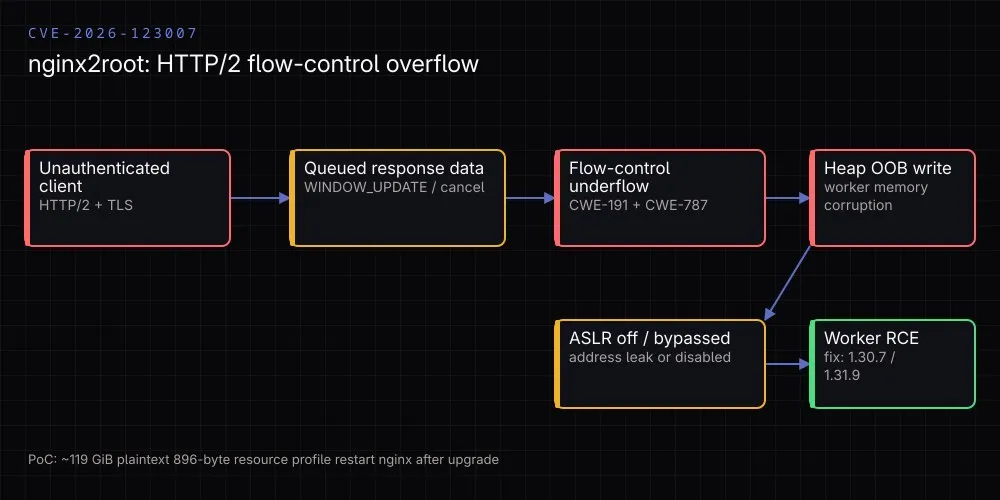
On November 18, 2026, F5 published CVE-2026-123007 for NGINX Open Source and NGINX Plus. It is the oldest and most critical part of the group Xint calls nginx2root. An unauthenticated client can corrupt an NGINX worker’s heap memory through the HTTP/2 flow-control state machine; if ASLR is disabled or can be bypassed, that can become code execution with the worker’s privileges.
The bug has been present since NGINX 1.9.5 — since autumn 2015. The fix shipped the same day in 1.30.7 (stable) and 1.31.9 (mainline). This post covers the mechanism, the right inventory checks, and what to do before patching.
Quick summary
| Field | Value |
|---|---|
| CVE | CVE-2026-123007 (nginx2root set) |
| Impact | Unauthenticated worker heap corruption; DoS and conditional RCE |
| CVSS | 3.1: 8.1 High / 4.0: 9.2 Critical |
| Weakness | CWE-191 (integer underflow) + CWE-787 (heap out-of-bounds write) |
| Precondition | HTTP/2 enabled on a listener |
| Affected OSS | 1.9.5–1.30.6 and 1.31.0–1.31.8 |
| Fixed | 1.30.7 / 1.31.9; Plus 37.0.8.1 / 37.3.0.1 |
| PoC cost | Rapid7: ~119 GiB plaintext; ~2 min at 10 Gbit/s, ~17 min at 1 Gbit/s |
| Exploitation | Not confirmed as of November 18, 2026 |
Where is the bug?
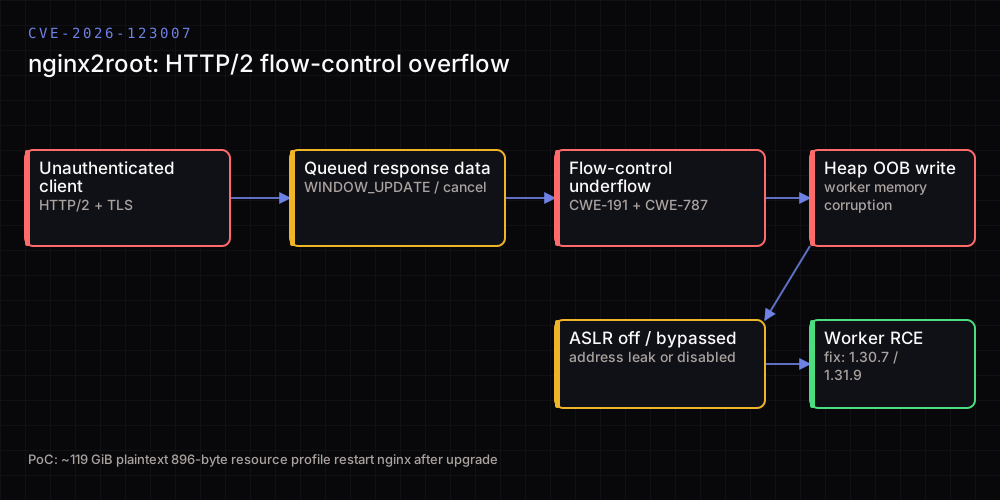
HTTP/2 multiplexes streams over one connection, and every stream has a receiver-advertised flow-control window. WINDOW_UPDATE grows that window; the sender must not exceed it. According to Rapid7’s analysis, NGINX miscalculates how much response data the client has allowed it to send: when queued response data is cancelled, an underflow occurs and a later copy uses an invalid length. F5 describes the same condition as the flow-control window exceeding the allowed threshold; CERT-EU calls it an integer overflow leading to an out-of-bounds heap write.
The usual result is a worker segmentation fault. But if the corruption is controlled, an attacker can execute code as the worker. F5 says this requires ASLR to be disabled or bypassed; Xint’s technical write-up describes leaking addresses to cross that barrier. F5 also stresses that this is a data plane issue only — the control plane is not exposed.
A second HTTP/2 flaw, CVE-2026-123633, is a use-after-free triggered when connection draining closes an active HTTP/2 connection while NGINX is connecting to an upstream. It is fixed in the same releases, but its precondition is different: an upstream path such as proxy_pass.
The real PoC cost: an 896-byte profile and ~119 GiB of traffic
Rapid7’s public PoC measures the cost behind the “unauthenticated RCE” headline. Its target is the default index.html in the pinned nginx 1.31.8 image; that file has a content-length of 896 bytes. The PoC first probes it with Range: bytes=0-9 and checks for content-range: bytes 0-9/896. The runtime profile line looks like this:
runtime HTTP profile: resource=896 initial=2 probes + 71 full + 127 ranged bytes max_concurrent=128The 896 bytes are not the exploit payload size — they are the size of the chosen static resource used to profile the heap layout. That profile calibrates which response owners produce which heap arrangements and which offsets are useful for address disclosure and cleanup-callback overwrites. A different file size, nginx build, or already “messy” heap should not be expected to work with the same profile.
The traffic budget is also stark: 2^32 13-byte WINDOW_UPDATE frames take ~52 GiB, approaching 2^64 takes ~104 GiB, and the PoC adds a 15 GiB fixed request-header carrier for a reported ~119.02 GiB of plaintext. Rapid7’s blog rounds this to ~128 GB of HTTP/2 data; TLS and network overhead push the actual wire volume higher. Even the crash-only trigger sends about 60 GiB.
Bandwidth becomes a practical limit: ~2 minutes at 10 Gbit/s, ~17 minutes at 1 Gbit/s. With nginx’s default one-hour connection lifetime, a link below roughly 300 Mbit/s will exceed the limit. The PoC also opens 16 auxiliary connections, and each ~1.08 GiB response-owner interval must fit inside the 60-second send timeout. Slow or jittery links, L7 proxies/CDNs that terminate HTTP/2, and intermediaries that rebuild frames break this method. Rapid7’s PoC assumes a fresh or lightly exercised worker heap; attempts against busy workers can fail after transferring the full volume.
This is why “remote and unauthenticated” does not mean “easy and quiet.” The demonstrated attack is loud, bandwidth-hungry, and needs fairly direct TCP/TLS access. The public PoC and the cheap fix still make patching urgent.
Scope and severity
- No authentication and no user interaction:
AV:N/AC:H/PR:N/UI:N. http2 on;orlisten ... http2is enough. Even an origin serving only static files can be affected.- A CDN or WAF that terminates HTTP/2 at the edge may block part of the attack, so test directly against the origin.
- Containers do not help: the worker runs inside the container and that is where the memory corruption happens.
- As of November 18, trusted sources have not confirmed in-the-wild exploitation; CERT-EU explicitly says no exploitation has been reported. A PoC exists, so patching is still urgent.
Inventory: are you exposed?
nginx -v
nginx -T 2>/dev/null | grep -nE '^\s*(http2\s+on\b|listen\b[^#]*\bhttp2\b)'
nginx -T 2>/dev/null | grep -nE '\b(proxy|fastcgi|uwsgi|scgi|grpc)_pass\b'
If the first grep returns output, the precondition for CVE-2026-123007 is present. If the second one also returns output, CVE-2026-123633 is in scope too. Do not rely on the version string alone: distributions can backport the fix without changing nginx -v. Compare your package version with your distribution’s security advisory.
What to do
Permanent fix: move to 1.30.7 or 1.31.9 — or your vendor’s patched package — and restart NGINX. As JFrog and Cloudflare Radar both note, a config reload is not enough; old workers can keep running the previous binary on existing connections. Docker users should re-pull images: the official 1.31.9, 1.30.7, mainline, stable, and latest tags were updated on November 18.
If NGINX is embedded in OpenResty, an ingress controller, or another product, wait for that vendor’s build. According to JFrog, the archived kubernetes/ingress-nginx will not receive a fix; deployments using it need an alternative controller.
If patching is delayed, temporarily disable HTTP/2:
listen 443 ssl;
http2 off;
or remove the http2 parameter from listen 443 ssl http2;, then test and reload. http2 off; is available in NGINX 1.25.1 and later. This blocks 123007 and 123633 but not the HTTP/3, resolver, and mail-proxy flaws F5 disclosed the same day. It is a stopgap, not a fix.
Detection: look for worker process ... exited on signal messages, repeated worker restarts, and core dumps. On their own these indicate attempts, not successful RCE; correlate them with process-creation logs showing unexpected shells or child processes from the worker.
The lesson
A flow-control counter is not just traffic management — it is a memory-safety boundary. Cancellation, timeout, and connection-draining paths need the same scrutiny as the happy path. A state machine that looked correct for a decade turned into a worker escape because of one wrong length calculation on a cancellation path.
Sources: F5 K000163926, CVE record, CERT-EU 2026-022, Rapid7 analysis, Rapid7 PoC repo, standalone reproduction and 896-byte profile, JFrog nginx2shell write-up, Cloudflare Radar, NGINX security advisories.