Apache Roller (CVE-2026-129448): unauthenticated XML-RPC RCE under active exploitation
Untrusted deserialization in Apache Roller before authentication leads to remote code execution: a technical analysis of CVE-2026-129448 and the urgent mitigations.
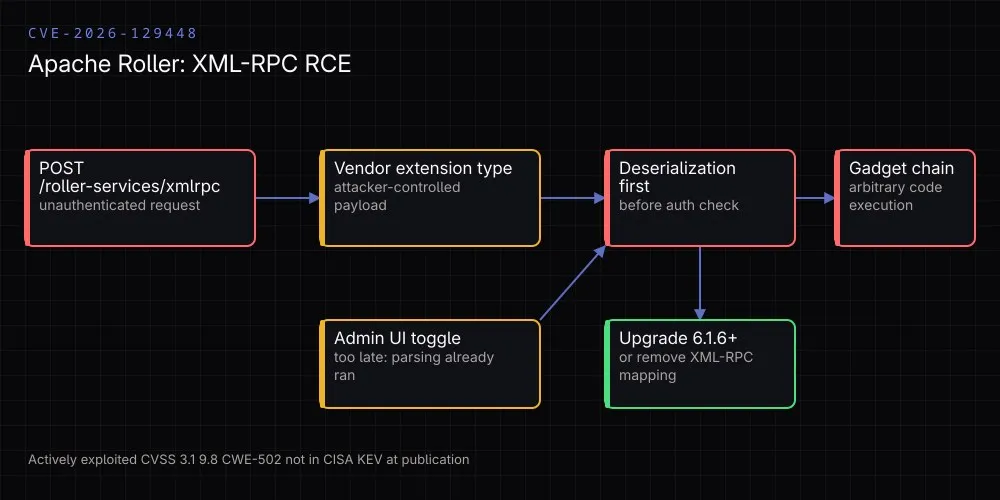
On November 17, 2026, the Apache Software Foundation published CVE-2026-129448 for Apache Roller and confirmed that the flaw is being actively exploited. The Java blog server’s XML-RPC endpoint deserializes attacker-controlled data before authenticating the requester, resulting in unauthenticated remote code execution.
The same bug was previously tracked as CVE-2026-82384, which listed only Roller 6.1.5. The new advisory expands the affected range to 4.0.0–6.1.4 and explicitly says both CVE IDs describe the same issue. Teams that only read the September advisory may still be exposed.
Quick summary
| Field | Value |
|---|---|
| CVE | CVE-2026-129448 / CVE-2026-82384 (same flaw) |
| Impact | Unauthenticated remote code execution |
| CVSS | 3.1 9.8 Critical, AV:N/AC:L/PR:N/UI:N |
| Weakness | CWE-502, deserialization of untrusted data |
| Endpoint | /roller-services/xmlrpc |
| Affected | Apache Roller 4.0.0–6.1.5 |
| Fixed | 6.1.6 or later |
| Status | Apache confirms active exploitation; not in CISA KEV |
Technical mechanism
The critical part of Apache’s advisory is the ordering: the XML-RPC endpoint accepts vendor extension types and deserializes them before authenticating the requester. A normal flow would authenticate first and construct objects afterwards. Here the attacker’s XML becomes an object graph inside the servlet container, and a gadget chain can lead to code execution.
Apache has not disclosed the specific gadget chain used in the attacks, so claims about a particular library class are unverified. What is confirmed: the attacker needs no valid account, and the flaw is reachable whenever /roller-services/xmlrpc is available over the network.
Disabling XML-RPC in the admin interface is also not enough. Apache says affected versions deserialize the request before checking that setting, so the toggle runs too late. This is a textbook case of a feature-flag illusion.
Who is affected?
Roller is a niche Java blogging platform, so it gets less attention than mainstream CMSs. But an unpatched, internet-facing Java web application is still a server-side code execution opportunity. The affected range is 4.0.0 through 6.1.5. Version 6.1.6 disables extension types and rejects XML-RPC requests when the feature is disabled.
Apache confirms exploitation but has not shared details about the threat actors, number of targets, or campaign. Rapid7’s record shows the CVE is not yet in CISA’s KEV catalog — that means KEV has not caught up, not that exploitation is absent.
Immediate actions
- Upgrade: move to Apache Roller 6.1.6 or later, redeploy, and restart. Prefer the current release if possible, but at minimum verify that the build includes this fix.
- If patching must wait, disable extensions: set
enabledForExtensionstofalseinWEB-INF/web.xmlor remove the/roller-services/xmlrpcservlet mapping. Apache says a restart is required either way. - Do not trust the admin UI toggle: without step 1 or 2, the deserialize-before-auth ordering remains.
- Verify exposure: after the change, confirm
/roller-services/xmlrpcreturns 404/403 and that the old servlet is no longer live. A WAF rule can be an extra layer, not a replacement for the patch.
Detection and hunting
Apache has not published concrete IOCs, so focus on behaviour:
- Unexpected
POSTrequests to the XML-RPC endpoint and unfamiliar source IPs. - Shells,
curl/wget, or unusual child processes spawned by the Java servlet container. - New or modified
.jsp/.war-like files in the webroot, or unknown scheduled jobs. - Unusual outbound connections from the application server.
Check log retention for the period before patching. With confirmed exploitation, “we’ll look later” is expensive.
Root cause
The problem is not that XML-RPC exists; it is object construction before the trust boundary. Deserialization is a privileged parsing operation, not neutral input validation. If extension types are accepted, incoming data must not become an object graph before authentication and allowlisting have run. The 6.1.6 fix corrects exactly that ordering.
Sources: Apache mailing list advisory, CVE-2026-129448, CVE-2026-82384, Apache Roller patch PR, Rapid7 record, BleepingComputer report.