Apache Axis 1.x CVE-2026-90436: an EOL SOAP fault flaw in KEV
Unauthenticated class instantiation in Apache Axis 1.x via SOAP Fault exceptionName. CVE-2026-90436, EOL status, KEV, and migration guidance.
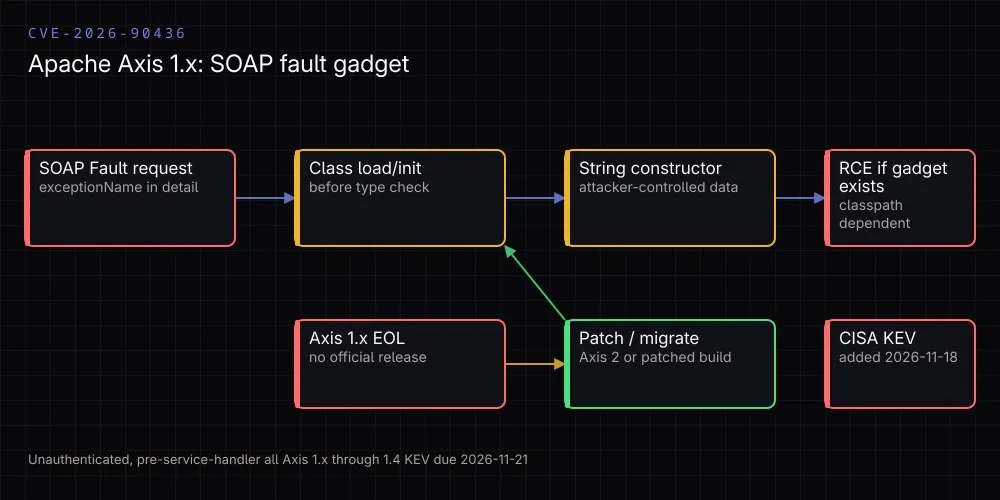
On November 18, 2026, CISA added CVE-2026-90436 to the KEV catalog. The vulnerability allows unauthenticated class loading/instantiation in Apache Axis 1.x while processing a SOAP Fault exceptionName. The hard part: Axis 1.x is EOL. There is no official “upgrade to 1.x.y” answer—only a patched build or migration to Axis 2/another supported SOAP engine.
Quick summary
| Field | Value |
|---|---|
| CVE | CVE-2026-90436 |
| Product | Apache Axis 1.x (all 1.x through 1.4) |
| Weakness | CWE-470 — Unsafe Reflection / class instantiation from untrusted data |
| CVSS v3.1 | 9.8 (Critical), AV:N/AC:L/PR:N/UI:N/S:U/C:H/I:H/A:H — CISA ADP |
| NVD status | Analyzed |
| KEV added | 2026-11-18, due 2026-11-21, forensic triage: Yes |
| Official status | EOL; Axis project does not expect a 1.x fix release |
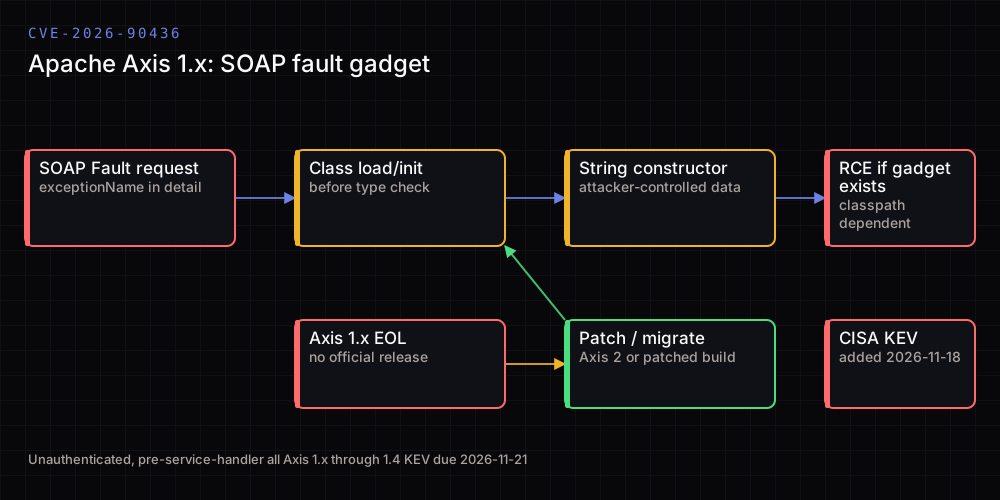
Technical view
Per NVD, an inbound SOAP <Fault> with <detail><exceptionName> causes the fault deserializer to load the named class. If a String <data> element is present, Axis instantiates the class through its String constructor before checking that it is an AxisFault. Loading alone can run a static initializer.
A critical detail: the fault is parsed while the engine resolves the target service, before per-service handler chains run. Authentication handlers configured on a service do not protect this path.
Apache’s commit (41f3b4e) adds two defenses: exceptionName is loaded without initialization and accepted only if it is an org.apache.axis.AxisFault subtype; the reflective constructor path is gated by AxisFault assignability. The regression test confirms an arbitrary class is neither initialized nor constructed.
Why urgent
- KEV: CISA added it with evidence of active exploitation.
knownRansomwareCampaignUseis Unknown, butforensicTriageis Yes. - EOL: No official patch release is expected. This is not a normal patch-cycle issue.
- Visibility: Axis 1.x may hide in legacy/embedded SOAP services and fat jars.
- Precondition: No authentication required; network-reachable.
What to do
- Inventory. Search Java apps for
axis.jar,axis-1.*, embedded Axis classes, and SOAP endpoints. Check transitive and fat-jar dependencies. - Migrate where possible. Apache recommends Axis 2/Java or another supported SOAP engine. Staying on EOL means waiting for the next KEV.
- If migration is not immediate, use a patched build. Apache commit
41f3b4e8d04e310ca81f86b92630ab2c11d608bdexists. Note: not an official 1.x release. - Restrict SOAP endpoints. If an Axis endpoint is exposed, narrow access with WAF/ACL. Not a complete fix, but reduces exposure.
- Hunt for signs. KEV requires forensic triage. Look for abnormal SOAP Fault requests, unexpected classloading/javacore behavior, odd outbound connections from the service account.
What not to claim
- Do not say every Axis user got RCE; RCE depends on a suitable gadget/chain on the classpath. The primary description states this condition.
- Do not call it an official patch release; Axis 1.x is EOL.
- Do not rely on service auth alone; fault parsing happens before service handler chains.
- Do not skip it because “nobody uses Axis 1.x”; legacy enterprise SOAP services still do.
Status
As of November 21, 2026, this flaw is well verified in primary records, in KEV, and urgent. NVD analysis is complete; the 9.8 CVSS and CWE-470 come from CISA ADP. Axis 1.x is EOL, so there is no official fixed release; the Apache commit and migration path remain. CISA requires forensic triage. The open question is whether a suitable gadget chain exists on the target classpath, so “every Axis user was RCE’d” is not a valid claim.