Xen Orchestra CVE-2026-133469: admin login via empty-object token
VSA-2026-062, XO 6.9.2 and 6.10.1, xo-server 5.211.2 and 5.213.1, CNA CVSS 9.8, KEV, and IOC steps.
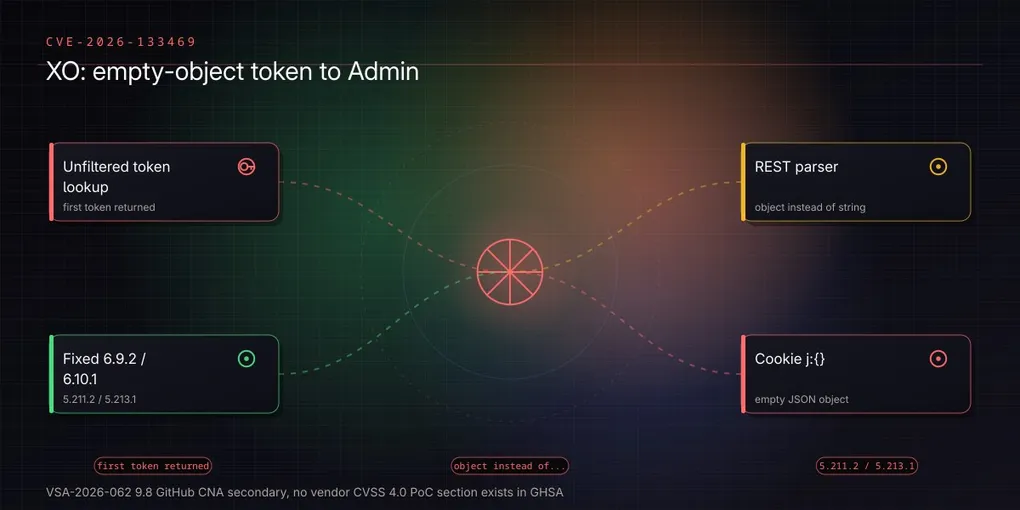
As of November 26, 2026, Vates published advisory VSA-2026-062 for Xen Orchestra on November 10, 2026. The flaw was recorded as CVE-2026-133469: an empty JSON object in a REST cookie bypasses authentication and grants Admin privileges. The vendor states that a CVSS 4.0 score is not available yet; the 9.8 in the NVD record comes from the GitHub CNA. NVD published the record on November 23 and modified it on November 26. CISA added the same CVE to KEV on November 25, with a November 28 due date and a forensic triage field of Yes. Sources: Vates advisory, NVD API, CISA KEV alert, KEV JSON feed; no victim, campaign, or extra IOC has been invented.
Quick summary
| Field | Value |
|---|---|
| CVE | CVE-2026-133469 |
| Advisory | VSA-2026-062, published November 10, 2026 |
| Product | Xen Orchestra, Xen Orchestra Appliance, xo-server |
| Affected XO | Before 6.9.2 and from 6.10.0 to before 6.10.1 |
| Affected xo-server | Before 5.211.2 and 5.213.0 (GitHub CNA affected; NVD CPE excludes it) to before 5.213.1 |
| Fix | XO 6.9.2 / 6.10.1; xo-server 5.211.2 / 5.213.1 |
| Weakness | CWE-287 and CWE-1287 |
| Input value | authenticationToken=j:%7B%7D, that is authenticationToken=j:{} |
| CVSS | 9.8 CRITICAL, GitHub CNA secondary; no vendor CVSS 4.0 |
| Vector | CVSS:3.1/AV:N/AC:L/PR:N/UI:N/S:U/C:H/I:H/A:H |
| NVD status | Published November 23, modified November 26, Modified, no NVD analysis score |
| SSVC | CISA Coordinator: exploitation: active, automatable: yes, technicalImpact: total |
| KEV | Added November 25, 2026, due November 28, 2026, forensicTriage: Yes |
| Vendor IoCs | Yes; HTTP patterns, VM and file checks, C2 block list |
Technical view
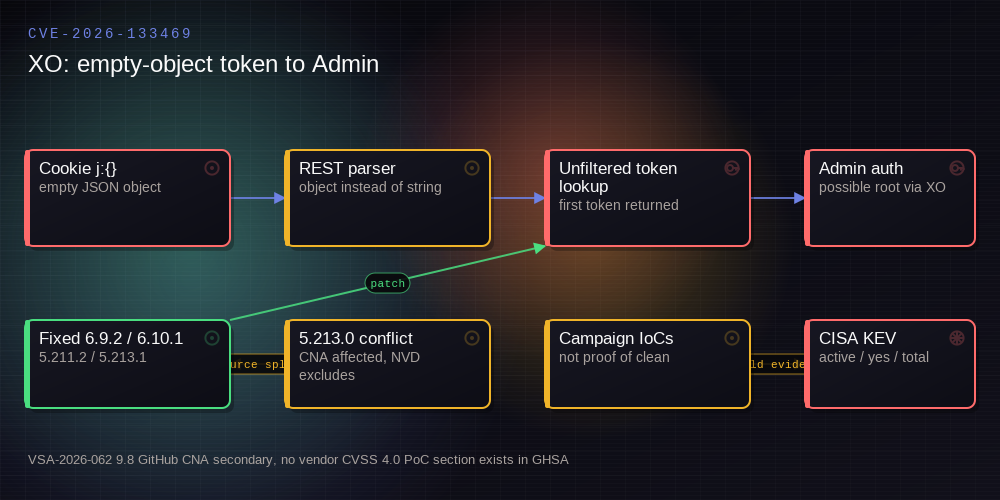
The Vates advisory summarizes the chain as follows: the REST cookie parser turns authenticationToken=j:%7B%7D into the {} object. REST authentication passes that object to the XO token provider without requiring a string. The token collection treats {} as an unfiltered lookup and returns its first token; the provider authenticates as that token’s owner if the token is unexpired. The authenticated /rest/v0/users/me/authentication_tokens route then returns reusable login token IDs. This chain is stated by the vendor; no extra payload or hidden endpoint is invented here.
The vendor says an adversary can bypass authentication and act with Admin privileges. XO compromise can lead to arbitrary code execution on managed pools and a full XCP-ng node takeover as root; that is the advisory’s own impact statement, not a claim that root access occurred on every deployment. A management-plane compromise can expose credentials, so the vendor asks that all passwords and secrets be rotated if XO was compromised, including proxy credentials, backup remotes (NFS, S3, Azure, SMB), the root account and pool secret, user accounts, OTP secrets, and mail server passwords.
NVD CPE entries mark XO before 6.9.2 and from 6.10.0 to before 6.10.1, and xo-server before 5.211.2 and above 5.213.0 (versionStartExcluding) to before 5.213.1; the GitHub CNA affected list includes 5.213.0. Vates gives the same boundaries as stable and latest channels: 6.9.2 / xo-server 5.211.2 stable, 6.10.1 / 5.213.1 latest. Version 6.10.0 is not safe; the fix arrives in 6.10.1. For source installs, the vendor recommends the latest master and references PR #10748.
The vendor IoCs cover one observed campaign. On XO, check HTTP requests for authenticationToken=j:%7B%7D and authenticationToken=j:{}, and running VMs for pivot2; successful exploitation leaves no session log of unauthenticated access, so network capture is needed. On XCP-ng hosts, check for VMs with hvm_serial: file, serial traces in xensource.log, and /etc/cron.d/zz-ustar2, /etc/cron.d/zz-ustar, /.ustar5, and /.ustar6. Vates lists eight C2 IP addresses and a .onion domain. It says these IoCs cover only that campaign and their absence does not prove a clean system.
The CISA KEV JSON entry names the flaw as improper validation of specified type of input, gives an added date of November 25 and a due date of November 28, 2026, and sets forensicTriage: Yes. NVD’s SSVC fields say exploitation: active, automatable: yes, technicalImpact: total. KEV means known exploited and should be read together with the vendor’s IoCs.
What to do
- Pin down the versions. Read both the XO and xo-server versions and their channel. Fixed builds are 6.9.2 / 5.211.2 on stable and 6.10.1 / 5.213.1 on latest; 6.10.0 and (per GitHub CNA) 5.213.0 are affected; NVD CPE excludes 5.213.0.
- Apply the fix. XOA users can upgrade via XOA > Updates on the stable or latest channel; source installs should move to the latest
master. - Remove Internet exposure. Vates advises against exposing XO to the Internet and recommends a dedicated management network. This reduces risk and is not a substitute for the patch.
- Block the known C2 infrastructure. Apply ingress and egress filters for the eight addresses in the advisory and block Tor traffic.
- Scan with IoCs, but do not trust silence. Check HTTP patterns in network captures, look for
pivot2, and check the named XCP-ng files; absence of IoCs is not proof of cleanliness. - Treat the WAF rule as partial. Vates gives two cookie patterns to match but warns the regex rule can be bypassed with other formats; it is not a fix by itself.
- Rotate secrets and reinstall after compromise. Vates asks for rotation of all passwords and secrets and recommends a full reinstall, since cleanup alone cannot guarantee removal of backdoors.
What not to claim
- Do not say the vendor assigned 9.8. Vates says CVSS 4.0 is not available; 9.8 comes from the GitHub CNA via NVD.
- Do not say NVD published its own analysis score. There is no NVD analysis score in the record; the 9.8 metric is secondary.
- Do not say there is no PoC. The GitHub CNA advisory has a Proof of concept section and NVD tags it Exploit; this article does not reproduce the payload. KEV and SSVC say active exploitation.
- Do not say 6.10.0 is safe. The affected range runs from 6.10.0 to before 6.10.1; the fix is in 6.10.1.
- Do not say no IoCs means a clean system. Vates states the IoCs cover only the observed campaign and their absence is not sufficient.
- Do not say root was obtained on every XO deployment. The vendor describes root takeover as a possible impact, not a confirmed outcome everywhere.
- Do not say a WAF rule closes the flaw. The advisory warns that the regex can be bypassed.
- Do not say Internet isolation makes the version irrelevant. An affected version stays affected; lack of exposure lowers risk but does not fix the flaw.
Status
As of November 26, 2026, the table was read from VSA-2026-062, the NVD API record, the CISA KEV alert, and the KEV JSON feed. Vates published the advisory on November 10, 2026 and updated it the same day; its status is Released. The NVD record was published on November 23, modified on November 26, and has status Modified. CISA added CVE-2026-133469 among ten new KEV entries on November 25; the catalog version is 2026.11.25.
Open points: the vendor CVSS 4.0 score is unavailable, so 9.8 is a CNA measurement only. The IoCs belong to one campaign; other actors may use different infrastructure. The primary records give no victim list or named actor attribution; Vates provides observed C2 infrastructure only. NVD links the GitHub CNA advisory with an Exploit tag, but this article invents neither payload nor victim. The root-impact statement stays within its vendor source.