WP Rocket CVE-2026-125812: cache file validation to RCE
WP Rocket before 3.24.2: NVD CWE-22 path traversal, Patchstack unauthenticated RCE, CVSS 9.8, SSVC fields, and patch steps.
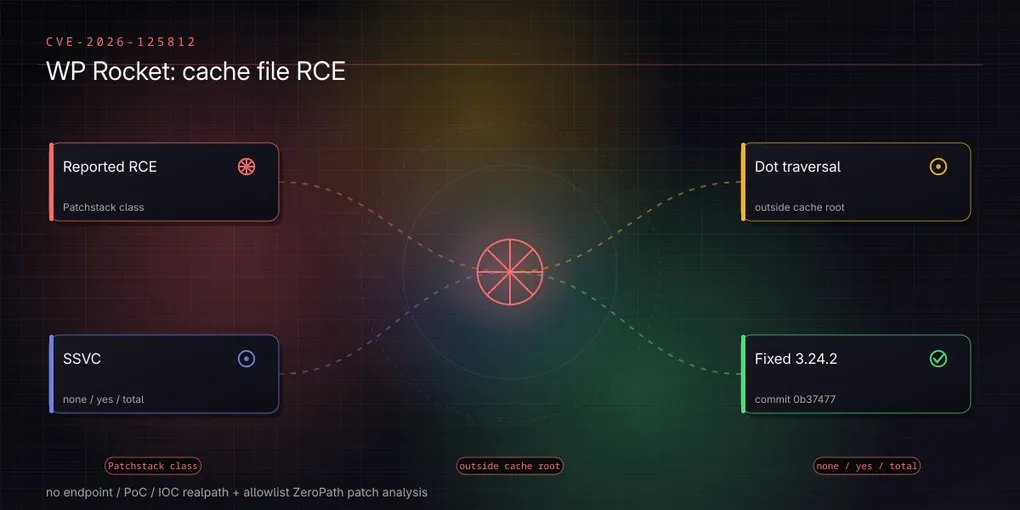
As of November 26, 2026, WP Rocket versions before 3.24.2 are described in the NVD record as CWE-22 path traversal and in the Patchstack advisory as unauthenticated remote code execution (RCE). The vendor’s November 19 release note for 3.24.2 lists a single security line: improved validation of cached CSS, font, and preconnect files. Below are the Patchstack/NVD records, vendor release note, 3.24.2 patch commit, and ZeroPath’s secondary analysis of the patch diff; no working exploit chain, payload, victim, or IOC has been invented.
Quick summary
| Field | Value |
|---|---|
| CVE | CVE-2026-125812 |
| Product | WP Media WP Rocket (wp-rocket) |
| Affected | Before 3.24.2; NVD: from n/a before 3.24.2 |
| Fix | 3.24.2, November 19, 2026 |
| Weakness | CWE-22 path traversal outside a restricted directory |
| Patchstack | High priority RCE; required privilege: Unauthenticated |
| CVSS | 9.8 CRITICAL, secondary CVSS 3.1, source [email protected] |
| Vector | CVSS:3.1/AV:N/AC:L/PR:N/UI:N/S:U/C:H/I:H/A:H |
| NVD status | Deferred; no NVD analysis score, score above is secondary |
| SSVC | CISA Coordinator: exploitation: none, automatable: yes, technicalImpact: total |
| KEV | No entry in the November 26, 2026 KEV JSON check |
| Discovery | Vorelito; reported November 4, published by Patchstack November 23 |
| Vendor note | Validation of cached CSS, font, and preconnect files improved |
| Patch evidence | Commit 0b37477, PR #9235; 45 files, +3,217/-132 lines |
Technical view
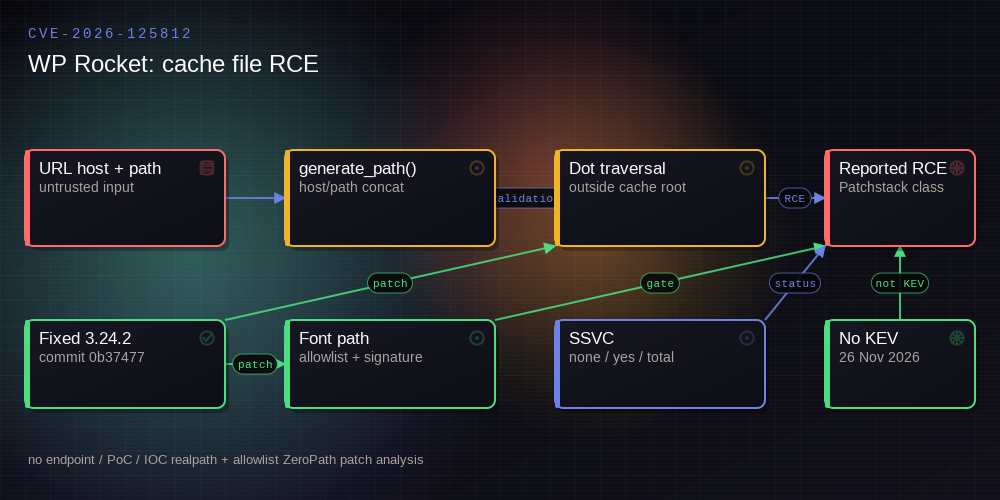
The NVD description says that WP Media WP Rocket wp-rocket has an “Improper Limitation of a Pathname to a Restricted Directory” weakness, CWE-22, that allows path traversal. The affected range is recorded as from n/a before 3.24.2; there is no evidence for treating any version below 3.24.2 as out of scope. The CWE is marked secondary for Patchstack and NVD, and the NVD record status is Deferred, meaning there is no NVD analytical score of its own.
The Patchstack entry classifies the same flaw as Remote Code Execution and sets required privilege to Unauthenticated. Its CVSS vector includes PR:N and UI:N, indicating no WP Admin account and no user interaction are required. Patchstack labels 9.8 as “high priority” and notes that similar flaws are used in mass-exploitation campaigns; that is a risk assessment, not evidence of exploitation in the wild.
The concrete code side is visible in the 3.24.2 security commit 0b37477. WP Rocket’s LazyLoad for CSS background images writes fetched stylesheets under wp-content/cache/background-css/<blog>/<host>/<path>. Before the patch, FilesystemCache::generate_path() appended the URL host and path directly to the cache root: it did not resolve .. segments, validate the host, or constrain the file name or extension. The patch checks host and path characters, uses rocket_realpath() to clamp dot segments inside the host directory, allows only .css and .css.json, rejects inner extensions such as .php, .cgi, .pl, and .asp*, rejects dot-leading names, and ends with an is_inside_root() containment check. get(), set(), has(), delete(), and generate_url() now return early for an unmappable path.
The same commit adds get_local_font_path() for Fonts\Filesystem::write_font_css(). The font path is constrained to [A-Za-z0-9._/-] before download, .. segments are clamped inside the fonts directory, file names are forced to .woff2, .woff, .ttf, .otf, or .eot, and downloaded bytes are checked against format signatures. Google Fonts matching now uses the parsed host/path; <link> tags are read from rel and as attributes; and preconnect entries are reduced to valid http(s) origins. ZeroPath’s November 25 analysis summarizes this diff as URL input becoming a disk path, but no source names a specific HTTP endpoint, request parameter, or required feature setting. A “this request writes that file” claim is therefore not proven.
The NVD SSVC v2.0.3 fields come from a CISA Coordinator source: exploitation: none, automatable: yes, technicalImpact: total. That combination says no exploitation evidence is recorded, while automation potential and technical impact are high. The CISA KEV JSON feed has no entry for this CVE as of November 26; “in KEV” or “actively exploited” would be incorrect.
A separate WP Rocket advisory, CVE-2026-125806, covers a pre-3.24.1 XSS flaw; Patchstack labels it low priority at 6.5 with Contributor privilege. Upgrading to 3.24.2 also leaves that older version behind, but the two CVEs are not the same flaw.
What to do
- Verify the version. Read the WP Rocket version in WP Admin > Plugins. Anything below 3.24.2 should be treated as affected; do not assume automatic updates handled it. WP Rocket does not allow automatic updates to be enabled, and notices can be delayed.
- Update with the plugin active. The WP Rocket Knowledge Base says the plugin must be active during an update. Use
Update nowunder Plugins, or Dashboard > Updates >Check Again. - Force the notice if needed. Append
?rocket_force_update=1to the Plugins page URL, for examplehttps://example.com/wp-admin/plugins.php?rocket_force_update=1. Confirm the WP Rocket license is valid and the server can reach WP Rocket’s update service. - Use the manual path deliberately. Export settings from WP Rocket Tools, download 3.24.2 from your account, deactivate and delete the old plugin, upload the new ZIP, activate it, then re-import settings. On Multisite, updates are managed from Network Admin;
https://example.com/wp-admin/network/plugins.php?rocket_force_update=1can trigger the notice. - Reduce exposure if patching is delayed. Patchstack customers have a mitigation rule. As a general temporary step, deactivate WP Rocket and clear the cache; this affects performance and is not a substitute for the patch. Restricting wp-admin alone is not enough because the required privilege is
Unauthenticated. - Check after patching. Confirm version 3.24.2 or later, clear the cache, and review logs from before the patch for unusual HTTP requests, new PHP files, cron entries, and new administrator accounts. Start incident response if anything looks wrong.
What not to claim
- Do not say WP Rocket is actively exploited. SSVC says
exploitation: noneand the CVE is not in KEV. - Do not say NVD confirmed a 9.8 score. The 9.8 metric is Patchstack-sourced
Secondaryin the NVD record; NVD status isDeferred. - Do not say Patchstack observed mass campaigns. Patchstack only assesses that similar flaws can be used that way.
- Do not say closing wp-admin is sufficient. The required privilege is
Unauthenticated. - Do not say 3.24.1 is safe. The RCE fix is in 3.24.2; 3.24.1 appears as patched only in the earlier XSS advisory.
- Do not say the vendor published a PoC or IOCs. That line is absent from the vendor note and the CVE records.
- Do not say ZeroPath published a working exploit. Its analysis is based on the patch diff and names no endpoint or request parameter.
- Do not conflate RCE and XSS. CVE-2026-125812 and CVE-2026-125806 are separate records.
- Do not say
rocket_force_update=1fixes the flaw. It only helps trigger the update notice.
Status
As of November 26, 2026, CVE-2026-125812 is verified through the Patchstack advisory, the NVD API record, the WP Media release note, and the 3.24.2 security commit. Patchstack published on November 23, credits Vorelito, and records a November 4 report date. The NVD record was created on November 25, is Deferred, and carries CWE-22 plus a secondary CVSS 3.1 base score of 9.8. WP Media published 3.24.2 on November 19 at 14:52 UTC; its security line describes improved validation of cached CSS, font, and preconnect files. Commit 0b37477 changes 45 files by +3,217/-132 lines, centered on cache path generation, font file paths, and preconnect origin validation.
The open questions are clear: none of the primary records provides a PoC, victim list, campaign name, port, or IOC. ZeroPath’s analysis starts from the patch diff and publishes neither a working exploit nor a specific endpoint or request parameter. There is no KEV JSON entry; the SSVC fields say no exploitation evidence is recorded, automation is possible, and technical impact is total. The CVE.org record page requires JavaScript and was not used as evidence; technical fields were read from the NVD API, Patchstack advisory, GitHub patch diff, and ZeroPath’s secondary analysis. This article does not claim in-the-wild exploitation.
From this series
Sources
- Patchstack - WordPress WP Rocket Plugin < 3.24.2 Remote Code Execution (RCE)
- NVD API - CVE-2026-125812
- WP Rocket 3.24.2 release notes
- WP Rocket - Updating WP Rocket
- WP Rocket - Missing update notification in dashboard
- WP Rocket - How to use WP Rocket in a multisite environment
- WP Rocket - security patch commit 0b37477
- WP Rocket - PR #9235, 3.24.2
- WP Rocket - v3.24.1…v3.24.2 comparison
- ZeroPath - CVE-2026-125812 path traversal analysis
- Patchstack - WordPress WP Rocket Plugin < 3.24.1 Cross Site Scripting (XSS)
- CISA KEV JSON feed