vCenter CVE-2026-123903: vmdir authentication bypass
Broadcom VMSA-2026-0011, separation from CVE-2026-123890, vendor CVSS 9.8, fixed builds, KEV status, and secondary PoC analysis.
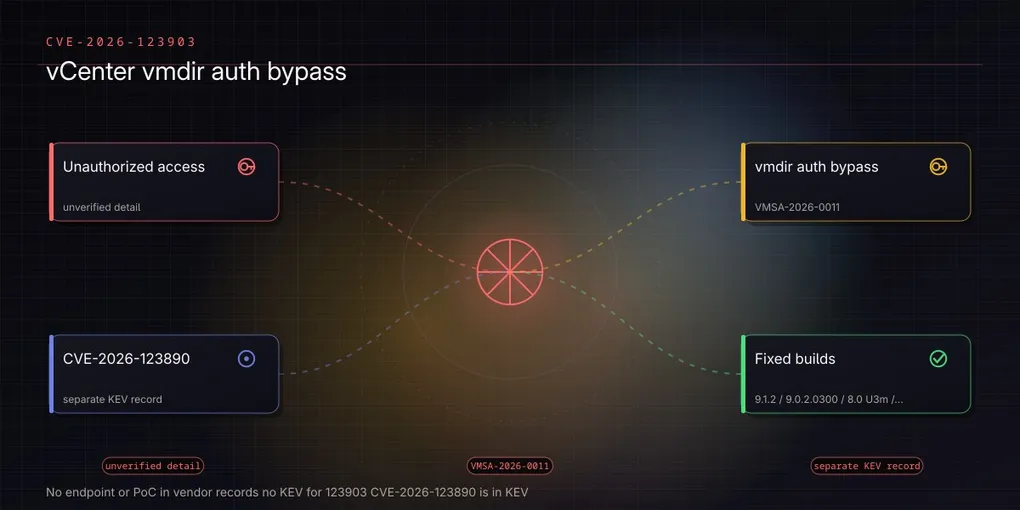
As of November 26, 2026, Broadcom has published VMSA-2026-0011, issued November 24, for CVE-2026-123903, an authentication bypass in the VMware Directory Service (vmdir) component of vCenter. The vendor maximum CVSS 3.1 score is 9.8 and no workaround is listed. This is a separate issue from CVE-2026-123890 in VMSA-2026-0009, published November 19 and updated November 20; the older record is listed in CISA KEV. Below are the VMSA text, the Broadcom FAQ, VMSA-2026-0009, NVD API queries, the KEV JSON, and Rapid7 analysis explicitly labeled secondary; no payload, victim, campaign, or IOC has been invented.
Quick summary
| Field | Value |
|---|---|
| CVE | CVE-2026-123903 |
| Product | Broadcom VMware vCenter Server, VMware Directory Service (vmdir) |
| Advisory | VMSA-2026-0011; initial publication and last update November 24, 2026 |
| Weakness | Authentication bypass; attacker with network access may gain unauthorized system access |
| CVSS | Vendor maximum 9.8 CRITICAL, CVSS 3.1; vector CVSS:3.1/AV:N/AC:L/PR:N/UI:N/S:U/C:H/I:H/A:H |
| Conditions | AV:N, PR:N, UI:N: network access is enough, no account or user interaction |
| Fix | vCenter 9.1.x: 9.1.2; 9.0.x: 9.0.2.0300; 8.0: 8.0 U3m; VCF 5.x: 5.2.5 |
| 7.0 | General support ended; contact Broadcom Support under extended support |
| Workaround | None; patches are cumulative and not eligible for vCenter Quick Patch |
| NVD API | No record returned for CVE-2026-123903 in the November 26, 2026 08:17 UTC query |
| KEV | No CVE-2026-123903 entry in the 2026.11.25 KEV JSON and catalog check |
| Separate record | CVE-2026-123890 / VMSA-2026-0009, November 19, updated November 20; added to KEV November 20 |
| Secondary analysis | Rapid7, November 25: public PoC validated; no vendor-confirmed exploitation |
Technical view
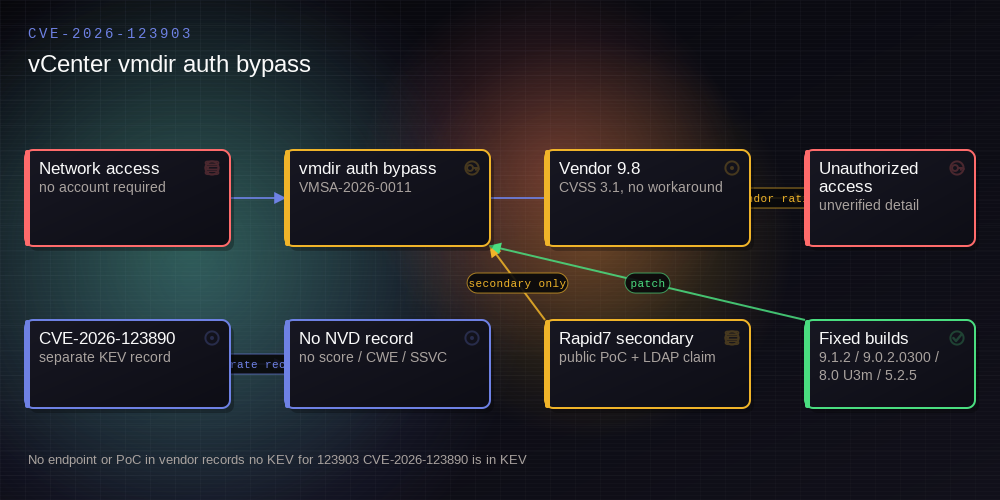
Section 3a of VMSA-2026-0011 defines the flaw as an authentication bypass in the VMware Directory Service of vCenter: a malicious actor with network access to vCenter may bypass authentication and gain unauthorized access to the system. Broadcom rates the issue Critical with a maximum CVSS 3.1 base score of 9.8. The calculator link in the VMSA carries AV:N/AC:L/PR:N/UI:N/S:U/C:H/I:H/A:H: network reachable, low complexity, no privileges, no user interaction, and high confidentiality, integrity, and availability impact. The vendor does not name a specific request, endpoint, port, or protocol; “network access to vCenter” describes reachability rather than confirming an attack path in detail.
The Broadcom FAQ clarifies two points. First, CVE-2026-123903 is a “new and distinct issue” from CVE-2026-123890, so the exploitation history of the older record cannot be transferred to the new CVE. Second, the vmdir issues are not specific to Enhanced Linked Mode; FAQ question 30 says installations without ELM are affected too. The FAQ also says patches are cumulative. If vCenter 8.0 U3m was installed for VMSA-2026-0009, no further vCenter patch is needed in this case, while 9.1.x and 9.0.x need the builds named in this advisory. The vCenter updates are not eligible for Quick Patch, so the standard update mechanism applies.
The response matrix covers four main branches. vCenter in VCF or VVF 9.1.x is fixed in 9.1.2, 9.0.x in 9.0.2.0300, standalone vCenter 8.0 in 8.0 U3m, and VCF 5.x in 5.2.5. vCenter 7.0 is handled through Broadcom Support under an extended support contract; the FAQ says 6.5 and 6.7 should be presumed affected. Telco Cloud Platform and Infrastructure customers are pointed to KB463501. The VMSA row for this CVE says “Workarounds: None”. The partial mitigations discussed in the FAQ concern the ESX I/O filter service and XHCI USB controller, not this vmdir authentication bypass.
The separate record matters. CVE-2026-123890 is the vCenter authentication bypass in VMSA-2026-0009, published November 19 and updated November 20. Its NVD record is Analyzed, carries CWE-288 and CISA exploitation: active, and the KEV JSON records November 20 as the added date and November 23 as the due date. By contrast, the NVD API returned zero results for CVE-2026-123903 on November 26, so there is no NVD score, CWE, or SSVC field to quote, and no KEV entry. Rapid7’s November 25 analysis separates the two issues by access path: 123890 over RPC and 123903 over LDAP. That detail appears only in the secondary source and is not confirmed by the vendor documents. The same secondary analysis reports a public PoC validated by Rapid7. This is not vendor confirmation; the VMSA, FAQ, NVD, and KEV records contain no in-the-wild exploitation report or PoC for the new CVE.
What to do
- Inventory by build. Read the vCenter version and build from the vSphere Client Summary tab or with PowerCLI using
DefaultVIServer.VersionandBuild. The major version alone is not enough because fixed builds are listed per branch. - Pick the matching fixed release. Use 9.1.2 for 9.1.x, 9.0.2.0300 for 9.0.x, 8.0 U3m for 8.0, and 5.2.5 for VCF 5.x. Customers on 7.0 with extended support should contact Broadcom Support.
- Check earlier patches. 8.0 U3m was also the fixed build for VMSA-2026-0009. If it is already installed, vCenter does not need another patch for this advisory. Older 9.x express patches do not cover the new issue.
- Treat the patch as urgent. The Broadcom FAQ classifies the four Critical issues as emergency changes under ITIL methodologies. Quick Patch is not eligible, so use the standard update mechanism. The vSphere Client is briefly unavailable during the update while virtual machine workloads continue to run.
- Reduce exposure without calling it a workaround. Restricting the vCenter management interface to trusted networks is sound practice, but the VMSA lists no workaround for this CVE; exposure control is not a substitute for the patch.
- Check after patching. Review logs back to November 24 for new administrator accounts, directory changes, and unusual vCenter sessions. Start incident response if anything looks wrong.
What not to claim
- Do not say CVE-2026-123903 is actively exploited. There is no KEV entry and no exploitation report in the vendor records.
- Do not say this CVE is in KEV. The KEV entry is for CVE-2026-123890, added November 20 and due November 23.
- Do not say NVD confirmed a 9.8 score. The 9.8 is the vendor score in the VMSA; the NVD API returned no record for this CVE on November 26.
- Do not describe them as the same flaw or the same patch. Broadcom identifies CVE-2026-123903 as a new and distinct issue.
- Do not say the Rapid7 PoC came from the vendor. The PoC claim is secondary; the vendor notes contain no PoC or IOCs.
- Do not say disabling ELM removes the risk. The FAQ says the vmdir issues are present without ELM.
- Do not say a workaround exists. The VMSA says
Nonefor this CVE. - Do not say Quick Patch can apply it. The FAQ excludes these updates from Quick Patch.
- Do not say 8.0 U3m covers every branch. That build applies to 8.0; 9.1.x and 9.0.x need newer builds.
Status
As of November 26, 2026, CVE-2026-123903 is verified through Broadcom VMSA-2026-0011 and the vendor FAQ. The advisory was issued November 24, rated Critical, and describes an authentication bypass in vmdir. Fixed versions and the no-workaround statement come directly from the response matrix. The FAQ explains the relationship to CVE-2026-123890, ELM scope, cumulative patching, and the Quick Patch restriction. The NVD API returned zero results for this CVE at 08:17 UTC on November 26, and the CVE record API returned 404, so no NVD score, CWE, or SSVC value has been carried into this article.
The CISA KEV JSON version 2026.11.25 and the catalog page have no CVE-2026-123903 entry. The same JSON file does contain CVE-2026-123890 with a November 20 added date and November 23 due date, while VMSA-2026-0009 records November 19 publication and November 20 update. Rapid7’s November 25 analysis is labeled secondary; the public PoC validation and the RPC versus LDAP distinction appear only there. The vendor advisory, FAQ, NVD, and KEV sources contain no victim list, campaign name, IOC, or in-the-wild exploitation report for the new CVE. This article does not claim active exploitation.
From this series
Sources
- Broadcom - VMSA-2026-0011, November 24, 2026
- Broadcom - VMSA-2026-0011 Questions & Answers
- Broadcom - VMSA-2026-0009, CVE-2026-123890
- NVD API - CVE-2026-123903 query, November 26, 2026
- NVD API - CVE-2026-123890
- CISA KEV JSON feed, version 2026.11.25
- CISA KEV catalog - CVE-2026-123903 query, no result
- CISA KEV catalog - CVE-2026-123890
- Rapid7 - CVE-2026-123903 analysis, secondary source