Traefik CVE-2026-137481: authorization bypass via sanitizePath
Traefik before 2.11.62 and 3.7.18: path-parameter dot-segments, middleware bypass, GHSA and NVD records, fixed releases.
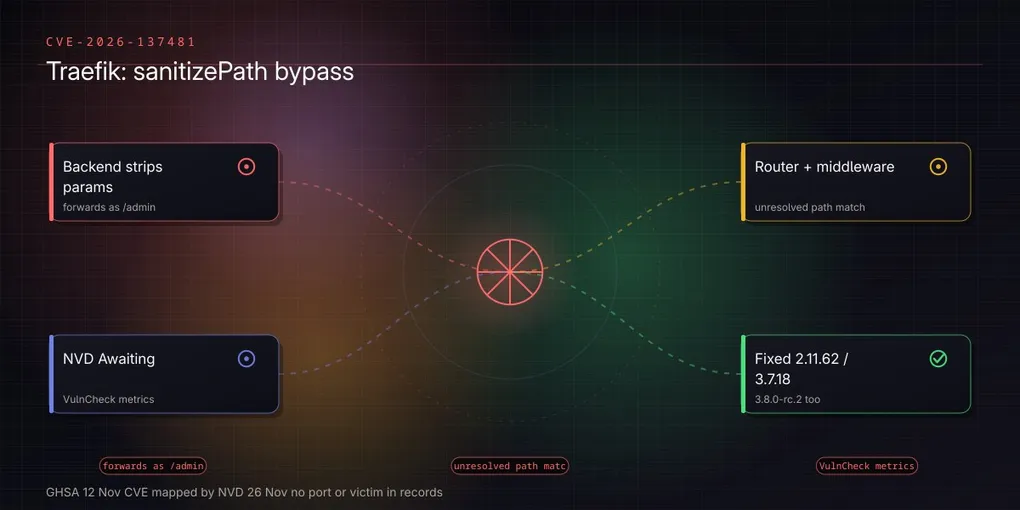
As of November 27, 2026, Traefik’s request-path sanitization option sanitizePath does not resolve dot-segments that carry path parameters, such as /..;x/. Traefik matches routers and applies middlewares on that unresolved path and forwards it unchanged to the backend. When a backend that strips path parameters shares one service between an unauthenticated route and a protected route, a single request can bypass an authentication or authorization middleware. Below are the Traefik advisory, the NVD API record, fixed releases, and the KEV JSON check; there is no claim of in-the-wild exploitation, victims, or campaigns.
Quick summary
| Field | Value |
|---|---|
| CVE | CVE-2026-137481 |
| Product | Traefik proxy (github.com/traefik/traefik) |
| Affected | v2 <= 2.11.61; v3 >= 3.0.0 <= 3.7.17; v3.8.0-rc.1 |
| Fixed | v2.11.62, v3.7.18, v3.8.0-rc.2 |
| Weakness | CWE-22; advisory also lists CWE-436 interpretation conflict |
| Impact | Path-based authentication or authorization bypass |
| Condition | sanitizePath enabled by default and a parameter-stripping backend |
| CVSS 4.0 | 7.8 HIGH, GHSA source, SC:H/SI:L |
| CVSS 3.1 | 9.3 CRITICAL, VulnCheck secondary source |
| NVD status | Awaiting Analysis; no NVD analysis score or SSVC fields |
| GHSA | GHSA-cp28-5662-543f, November 12, 2026, High |
| KEV | No entry in the 2026.11.25 KEV JSON |
| Reported by | TristanInSec |
Technical view
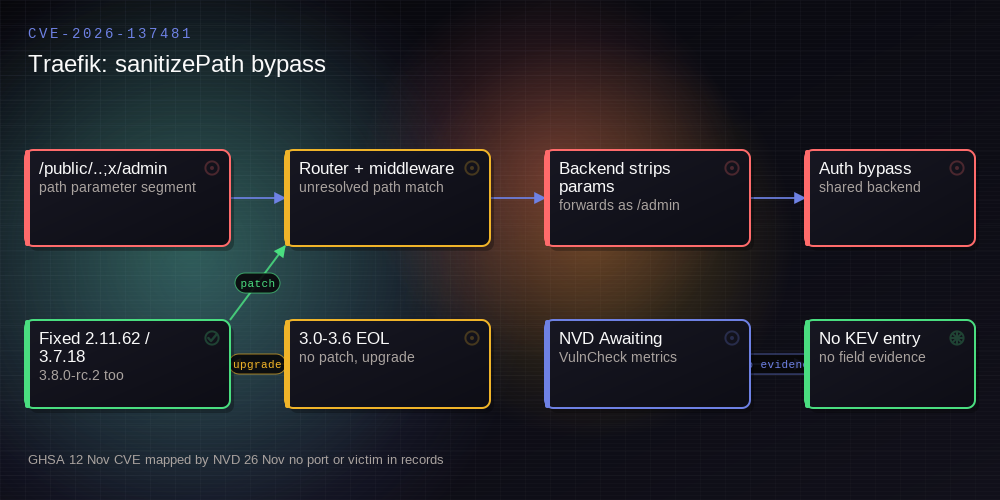
The Traefik advisory says the default-enabled sanitizePath option resolves .. and . dot-segments and duplicate slashes, but leaves a dot-segment carrying a path parameter, such as /..;x/, untouched. Router matching and the middleware chain are computed against the unresolved path, and the request reaches the backend in the same form. Backends that strip path parameters, such as Servlet containers and Spring, interpret /public/..;x/admin as /admin. If an open router for /public and a protected router for /admin share a backend, one request can bypass the protecting middleware.
The advisory gives /public/..;x/admin as a request shape. That is a request form present in the source, not a verified exploit against arbitrary deployments. The attack surface is the HTTP request path; the records name no specific port, protocol, or network position. One condition is that the backend strips path parameters and that open and protected routes share the same service. There is no evidence that the flaw produces an effect without those conditions.
The fixed releases are v2.11.62, v3.7.18, and v3.8.0-rc.2. With sanitizePath enabled, these releases resolve dot and empty segments before dot-segment removal, even when the segments carry path parameters. Traefik v3.0 through v3.6 are end of life and will not be patched; the advisory tells users on those lines to move to a patched release.
The NVD record was created on November 26, 2026 at 16:17 UTC and is Awaiting Analysis. CWE-22 and the 9.3 CVSS 3.1 metric come from [email protected]; the 7.8 CVSS 4.0 metric is also secondary and appears on the GHSA page. There is no NVD analytical score, so saying NVD assigned 9.3 would be wrong. The GHSA also lists CWE-436 interpretation conflict, while the NVD record carries only CWE-22. The GitHub advisory said “No known CVE” at publication time; the CVE ID was mapped later through the NVD record. The differing dates are not a contradiction.
The 2026.11.25 CISA KEV JSON contains no entry for CVE-2026-137481. The records contain no victim list, actor name, IOC, or campaign information. This article does not claim active exploitation.
What to do
- Inventory versions. List Traefik deployments and target 2.11.62 on v2, 3.7.18 on v3, and 3.8.0-rc.2 for release-candidate users.
- Leave EOL lines. v3.0 through v3.6 receive no patch. Staying there falls outside the remedy described in the advisory.
- Review router matching. Find configurations where an open route and a protected route share one backend and middleware is applied by path alone. That mapping is risky with a parameter-stripping backend.
- Keep path handling consistent. If the backend strips parameters, verify that protected resources cannot be reached through those parameters and normalize the path at one layer.
- Search logs. Look for
/..;x/requests in access logs. This is a local search pattern suggested here, not a vendor IOC. - Verify after patching. In your own test environment, confirm the same request shape no longer reaches the protected resource after the upgrade.
What not to claim
- Do not say exploitation was observed. There is no KEV entry and no field evidence in the primary sources.
- Do not say NVD confirmed a 9.3 score. The metric is VulnCheck-sourced and NVD is
Awaiting Analysis. - Do not say Traefik has RCE. The advisory describes an authorization bypass and makes no code-execution claim.
- Do not say every Traefik version is affected. The advisory limits the range and states a backend condition.
- Do not say disabling
sanitizePathis the fix. The advisory lists no such workaround. - Do not say GHSA already had a CVE. The advisory said the CVE was unknown at publication.
- Do not say every backend is affected. The condition is a parameter-stripping backend shared by open and protected routes.
- Do not say an exploit kit is circulating. The sources give only a request shape.
Status
As of November 27, 2026, CVE-2026-137481 is verified through the Traefik advisory GHSA-cp28-5662-543f and the NVD API record. The advisory was published on November 12 and credits TristanInSec; the NVD record was created on November 26 at 16:17 UTC and is Awaiting Analysis. Affected and fixed versions were read directly from the GHSA affected-versions section. The CVSS 4.0 and 3.1 metrics are VulnCheck/GHSA-sourced; there is no NVD analytical score and no SSVC data.
The open questions are clear: NVD analysis is pending, the GHSA did not know the CVE at publication, the records name no port or network position, and no source reports victims, actors, IOCs, or in-the-wild exploitation. /public/..;x/admin is a request example, not a verified campaign indicator. The 2026.11.25 CISA KEV JSON has no entry. This article avoids sensational framing and does not present an unproven flaw as actively exploited.