Symfony Mailer CVE-2026-133755: replies injected right after STARTTLS
EsmtpTransport reads cleartext replies injected after 220 as if they came from the encrypted session; affected versions, fix and claim boundaries.
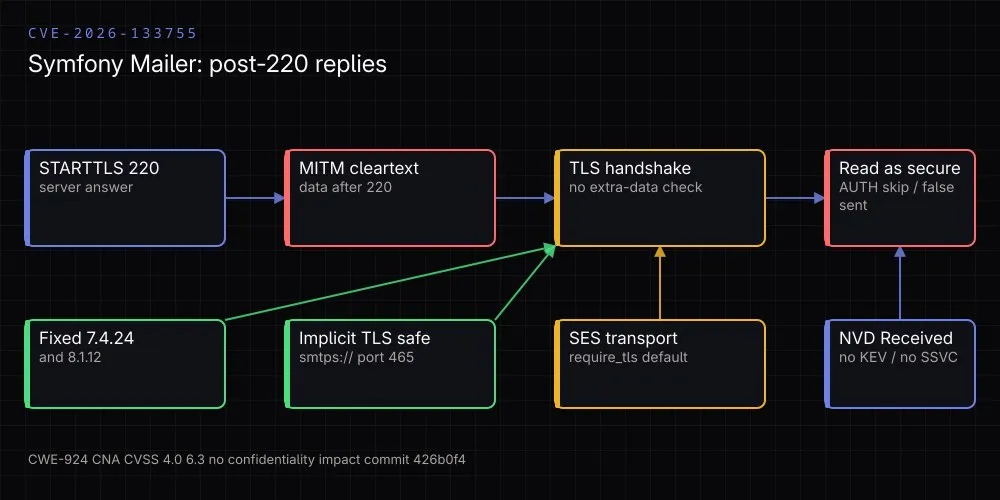
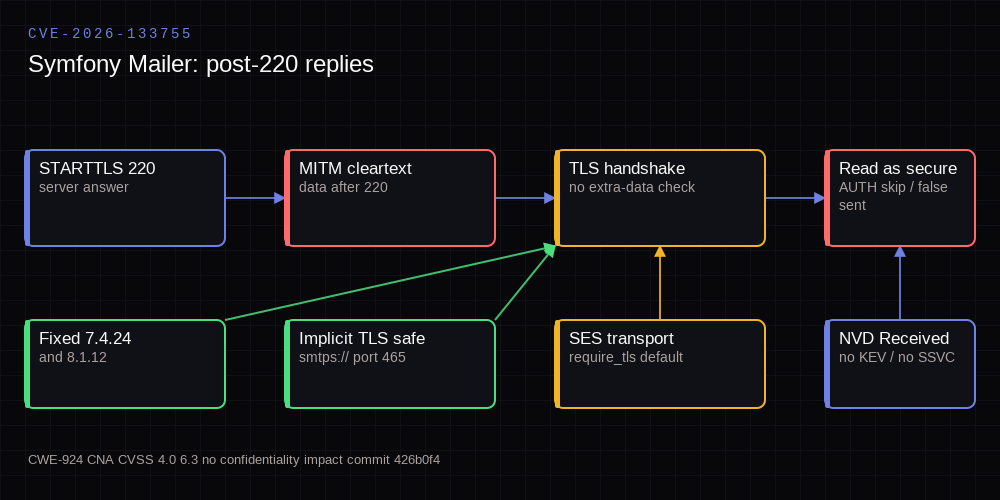
On November 25, 2026, Symfony published CVE-2026-133755 for its Mailer component. With a require_tls-protected SMTP connection, an on-path attacker can add cleartext replies immediately after the STARTTLS response and have them read as part of the encrypted session. The NVD record is Received; there is no KEV entry and no claim of active exploitation. Below are the vendor advisory and NVD fields.
Quick summary
| Field | Value |
|---|---|
| CVE | CVE-2026-133755 |
| Product | symfony/mailer, symfony/symfony (Packagist) |
| Affected | >=7.3 <7.4.24, >=8 <8.1.12 |
| Fix | 7.4.24, 8.1.12 |
| Weakness | CWE-924; replies after STARTTLS not verified |
| CVSS 4.0 | 6.3 Medium, AV:N/AC:H/AT:P/PR:N/UI:N/VC:N/VI:L/VA:N/SC:N/SI:N/SA:N — secondary Symfony CNA metric |
| NVD status | Received, published 2026-11-25T10:17:13.140; no NVD analysis or SSVC |
| KEV | KEV query returned no results; no evidence of active exploitation |
| Impact | AUTH can be skipped or a message reported as sent although the server rejected it |
| Exempt path | Implicit TLS: smtps:// or port 465 |
Technical view
Since Symfony 7.3, the require_tls option on EsmtpTransport refuses to send a message over an unencrypted connection; that prevents an on-path attacker from stripping STARTTLS. The vendor advisory places the flaw immediately after that protection: after the server’s 220 reply to STARTTLS, the transport started the TLS handshake without checking whether more data had already arrived.
An attacker in the middle of the connection can add cleartext replies right after the 220. The transport reads them as if they came from the encrypted session. Two outcomes are described: the attacker can make the transport skip AUTH, or the transport can report the message as sent while the server has rejected it.
Connections using implicit TLS, smtps:// or port 465, are not affected. Since Symfony 8.1, the Amazon SES SMTP transport enables require_tls by default on ports other than 465 and 2465, so ses+smtp:// DSNs are affected without setting the option explicitly.
The fix changes transport behavior: if the server sends data right after its STARTTLS answer, TLS is not started and a TransportException is thrown. The patch was published on the 7.4 branch in commit 426b0f4c90daf0a16ee4fa41a8fd19005bb172ec and forward-ported to 8.1 and 8.2. The advisory credits Nicolas Grekas for both the report and the fix.
The NVD record is Received; it carries the Symfony CNA’s CVSS 4.0 6.3 score but no NVD analysis or SSVC fields. A CISA KEV query returned no results. The vector’s VC:N and VI:L values show that the primary record claims no confidentiality loss and rates integrity impact as low.
What to do
- Patch. Upgrade
symfony/mailerandsymfony/symfonyto7.4.24or8.1.12. - Prefer implicit TLS where possible.
smtps://or port 465 stays outside the post-STARTTLS reply-injection path. - Verify
require_tls. In particular, check the default behavior and chosen port forses+smtp://DSNs on Symfony 8.1. - Question send results from the affected window. If you trusted “sent” responses while running affected versions, compare them with actual delivery or rejection logs on the server side.
- Assess with the on-path precondition. CVSS
AC:Hrecords that the attack is conditional; the described scenario targets an SMTP session visible to the attacker.
What not to claim
- Do not say STARTTLS was stripped.
require_tlsalready prevents unencrypted sending; the flaw is reading replies injected after220. - Do not say email contents leaked. The NVD/Symfony vector sets
VC:N, no confidentiality impact. - Do not claim active exploitation. NVD is
Received, there is no SSVC field, no KEV entry and no field finding in the advisory. - Do not say NVD assigned 6.3. That is Symfony CNA’s secondary CVSS 4.0 metric; NVD has no analysis.
- Do not say all PHP email delivery is affected. Impact is bounded by the listed
symfony/mailer/symfony/symfonyversions. - Do not say port 465 is unsafe. The vendor lists implicit TLS connections as unaffected.
- Do not invent a victim, campaign or PoC; none appears in the vendor advisory.
Status
As of November 25, 2026, the flaw is verified in the vendor advisory and NVD record, but NVD analysis is not complete. The Symfony advisory gives affected versions, fixed versions, mechanism, exempt TLS path and fix commit. NVD has vulnStatus: Received, published: 2026-11-25T10:17:13.140 and the same lastModified; CVSS 4.0 6.3 comes only from Symfony CNA, as does CWE-924. The KEV query was empty.
Open questions: there is no NVD primary score or SSVC choice, no reported exploitation, and no victim, campaign or PoC information. The vendor states that the fix was made on the 7.4 branch and forward-ported to 8.1 and 8.2, with 8.1.12 listed as the fixed version.
From this series
- FlowIntel TLS verification flaw CVE-2026-133648
- Apache mod_http2 CVE-2026-119618
- Idunno AntiCsrf CVE-2026-131914