Puppet CVE-2026-115731: report-processing flaw in KEV
Untrusted data deserialization in Puppet Server report processing. CVE-2026-115731, KEV status, CVSS source split, and fixed releases.
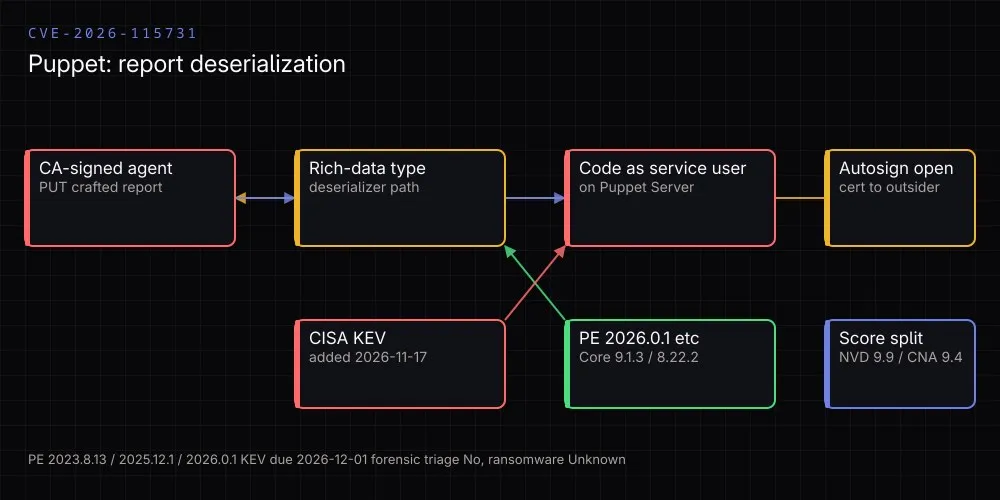
Perforce disclosed a critical report-processing flaw in Puppet Server on November 3, 2026. On November 17, CISA added CVE-2026-115731 to the KEV catalog based on evidence of active exploitation. The timing matters: the vendor’s November 3 note saying it was not aware of active exploitation does not override the November 17 KEV decision.
Quick summary
| Field | Value |
|---|---|
| CVE | CVE-2026-115731 |
| Product | Puppet Enterprise and Puppet Core (Puppet Server report processing) |
| Weakness | CWE-502 (deserialization of untrusted data) and CWE-94 (code injection), per CVE record |
| CVSS v3.1 | 9.9 Critical, AV:N/AC:L/PR:L/UI:N/S:C/C:H/I:H/A:H — NVD primary analysis |
| CVSS v4.0 | 9.4 Critical, AV:N/AC:L/AT:N/PR:L/UI:N/VC:H/VI:H/VA:H/SC:H/SI:H/SA:H — Perforce CNA |
| NVD status | Analyzed |
| KEV | added 2026-11-17, due 2026-12-01, ransomware Unknown, forensic triage No |
| SSVC (CISA) | exploitation: active, automatable: no, technicalImpact: total |
Technical view
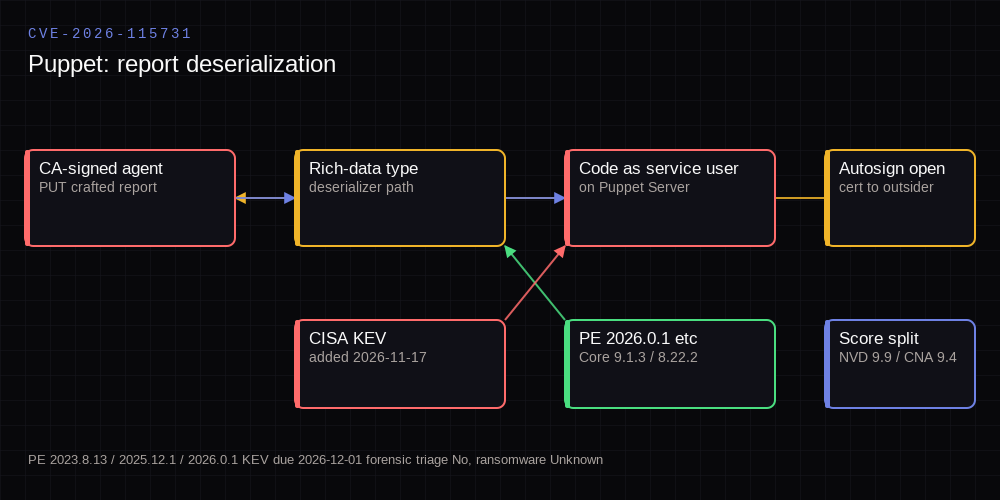
Per the CVE record, the flaw is in the code that processes reports agents send after each run. A client holding any CA-signed agent certificate can submit a report containing a crafted rich-data type via a PUT request and execute arbitrary code on Puppet Server as the service user. Where the CA autosigns certificate requests without strong verification, an unauthenticated network attacker can obtain such a certificate and use the same path.
That distinction is critical. Calling this “unauthenticated RCE” is only valid for the autosign configuration; the normal precondition is a CA-signed agent certificate. NVD CPE data lists affected ranges as Puppet Core 8.x (before 8.22.2), 9.x (before 9.1.3), and Puppet Enterprise 2023.8 / 2025.0 / 2026.0 lines.
Perforce’s security update also fixes CVE-2026-115732 (certificate name authorization bypass) in the same releases. Both issues touch the same certificate trust model; neither is evidence for the other.
Vendor statement vs field evidence
Perforce’s November 3 trust center note said it was not aware of active exploitation and had no evidence of customer data access at that time. CISA added the CVE to KEV on November 17 citing evidence of active exploitation. These are observations from different dates. The November 3 vendor note does not mean “no exploitation” after November 17; the KEV entry also gives no detail on which organizations were hit or when.
The KEV record explicitly sets forensicTriage: No and knownRansomwareCampaignUse: Unknown. The generic “Forensics Triage Requirements” text inside requiredAction does not mean forensic triage was requested for this entry. The SSVC record (CISA Coordinator, November 17) says exploitation: active, automatable: no, technicalImpact: total; automatable: no does not mean exploitation is absent.
What to do
- Match versions. Upgrade Puppet Enterprise/Advanced to 2026.0.1, 2025.12.1, or 2023.8.13, and Puppet Core to 9.1.3 or 8.22.2. The vendor asks for a server restart after upgrading.
- Review autosign and authorization rules. If upgrading is not immediate, this is the vendor’s temporary mitigation. If autosign is not explicitly disabled, establish who validates certificate requests.
- Restrict the report endpoint. Apply network access control so only managed agents can reach the Puppet Server report intake. This reduces exposure; it is not a substitute for the patch.
- Review certificate history. Look for new or unexplained CA-signed agent certificates, unexpected report PUT requests, and processes spawned by the Puppet Server service account.
- Cover the second flaw. The same upgrade fixes CVE-2026-115732; do not stop at the report bug and skip the certificate name check.
What not to claim
- Do not present the vendor’s November 3 “not aware of active exploitation” note as “not exploited” today. CISA added it to KEV on November 17.
- Do not mix 9.4 and 9.9. The 9.4 is Perforce’s CVSS v4.0 CNA score; the 9.9 is NVD’s CVSS v3.1 analysis. Different sources and different versions.
- Do not say every installation without autosign is safe; the precondition is a CA-signed certificate, and how that certificate is obtained is a separate question.
- Do not add ransomware or forensic triage claims. The KEV record says the opposite.
- Do not assert a public PoC exists unless a primary record says so. Technical details from secondary sources such as CCB are unverified context.
Status
As of November 22, 2026, this flaw is verified in primary records and listed in KEV. The CVE record, NVD analysis, CISA KEV/SSVC fields, and Perforce’s fix notice agree. Open questions: which organizations were exploited is not in a public primary record; forensicTriage: No and ransomware use is Unknown; secondary technical details are not in the primary records. Headlines such as “every Puppet server was compromised” or “ransomware confirmed” are not supported by these records.