Optimizely CVE-2026-132224: project JavaScript injection via cdn.optimizely.com
The signup-flow flaw let an attacker place code in projectJS on cdn.optimizely.com assets; KEV, score provenance and hosted-service limits.
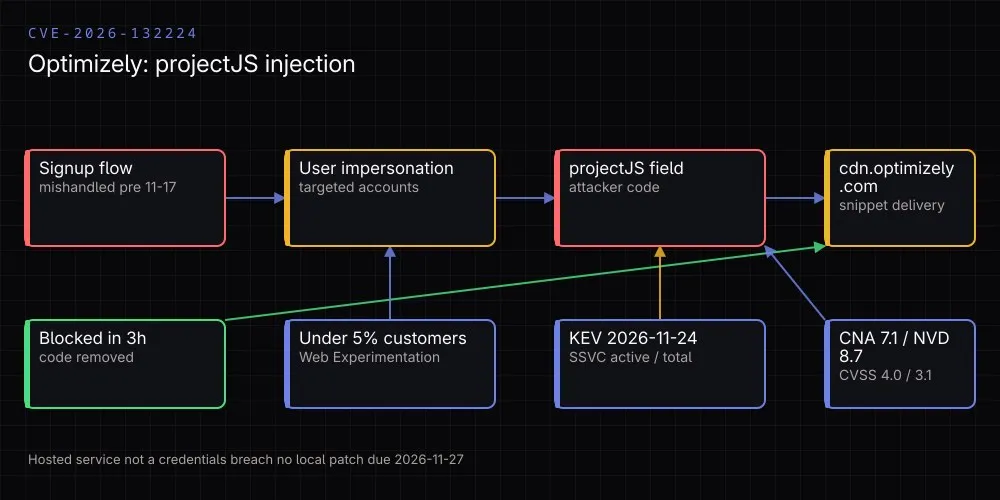
As of November 25, 2026, CVE-2026-132224 is a verified integrity flaw in Optimizely Web Experimentation and is listed in CISA KEV. The signup flow was mishandled, allowing an attacker to place code in the projectJS field of certain cdn.optimizely.com assets. The critical point: this is a hosted service, so there is no local patch to apply. Below are the NVD record, the vendor status page and the KEV fields.
Quick summary
| Field | Value |
|---|---|
| CVE | CVE-2026-132224 |
| Product | Optimizely Web Experimentation (hosted service), exclusively-hosted-service tag |
| Weakness | CWE-642 (external control of critical state data) |
| NVD status | Analyzed; SSVC exploitation: active, automatable: no, technicalImpact: total |
| CVSS 4.0 | 7.1 High, AV:N/AC:H/AT:N/PR:L/UI:N/VC:N/VI:H/VA:N/SC:H/SI:H/SA:N — secondary MITRE CNA metric |
| CVSS 3.1 | 8.7 High, AV:N/AC:L/PR:L/UI:R/S:C/C:H/I:H/A:N — NVD primary analysis |
| KEV | added 2026-11-24, due 2026-11-27, forensicTriage: Yes, ransomware Unknown |
| Incident date | Vendor: exploited on November 16, 2026, detected and closed the same day |
| Impact | Attacker-controlled JavaScript in the projectJS field of certain customer projects |
| Scope | Vendor: fewer than 5% of customers; Web Experimentation only |
| Attack surface | Snippet served from cdn.optimizely.com; no port in the primary record |
Technical view
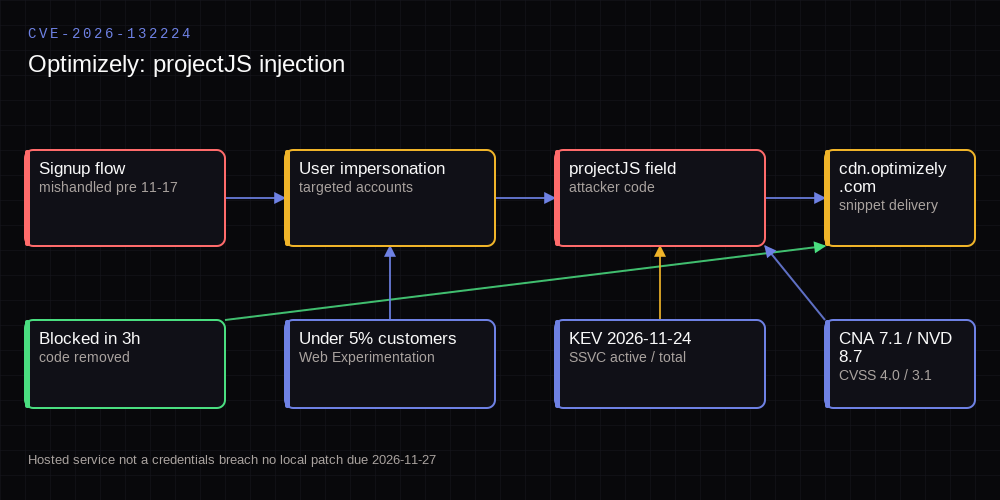
The NVD record says Optimizely Web Experimentation before November 17, 2026 mishandled the account signup flow, leading to attacker-controlled code in the projectJS (Project JavaScript) field of certain cdn.optimizely.com assets. CWE-642 describes external control of critical state data, and the cveTags field marks the issue exclusively-hosted-service.
The vendor status page gives a clearer timeline: on November 16, 2026, an unauthorized third party exploited the signup-flow flaw, impersonated users on targeted customer accounts and inserted malicious JavaScript into projects. Optimizely says it detected the activity the same day, blocked delivery of the code, closed the vulnerability within three hours of detection and removed the injected code from all affected projects. The vendor also states that this was not a credentials breach, that only Web Experimentation was affected, and that fewer than 5% of customers were impacted.
The scores have separate provenance: 7.1 (CVSS 4.0) is MITRE CNA’s secondary metric; 8.7 (CVSS 3.1) is NVD’s primary analysis. The NVD SSVC options are exploitation: active, automatable: no, technicalImpact: total. The CISA KEV entry was added on November 24 with a November 27 due date and forensicTriage: Yes.
Secondary coverage mentions hundreds of sites and named brands; NVD labels those references “Press/Media Coverage” or “Third Party Advisory”. This article does not treat victim names as primary evidence. The primary record contains no PoC, victim list, campaign name or port.
What to do
- Establish whether you use Web Experimentation. According to the vendor, customers who do not use it need take no action.
- Follow the vendor notice and guidance. The vendor says affected customers were contacted directly and given additional guidance; review your own CDN snippets and
projectJSfields. - Monitor snippet integrity. Look for unexpected changes in
cdn.optimizely.com-served scripts, requests to unfamiliar domains and browser console errors. - Restrict script sources with CSP. This does not fix the hosted flaw; it makes execution of a leaked snippet harder.
- Plan forensic triage on the KEV timeline.
forensicTriage: Yesand a November 27 due date apply; preserve access and change logs from November 16-18.
What not to claim
- Do not say all Optimizely customers were affected. The vendor says fewer than 5%, limited to Web Experimentation.
- Do not say credentials were breached. The vendor status page explicitly says this was not a credentials breach.
- Do not say NVD assigned 7.1. That is MITRE CNA’s secondary CVSS 4.0 score; NVD’s primary score is 8.7 at CVSS 3.1.
- Do not tell users to download and install a patch. This is a hosted service tagged
exclusively-hosted-service. - Do not claim ransomware was seen. The KEV field is
Unknown. - Do not name a specific victim as confirmed. Those claims come from secondary coverage; the primary record names no victims.
- Do not say a browser blocklist closed the incident. A Brave mitigation PR appears in NVD references as a third-party mitigation; the vendor notice is the primary record.
Status
As of November 25, 2026, the flaw is NVD Analyzed, listed in CISA KEV and confirmed by the vendor. NVD carries MITRE CNA’s CVSS 4.0 7.1 and its own CVSS 3.1 8.7, with SSVC active / no / total. CISA KEV sets dateAdded: 2026-11-24, dueDate: 2026-11-27, forensicTriage: Yes and knownRansomwareCampaignUse: Unknown. The vendor status page records the November 16 exploitation, closure within three hours, code removal and the under-5% scope.
Open questions: the primary record does not identify affected customers; named-victim lists from secondary coverage were not used as evidence; the exact injected JavaScript, any specific port and any network signature are absent from the vendor record. The vendor’s statement that no malicious code remains is a vendor assertion, not independent verification.