SSHole CVE-2026-123158: password bypass on musl sshd
OpenSSH before 10.6p2 lets sshd on musl libc without PAM accept an oversized password. CVE-2026-123158, KEV fields, GreyNoise telemetry and the fix.
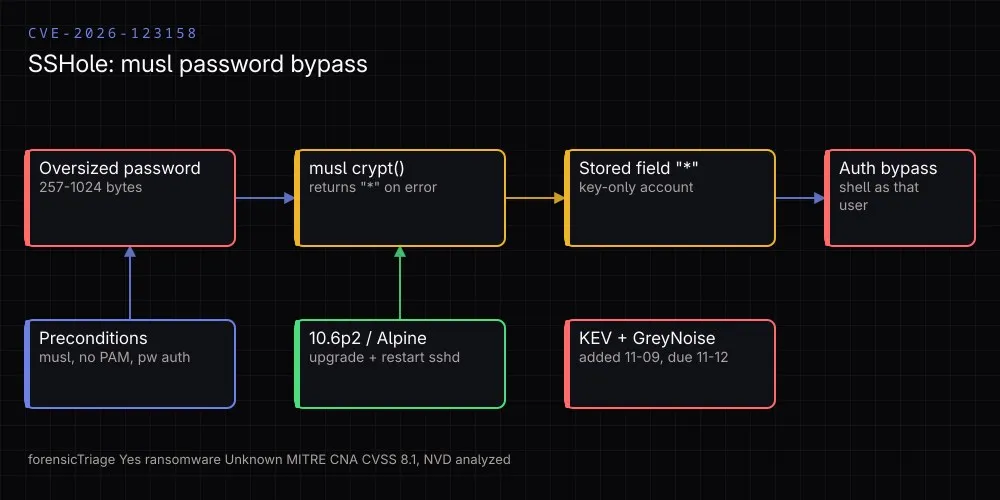
OpenSSH released 10.6p2 on November 5, 2026 with a workaround for a password authentication bypass affecting sshd on Linux systems built against musl libc without PAM. CISA added the flaw to KEV on November 9. GreyNoise telemetry updated as of November 23 confirms post-exploitation activity over TCP/22. None of that means every SSH server is affected: the conditions are narrow and the root cause sits outside sshd.
Quick summary
| Field | Value |
|---|---|
| CVE | CVE-2026-123158 (GreyNoise name: SSHole) |
| Product | OpenSSH sshd before 10.6p2; musl libc + PAM disabled Linux (Alpine is the main example) |
| Weakness | CWE-394 (Unexpected Status Code or Return Value), per NVD |
| CVSS v3.1 | 8.1 High, AV:N/AC:H/PR:N/UI:N/S:U/C:H/I:H/A:H — secondary CNA metric from [email protected], not an NVD analysis |
| NVD status | Analyzed; no NVD-produced v3.1 score in the record |
| SSVC (CISA) | exploitation: active, automatable: no, technicalImpact: total |
| KEV | added 2026-11-09, due 2026-11-12, forensic triage Yes, ransomware Unknown |
| Field evidence | GreyNoise: 5 possible exploitation attempts, 48 confirmed post-exploitation sessions from 10 attacker IPs |
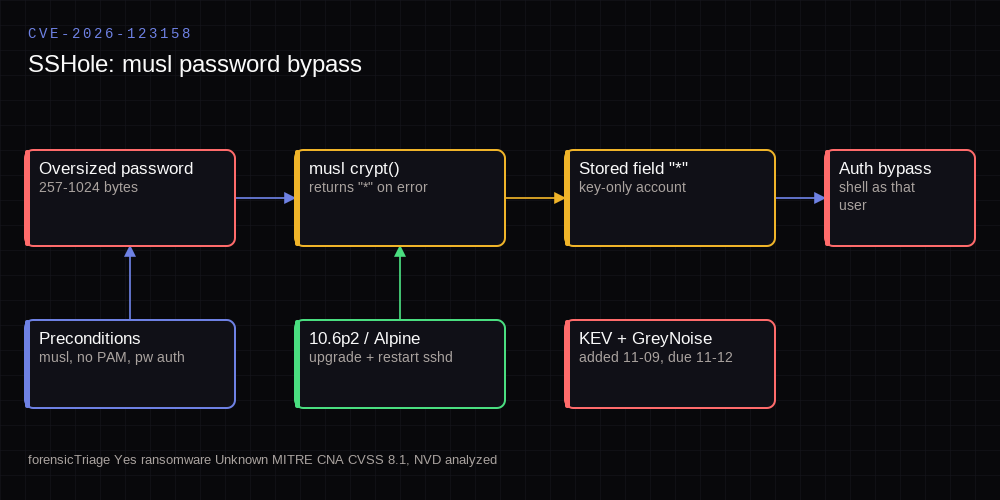
Technical view
Per the NVD record, the flaw is in the path where sshd hashes a password with crypt() and compares it to the /etc/shadow field. For an account whose password field is *, the field is too short to hold a salt, so sshd borrows one from another account with a $5$ or $6$ hash. musl’s crypt() returns * as an error indicator for keys over 256 bytes. That value is identical to the stored field of a passwordless account, so the comparison succeeds and the login goes through. NVD gives the lower bound as 256 bytes and Alpine’s advisory as 257; the one-byte gap is not resolved in either record.
One condition is not enough. Alpine’s advisory lists all of the following together: sshd built with musl libc and run without PAM (Alpine’s openssh-server package, or openssh-server-pam with UsePAM no), PasswordAuthentication yes, at least one account with a * password field, and at least one account with a $5$/$6$ hash. cloud-init images write PasswordAuthentication no and fall outside this configuration; PAM-enabled systems and glibc-based distributions are not affected through this path.
Which account is reached determines the outcome. The base Alpine image’s root:* account is protected by the default PermitRootLogin prohibit-password; setting PermitRootLogin yes makes root directly reachable. The more practical path is the alpine user in official tiny-cloud images: in 3.18.11 through 3.24.3 artifacts its password field is * and doas is passwordless. Once an admin sets a console password or user-data adds a $6$ hash, the image becomes exploitable and the attacker gets a shell as alpine then root through doas.
The fix has two layers. OpenSSH 10.6p2 carries the sshd-side workaround; the release note explicitly says the root cause is outside sshd but exploitable through it. Alpine shipped patched packages for 3.21.10 / 3.22.8 / 3.23.8 / 3.24.4 and edge (edge 10.6_p2-r0, 3.24 10.3_p1-r2, 3.23 10.2_p1-r1, 3.22 10.0_p1-r11, 3.21 9.9_p2-r1, with packages back to 3.16). Upgrading the package does not replace the running daemon; rc-service sshd restart is required.
Vendor statement vs field evidence
The OpenSSH 10.6p2 note and the Alpine advisory describe the conditions and the fix; neither names affected organizations. CISA added the CVE to KEV on November 9 citing an unexpected status code or return value and set a November 12 due date. The KEV record genuinely sets forensicTriage: Yes; this is not an inference from the generic “Forensics Triage Requirements” text in requiredAction. knownRansomwareCampaignUse is Unknown.
GreyNoise’s live telemetry as of November 23, 2026 supplies the field side: since November 5, 159M TCP/22 SYNs, 120M full connections, 118M SSH connections, 5 possible exploitation attempts (<0.01%), and 48 confirmed post-exploitation sessions from 10 attacker IPs. GreyNoise states plainly that SSH encryption prevents definitive CVE attribution from network traffic alone and labels these “possible CVE attempts.” So the 118M connections are not all exploitation; the 48 sessions are tracked as post-exploitation command execution. The same page says working exploits are publicly available, which is not an attribution of any specific exploit.
What to do
- Narrow the inventory. Find systems running sshd built against musl without PAM, especially Alpine and tiny-cloud images. Do not group glibc/PAM servers with them.
- Upgrade and restart. Move to OpenSSH 10.6p2 or the patched package for your Alpine branch (
apk upgrade -U -a), then runrc-service sshd restart. A package upgrade alone leaves the vulnerable daemon running. - Disable password auth if patching is delayed. Set
PasswordAuthentication no, then verify withsshd -t && rc-service sshd restartandsshd -T | grep -i passwordauthentication. Keep the current session open until a new key login works. - Treat tiny-cloud images separately. Audit the
alpineuser plus passwordlessdoascombination in qcow2/VHD/AMI artifacts from 3.18.11 through 3.24.3; a console password or a user-data$6$hash triggers the risk. - Search the logs. Look for
Accepted password forlines for passwordless accounts in/var/log/messages,doasuse, and newly created users or authorized keys. If you cannot rule out a login, treat the machine as compromised.
What not to claim
- Do not say all of OpenSSH is affected. The conditions are musl libc, a build without PAM, password auth enabled, and suitable shadow fields.
- Do not frame this as zero-click or direct root RCE. The attacker first gets a shell as that user; root depends on
doasorPermitRootLoginconfiguration. - Do not count 118M SSH connections as exploitation. GreyNoise’s own labels are 5 possible attempts and 48 post-exploitation sessions.
- Do not say NVD assigned 8.1. The score is a secondary CNA metric from
[email protected]; NVD’s record is Analyzed and contains no NVD v3.1 score. - Do not add a ransomware claim; the KEV field is
Unknown. - Do not stop at the package upgrade. Without a daemon restart, the vulnerable sshd stays up.
- Do not present Alpine’s “no CVE assigned at the time of writing” line as “no CVE exists” today; NVD published CVE-2026-123158.
Status
As of November 23, 2026, this flaw is verified in primary records and listed in KEV. The NVD record (Analyzed, CWE-394, MITRE CNA CVSS 8.1, CISA SSVC exploitation: active), the CISA KEV fields (dateAdded, dueDate, forensicTriage, knownRansomwareCampaignUse read separately), the OpenSSH 10.6p2 notes, the Alpine advisory, and GreyNoise telemetry agree. Open questions: affected organizations are not named in a public primary record; GreyNoise says encrypted SSH prevents definitive CVE attribution from traffic; NVD says 256 bytes where Alpine says 257; port data goes no further than TCP/22 and the configuration conditions. Headlines such as “every SSH server was compromised,” “zero-click root RCE,” or “ransomware confirmed” are not supported by these records.