NoisyTCP (CVE-2026-99288): an 11-year-old Linux TCP flaw crashes servers remotely
Unauthenticated kernel panic via a lockless TCP lookup race: how CVE-2026-99288 works, which kernels are affected, and the available workarounds.
On November 15, 2026, researcher Hyunwoo Kim (v4bel) disclosed a Linux kernel vulnerability on the oss-security list after the linux-distros embargo expired: NoisyTCP, tracked as CVE-2026-99288. In short: an unauthenticated, remotely triggerable race condition that ends in a kernel panic and takes down the whole host. The attacker only needs to be able to send packets to a TCP listener. Default-configured Nginx, Apache, or SSH is enough.
The bug entered the kernel in an October 2015 commit and was fixed on November 3, 2026 — roughly 11 years during which it sat in almost every Linux distribution. This post covers the mechanism, the conditions required for exploitation, and what to do before a patch is available.
Quick summary
| Field | Value |
|---|---|
| CVE | CVE-2026-99288 (NoisyTCP) |
| Impact | Unauthenticated remote denial of service (kernel panic) |
| Red Hat rating | Important, CVSS 3.1 7.5 |
| Weakness | CWE-362, CWE-476 (plus a harder-to-hit use-after-free path) |
| Introduced | 079096f103fa (Oct 3, 2015, Linux 4.4) |
| Fixed | 4e2b3ef19e0e (Nov 3, 2026) |
| Fixed stable releases | 6.12.117, 6.18.63, 7.3.4 |
| Exploitation | None confirmed as of Nov 17, 2026; not in CISA KEV |
How it works
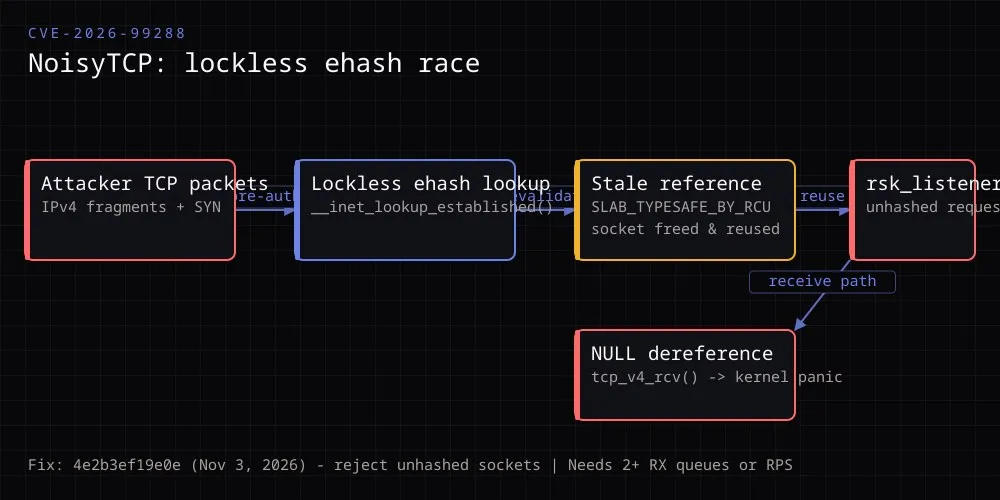
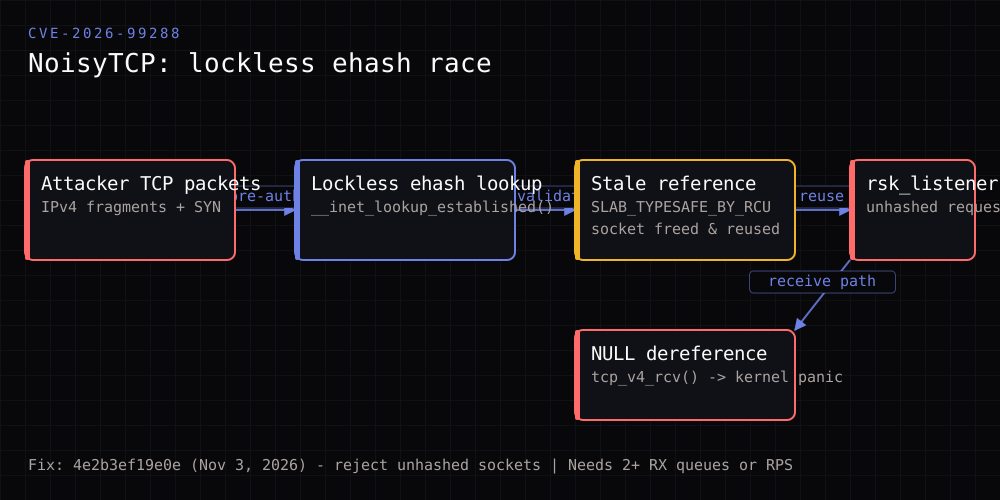
When a TCP packet arrives, the kernel finds the owning socket through a hash table (ehash). For speed this lookup is lockless: it finds a matching entry, takes a reference, then re-checks that the address and port still match.
The flaw is in that second check. The relevant socket caches use SLAB_TYPESAFE_BY_RCU, so memory can be reused while an RCU reader still holds the old address. If the memory is reallocated as a new request socket with the same address/port tuple, the lookup takes a reference to the new object and returns it — even though that object is not yet hashed.
Kim’s demonstrated path uses SYN cookies: one receive context holds a stale reference to an existing request socket while another context frees it and allocates a new SYN cookie request at the same slab address. The tuple check passes, but the new request socket’s rsk_listener is NULL. When the TCP receive path uses that pointer, the kernel dereferences NULL and panics.
Triggering the race requires the same connection tuple to be processed concurrently in two receive contexts. Kim achieved this by exploiting the difference in receive hash between IPv4 fragments and regular TCP packets. In practice that means two or more RX queues, or RPS spreading packets across multiple CPUs — conditions met by most cloud VMs and servers.
In Kim’s tests, default-configured QEMU/KVM guests running Nginx, Apache, and OpenSSH crashed in 5 seconds to 2 minutes. On a quiet bare-metal Nginx server with eight RX queues, winning the race took roughly 14 hours. Virtualization makes the race practical because vCPU preemption adds scheduling variance.
Scope: DoS, not RCE
Red Hat rates the issue Important (CVSS 3.1 7.5) and states that exploitation does not allow arbitrary code execution or data modification. Kim’s write-up describes a harder use-after-free variant but says RCE is “not yet.” No exploit code was published; the details are in his GitHub repository. As of November 17 there is no confirmed in-the-wild exploitation, and the CVE is not in CISA’s KEV catalog.
Containers do not protect you: a host kernel panic takes down every workload on the node. Busy, multi-queue, or virtualized servers should be prioritized.
Timeline
| Date | Event |
|---|---|
| Oct 3, 2015 | Faulty commit (079096f103fa) lands |
| Oct 29, 2026 | Kim sends the fix to the networking maintainers |
| Nov 3, 2026 | 4e2b3ef19e0e merged into mainline |
| Nov 10, 2026 | Linux CNA publishes CVE-2026-99288 |
| Nov 15, 2026 | Embargo ends, NoisyTCP report published |
What to do
Permanent fix: install a kernel carrying the correction and reboot. Upstream, the fix is in 6.12.117, 6.18.63, and 7.3.4 (also 7.4-rc2). Distribution timelines vary: Debian 12 (bookworm) and 13 (trixie) shipped fixed kernels; RHEL 8/9/10 and AlmaLinux were still in progress at publication time. Check your distribution’s advisory and the running kernel (uname -r) rather than a version number alone — an installed package does not protect you until you reboot into it.
If you cannot patch immediately, Kim and Red Hat suggest two stopgaps:
# 1) Disable SYN cookies (weakens SYN flood protection)
sudo sysctl -w net.ipv4.tcp_syncookies=0
This setting is per network namespace, so it must be applied in each container with its own namespace. The second option is to reduce the internet-facing interface to a single RX queue and disable RPS/RFS, removing the concurrency the race needs. Both affect availability/performance and are not substitutes for the patch.
Detection: classic IOCs (file hashes, payload URLs) do not apply — exploitation happens entirely over the network. Correlate kernel panics tied to tcp_v4_rcv, NULL pointer dereference messages, unexplained reboots, and unusual TCP/fragment/SYN traffic bursts immediately preceding a crash.
The wider lesson
This bug disproves the idea that long-standing code is safe by default. A lookup function written in 2015 and running on millions of machines for a decade surfaced only when someone examined the interaction between RCU and slab memory reuse. Lockless data structures buy performance; validation steps must check an object’s state, not just its identity. The fix commit title says exactly that: “inet: reject unhashed sockets during established lookups.”
Sources: Hyunwoo Kim’s oss-security report, NVD record, fix commit, AlmaLinux advisory.