Why does everything become 2shell?
Not every bug becomes 2shell. A field guide to the pre-auth parser + memory corruption + leak + callback + privileged process chain behind php2shell, Java4Shell, Ruby2Shell and nginx2root.
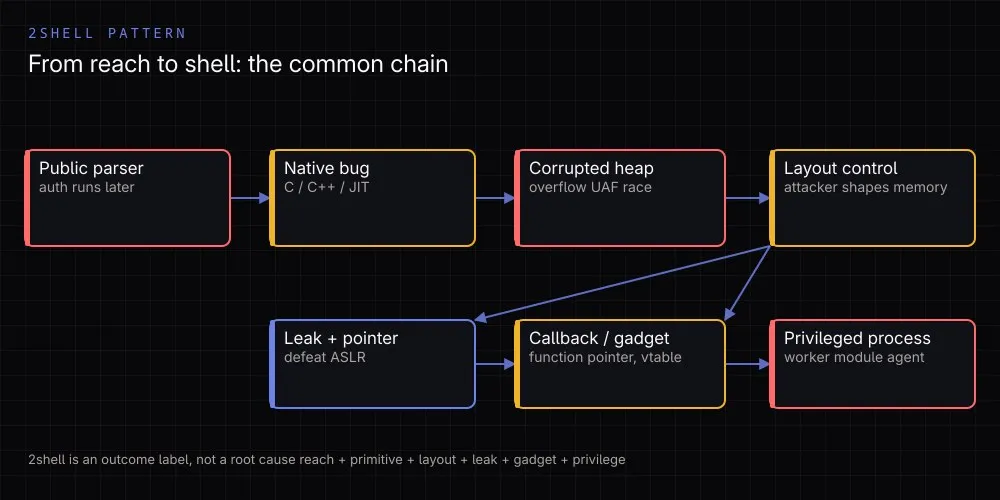
Over the last few weeks, PHP, Ruby, Java, NGINX, QUIC, WordPress and control-plane bugs have all ended with the same phrase: ...2Shell or ...2Root. That is not a coincidence, but it is not a diagnosis either. 2shell is an outcome, not a root cause.
Short answer: the branding is real, and so is the pattern. Researchers pick memorable names; vendors publish CVEs, CVSS scores and patch versions. Mixing the two leads to claims like “every Java app is RCE,” which is wrong. The useful question is: which trust boundary produces which primitive, and which privilege does it end with?
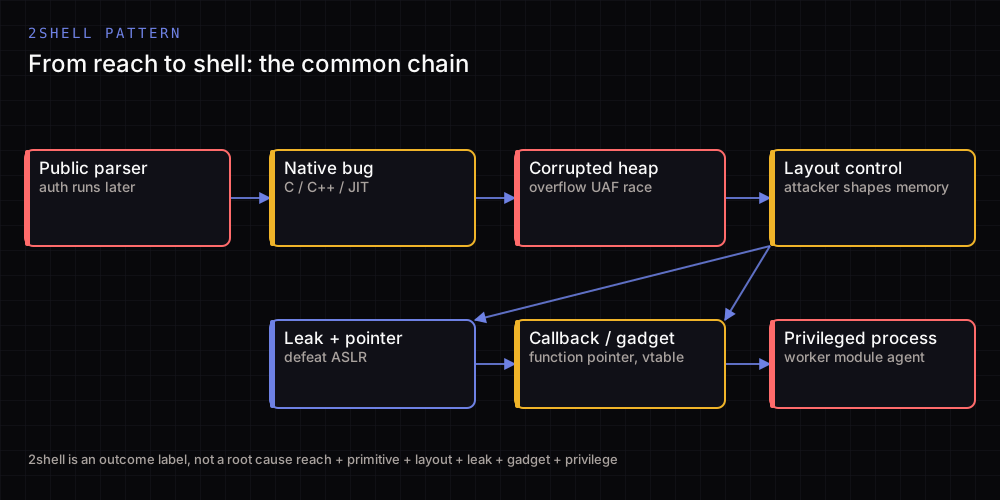
2shell = public reach
       + memory-safety primitive
       + attacker-controlled heap layout
       + pointer leak / ASLR bypass
       + callable gadget / callback
       + privileged process
Miss one link and the result is usually DoS, information disclosure or local privilege escalation — not a shell.
1. The name is marketing, the mechanism is engineering
Names like Ruby2Shell, Java4Shell, php2shell, Broccoli2Shell and nginx2root are shorthand for a finding. Vendor advisories usually do not use them; they say CVE-2026-132825, GHSA-34m4-m9fh-gqp5 or CVE-2026-119618.
That distinction matters:
| Label | What it tells you | What it does not tell you |
|---|---|---|
2shell / 2root |
The final outcome | The bug class |
| CVE / GHSA | A specific flaw and patch scope | Which app actually reaches it |
| CVSS | A technical impact vector | Exploitability in your environment |
| PoC | One trigger path | A public, reliable exploit |
Very different bugs can end up under the same “2shell” heading:
- Ruby2Shell: a one-byte heap overflow in case conversion for legacy encodings.
- php2shell: engine-level OOM corruption and stale global state.
- Broccoli2Shell: an out-of-bounds write in the Brotli decoder.
- nginx2root: HTTP/2 flow-control underflow and worker heap corruption.
- mod_http2: a race over shared HPACK state.
So “everything becomes 2shell” is not quite right. The accurate version is: different memory-safety bugs at the same trust boundary converge on the same outcome class.
2. The six links in the chain
2.1 Reach: parsing happens before authentication
A server has to read parts of a request before it can authenticate it. Headers, HTTP/2 frames, QUIC packets, TLS extensions, compressed bodies, Base64 credentials, image metadata and XML-RPC payloads are all parsed before identity is known.
That makes the trust boundary itself more important than the login page. In the cPanel WP Toolkit case, no panel login was needed; the public proxy bridged into a panel-level action. See cPanel WP Toolkit proxy.
2.2 Primitive: gaining a read/write capability
Memory corruption is not RCE on its own. First you need a primitive:
- heap buffer overflow,
- use-after-free,
- integer or flow-control underflow,
- race-driven stale state,
- deserialized gadget chain,
- a missing bounds check in a native intrinsic or JIT-generated stub.
In Ruby2Shell, ß → SS writes one extra byte. In MsQuic CVE-2026-105016 / GHSA-v2xv-r72g-h8j2, manipulating send allowance over IPv6 causes a uint16_t underflow and then a heap out-of-bounds write during stream framing. In the Brotli case, the decoder’s 8-byte internal buffer is overrun. Different code, same first link.
2.3 Layout control: shaping the heap
Modern heap exploitation is not “I overflowed one byte, now I have a shell.” The attacker usually controls request sizes, object lifetimes and allocation order: filling holes, placing same-sized objects together and reclaiming a freed chunk.
That is why some PoCs are resource-heavy. The nginx2root PoC uses roughly 119 GiB of plaintext and a tailored resource profile. That does not reduce the severity, but it does mean “one packet pops everything everywhere” is not a fair summary.
2.4 Leak: making addresses known
With ASLR/PIE enabled, even a pleasant OOB write may miss its target. Many chains therefore need an information leak: a freed pointer, function pointer, vtable or heap address.
Some of the Regexp issues disclosed alongside Ruby2Shell matter for exactly this reason. One bug may provide the write primitive while an out-of-bounds read makes addresses visible. A bug that looks like “only info disclosure” in isolation can be the key link in the chain.
2.5 Gadget: reaching control flow
The final step turns corrupted memory into executed code. Classic C/C++ targets use function pointers, vtables, return addresses or allocator metadata. In JIT-backed runtimes the details differ: the Java example discussed here involves malformed Base64 input corrupting memory in the x86-64 AVX-512 VBMI path of HotSpot’s generated java.util.Base64.Decoder code.
Be precise here. OpenJDK’s November 17, 2026 advisory lists CVE-2026-114938 under hotspot/compiler with CVSS 8.1; Red Hat’s note describes the impact through the Base64 decoder’s AVX-512 VBMI path. Saying “the whole C2 compiler exploded” goes beyond the sources.
2.6 Privilege: whose shell is it?
RCE and 2root are not the same thing. A PHP-FPM worker, nginx worker, Rails app user, cPanel panel process and root helper all carry different authority. The process whose control flow is taken over determines the identity of the “shell.”
That is why the process model matters as much as the exploit chain. seccomp, jailed workers, non-root service users, read-only filesystems and privilege separation do not remove the primitive, but they can cut the last link.
3. Why so many examples?
Native fast paths moved to the trust boundary
Compression, regex, HTTP/2/3 framing, Base64 decoding, media analysis and crypto all need to be fast. That is why C/C++, SIMD intrinsics and JIT-generated code run at the outermost layer. The optimization that buys speed also creates places where a bounds check can slip.
“Memory-safe language” does not mean safe runtime
Ruby, Java and Go hide pointers from application code; their runtimes still manage native memory. Ruby’s case-map loop, Java’s Base64 intrinsic and PHP’s engine allocation logic all fall into this category. Language safety does not replace runtime safety.
Parsing before auth is structurally unavoidable
Authentication can only happen after the server has read some of the request. The parser runs before authentication middleware. This structural constraint is what makes pre-auth memory corruption especially dangerous.
Fuzzing and sanitizers made primitives visible
A fuzzing/ASan/UBSan finding can become a CVE in hours and a memorable name in days. That is mostly good: bugs are found earlier. But naming moves faster than context, so overgeneralizations spread too.
Patch gap: upstream patch is not product patch
GitLab’s October 2026 patch notes make this explicit: official Linux packages and container images include the Ruby fix, while installations with their own Ruby runtime also need upgrades such as 3.3.13, 3.4.12 or 4.0.9+. “Ruby was updated” and “GitLab was updated” may sound like the same sentence, but they are different operations.
4. Case notes: verified examples
| Name / ID | Verified core | Trigger condition | Caveat |
|---|---|---|---|
php2shell, CVE-2026-109618/109619 |
Engine-level OOM corruption / stale global state | Request path | Heap engineering required |
Broccoli2Shell, CVE-2026-111497 |
Brotli decoder OOB write | Untrusted compressed stream | Fixed in 1.2.1 / 1.1.1 / 1.0.10 |
Ruby2Shell, CVE-2026-132825 |
One-byte heap overflow in case conversion | Legacy encoding + case conversion | Ruby’s official wording: “some scenarios” |
nginx2root, CVE-2026-123007 |
HTTP/2 flow-control underflow → heap OOB write | Pre-auth HTTP/2 client | PoC is resource-heavy |
Java4Shell, CVE-2026-114938 |
HotSpot/compiler, CVSS 8.1; Base64 AVX-512 VBMI path | Specific x86-64 CPUs + malformed Base64 | Not every Java app |
MsQuic, CVE-2026-105016 |
IPv6 send allowance underflow → heap OOB write | Remote peer | Fixed in 2.5.12 / 2.6.3 |
GitLab CVE-2026-110264 |
Critical 10.0, pre-auth, render path | .org render path |
Patch: 19.5.1 and equivalents |
Rails GHSA-v924-7rp8-4mxh |
Active Storage file read + RCE | PR:L, authenticated |
Not pre-auth |
| WordPress 7.1.5 | Unauth privesc; multisite admin → Super Admin | Affected endpoints | “privesc → RCE” is possible, not guaranteed |
| cPanel WP Toolkit | Panel-level action through public proxy | Exposed proxy | No CVE/CVSS/root cause published |
Labels such as Able2Shell and wp2shell are also circulating. This post kept the cores I could verify against primary sources. A name being popular does not make its CVE mapping correct; that is one of the fastest ways to corrupt a security note.
5. Questions to ask before calling something “2shell”
- Where is the reach? Before authentication or after a session exists?
- What is the primitive? OOB read, OOB write, UAF, race or deserialize gadget?
- Is there layout control? Can the attacker affect allocation order and sizes?
- Is there a leak? Can an address bypass ASLR/PIE?
- What is the gadget? Function pointer, vtable, callback, JIT stub or framework hook?
- Which process is taken over? Worker, panel or root helper?
- Where is the patch? Product package, runtime or container image?
- What is the evidence? PoC, public or not; KEV; reported exploitation?
Those eight questions describe severity better than the name does.
6. Operational takeaways
- Patch the runtime and the product. If a self-hosted product bundles its runtime, updating the system
ruby/java/phpbinary alone may not be enough. - Restart processes and rebuild images. A process still running old code will not benefit from a newer file on disk.
- Shrink the pre-auth surface. If unused, disable HTTP/2, QUIC, XML-RPC, remote preview/analysis, public proxies and legacy codecs.
- Layer memory defenses. ASLR, PIE, RELRO, CFI, seccomp, non-root workers and privilege separation can cut the last link.
- Take crash telemetry seriously. A single segfault can be the first sign of the chain.
- Classify by primitive. Ask “OOB write, leak or auth bypass?” instead of “Is it 2shell?”
7. What not to write
- “Every Java app is affected” — CPU, code path and input shape matter.
- “CVSS 10 means exploited” — a score is not evidence of exploitation in the wild.
- “PoC exists, so a public exploit exists” — a researcher demo and a weaponized public exploit are different things.
- “The admin panel is closed, so we are safe” — if the parser runs before auth, evaluate the proxy/parser surface, not the panel.
- “We moved to a memory-safe language, so we are done” — the runtime still uses native memory.
- “Ruby2Shell equals the GitLab CVE” — the same ecosystem can contain different bugs; do not mix CVE IDs.
Closing
2shell is a good headline and a poor threat model. The better question is not “Did this one become 2shell too?” It is: which trust boundary produced which primitive, and which privilege did it end with?
Read the chain that way and the names get less noisy while understanding improves.
From this series
- php2shell: when PHP becomes the attack surface
- Broccoli2Shell: Brotli decoder overflow
- Ruby2Shell: case-conversion overflow
- nginx2root: HTTP/2 flow-control underflow
- Apache mod_http2: shared HPACK state
- cPanel WP Toolkit proxy RCE
Sources
- OpenJDK: Vulnerability Advisory 2026/11/17
- Red Hat: CVE-2026-114938 — OpenJDK memory corruption on AVX-512 VBMI systems
- GitHub Advisory: GHSA-v2xv-r72g-h8j2 — MsQuic packet framing over IPv6
- GitLab: Patch Release 19.5.1, 19.4.3, 19.3.6, 19.2.9, 19.1.9, 19.0.10, 18.11.13
- Ruby: Regexp compilation fixes for GitLab CVEs
- GitHub Advisory: GHSA-v924-7rp8-4mxh — Active Storage video preview RCE
- WordPress: WordPress 7.1.5 Release
- cPanel: Security Vulnerability in WP Toolkit Proxy