N-able MailAssure CVE-2026-134624: SSRF in LDAP sync
MailAssure before 20261121.1943 leaves the LDAP connection check unrestricted when a relay is configured. CVE-2026-134624, KEV fields, CVSS v4.0 source and open questions.
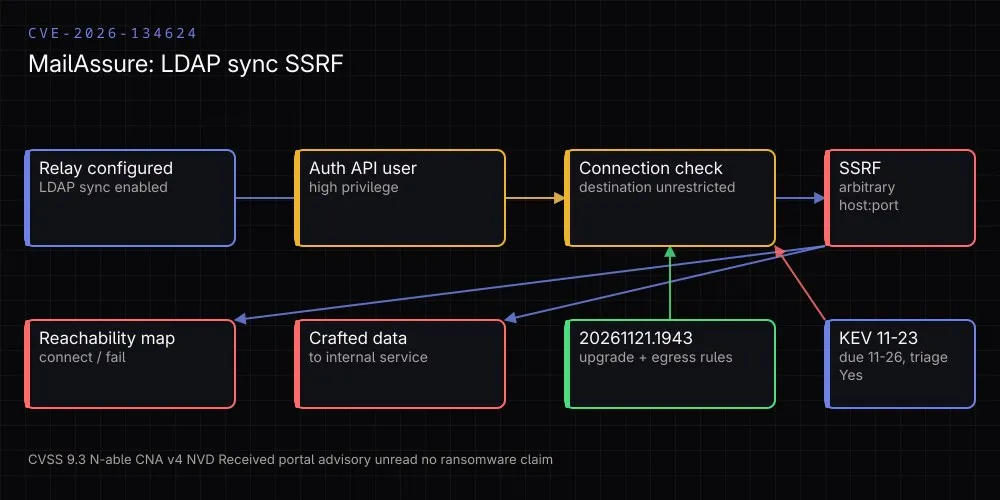
CISA added CVE-2026-134624 (N-able MailAssure, formerly SpamExperts) to the KEV catalog on November 23, 2026, with a November 26 federal due date. NVD published the record a day earlier and still marks it Received. The flaw is in the LDAP synchronisation connection check: the server does not restrict where it connects when a relay is configured. This write-up separates what the records actually say from what they do not: the KEV entry is verified, but the vendor advisory linked from the KEV notes could not be read independently.
Quick summary
| Field | Value |
|---|---|
| CVE | CVE-2026-134624 |
| Product | N-able MailAssure (SpamExperts), builds before 20261121.1943 |
| Weakness | CWE-918 (SSRF), secondary classification from N-able CNA |
| CVSS v4.0 | 9.3 Critical, AV:N/AC:L/AT:N/PR:H/UI:N/VC:H/VI:H/VA:N/SC:H/SI:H/SA:N — N-able CNA, not an NVD analysis |
| NVD status | Received; no NVD score and no v3.1 metric |
| SSVC (CISA) | exploitation: active, automatable: no, technicalImpact: total |
| KEV | added 2026-11-23, due 2026-11-26, forensic triage Yes, ransomware Unknown |
| Preconditions | Authenticated API user and a configured relay |
| Unread source | Vendor advisory in KEV notes is a JavaScript portal; content not independently verified |
Technical view
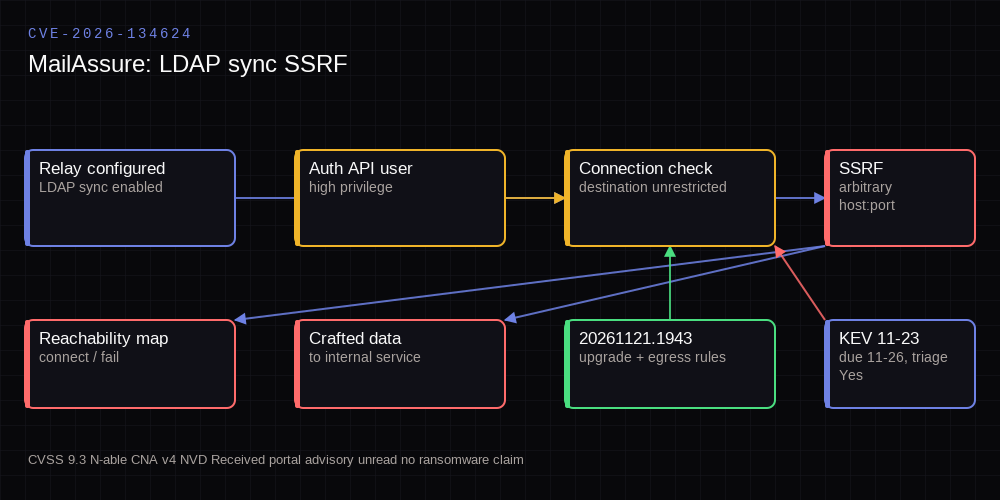
The NVD description is specific: MailAssure does not restrict the destination of the connection check it performs for LDAP synchronisation when a relay is configured. An authenticated API user can make the server connect to arbitrary internal hosts and ports, determine which are reachable from the connection result, and send crafted data to internal services. This is not an internet-facing RCE; it turns the server into an internal network probe and a data carrier.
The version is a timestamp-style build string, 20261121.1943. NVD gives the affected range as 0 to that build with custom versioning. Since the vendor advisory could not be read independently, there is no fuller version table in the records. The CVSS v4.0 vector requires high privileges (PR:H), needs no user interaction, and declares no availability impact (VA:N). The SC:H and SI:H values say effects can spread beyond MailAssure’s own security boundary, which fits an SSRF.
Score attribution matters: 9.3 is N-able CNA’s secondary v4.0 metric. NVD is Received, has produced no score of its own, and carries no v3.1 metric. The CISA SSVC options were read separately: exploitation: active, automatable: no, technicalImpact: total. The KEV record directly sets dateAdded: 2026-11-23, dueDate: 2026-11-26, forensicTriage: Yes, and knownRansomwareCampaignUse: Unknown. The generic “Forensics Triage Requirements” wording inside requiredAction is not what makes forensicTriage Yes; the field itself is.
The KEV notes give https://me.n-able.com/s/security-advisory/aArVy0000002mrlKAA as the vendor advisory. That is a Salesforce customer portal and the request returns a JavaScript loader rather than advisory text. We therefore cannot quote the vendor’s own wording, including any statement about observed misuse. The technical account here comes from NVD and the KEV fields, and vendor silence is not read as “no exploitation.” Which internal ports are reachable, which protocols are used, what the field evidence consists of, and who exploited the flaw are all absent from public primary records.
What to do
- Upgrade the build. Move MailAssure deployments to
20261121.1943or later and verify the installed build after patching. - Narrow API privileges. Inventory API accounts that can change relay settings or LDAP synchronisation; keep that access to management accounts only.
- Constrain egress. Limit connections originating from the MailAssure LDAP sync path to known directory servers; block arbitrary internal host and port attempts.
- Search logs. Look for unusual internal IP and port connections from the server, LDAP queries, and newly used API keys.
- Follow the KEV timeline. The November 26 due date and
forensicTriage: Yesfield mean the post-patch forensic step should not be skipped.
What not to claim
- Do not call this unauthenticated RCE. NVD requires an authenticated API user and the vector says
PR:H. - Do not say internal systems were taken over. The records describe arbitrary connections and data delivery, not a verified follow-on compromise.
- Do not say NVD assigned 9.3. It is N-able CNA’s v4.0 metric; NVD is
Receivedand has no score. - Do not add a ransomware claim; the KEV field is
Unknown. - Do not claim a PoC or exploit is circulating; no such field exists in the primary records.
- Do not assume the vendor said there is no misuse. The advisory portal could not be read; silence is not evidence.
- Do not invent a port list. The targeted internal services are not named in the records.
Status
As of November 24, 2026, this flaw is verified through the NVD record and CISA KEV, but the vendor advisory text could not be read independently. The NVD record (Received, CWE-918, N-able CNA CVSS v4.0 9.3, CISA SSVC exploitation: active), the KEV JSON (dateAdded: 2026-11-23, dueDate: 2026-11-26, forensicTriage: Yes, knownRansomwareCampaignUse: Unknown), and the vendor link in the KEV notes agree as far as they go. Open questions: the portal-backed advisory was not readable; there is no NVD analysis; the timing, method, actor, and affected organizations are not named; no target port or protocol is recorded; no v3.1 metric exists. Headlines such as every email gateway compromised, zero-click RCE, or ransomware confirmed are not supported by these records.