MONAI Label CVE-2026-133968: datastore write confinement and RCE risk
MONAI Label 0.8.5 and earlier lets the PUT /datastore/image image parameter write outside the datastore. CVE-2026-133968, KEV fields, AWS field findings and the 0.8.6 fix.
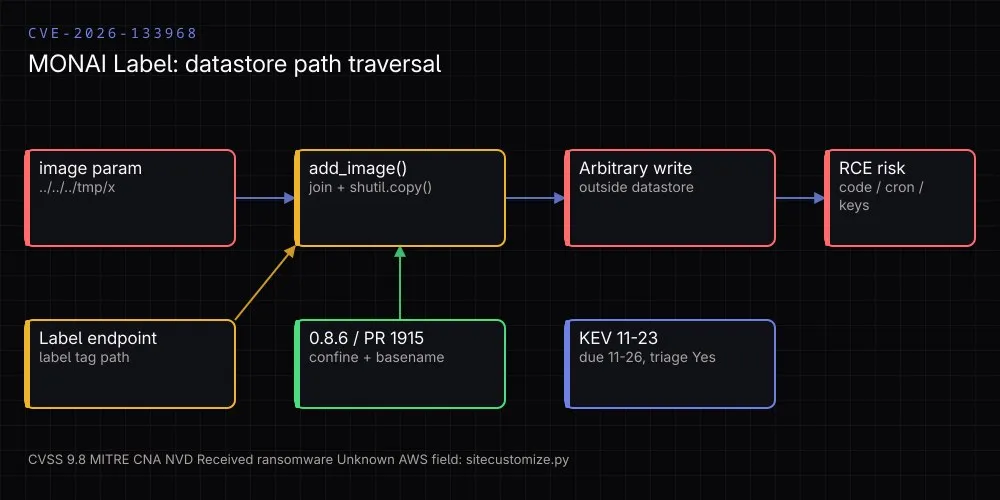
MONAI Label shipped 0.8.6 on November 22, 2026 as a security release. The same flaw entered CISA’s KEV catalog on November 23 as CVE-2026-133968, with a November 26 due date for federal agencies. It is an arbitrary file write in the upload endpoints of a medical imaging AI server. AWS Threat Intelligence’s November 20 post describes the same kind of flaw found in the field in September 2026, but the AWS post does not name the product. Keeping that distinction is the point of this write-up.
Quick summary
| Field | Value |
|---|---|
| CVE | CVE-2026-133968 (GHSA-qc22-rmgc-vg94) |
| Product | monailabel (PyPI), 0.8.5 and earlier; fixed in 0.8.6 |
| Weakness | NVD and KEV: CWE-24; GHSA: CWE-22 — records disagree |
| CVSS v3.1 | 9.8 Critical, AV:N/AC:L/PR:N/UI:N/S:U/C:H/I:H/A:H — secondary CNA metric from [email protected], not an NVD analysis |
| NVD status | Received; no NVD analysis or NVD-produced score |
| SSVC (CISA) | exploitation: active, automatable: yes, technicalImpact: total |
| KEV | added 2026-11-23, due 2026-11-26, forensic triage Yes, ransomware Unknown |
| Default access | MONAI_LABEL_AUTH_ENABLE=False; authentication disabled |
| Field claim | AWS: September 2026 path traversal on a medical imaging app, shell access; product not named in the post |
Technical view
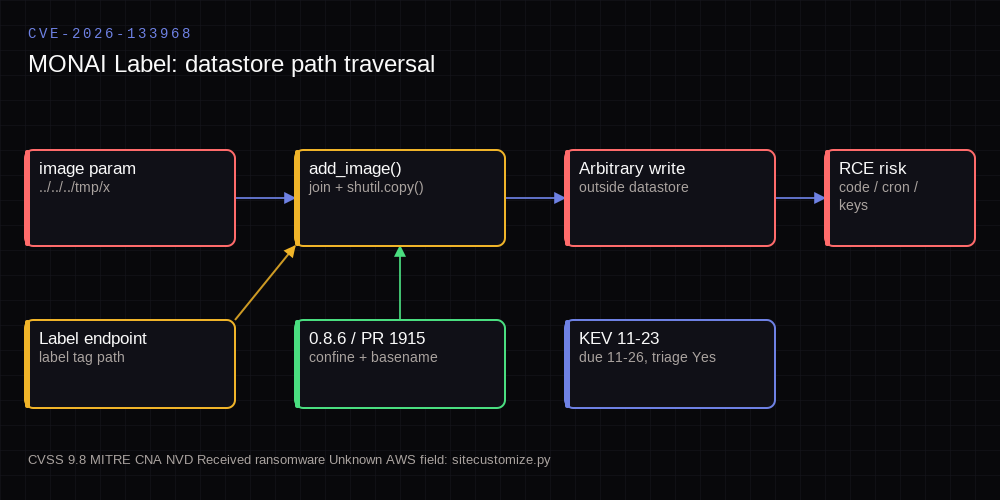
The NVD record summarises the flaw in one sentence: monailabel before 0.8.6 allows directory traversal, with resultant remote code execution, via the image parameter to PUT /datastore/image. The GHSA advisory explains the mechanism. The image query parameter is used as the image ID without validation; LocalDatastore.add_image() appends the file extension, joins it to the datastore image directory, and writes the upload with shutil.copy(). Nothing checks that the resolved path stays inside the datastore. A value such as ../../../tmp/x writes the uploaded content anywhere the MONAI Label process can write.
The second endpoint shares the bug. On PUT /datastore/label, LocalDatastore.save_label() builds its destination from the image ID and the label tag in the same way. So the label tag is an attacker-controlled path component too, not just the image ID. An arbitrary file write can become code execution by overwriting application code, persistence through .ssh/authorized_keys or cron entries, or denial of service by corrupting configuration files. That is a list of possibilities from the advisory, not a claim about which file was written or which organization was hit.
The access condition matters. Per GHSA, authentication is disabled by default (MONAI_LABEL_AUTH_ENABLE=False), so any network client that can reach the server can use the endpoint. With authentication enabled, the ANNOTATOR role is still enough; no admin privilege is required. The primary records give no port number or listen address. Beyond “a network-reachable HTTP endpoint,” no attack-surface detail is available.
The fix has two layers. GHSA says pull request #1915 was merged on October 19, 2026 and shipped in 0.8.6. The patch resolves destinations in add_image() and save_label() and rejects any path outside the datastore image/label directories; a Windows cross-drive commonpath error is rejected the same way. The /datastore/image endpoint reduces the image ID to its basename and returns HTTP 400 for empty or dot-prefixed values. The PR reports new unit tests, 174 passing tests and 2 expected failures (xfail).
The 0.8.6 notes also close a second path traversal: PUT /session/?uncompress=true extracted uploaded tar archives without checking member names, and session IDs were used as paths (#1942). The new release rejects archives containing links or device files and returns HTTP 400 for rejected, corrupt or unsupported archives. That flaw affects 0.8.5 and earlier too, and has the same access condition because authentication is off by default. The release also drops Python 3.9 and 3.10; 0.8.6 requires Python 3.11 or newer.
Vendor statement vs field evidence
The GHSA advisory was published on November 18, 2026 and said “CVE ID: No known CVE” at the time; it classified the weakness as CWE-22. NVD published CVE-2026-133968 on November 20, and KEV uses CWE-24. The advisory’s “no CVE” line is no longer current, while the CWE difference remains in the records. The NVD entry is still Received: the 9.8 score is a secondary CNA metric from [email protected], not an NVD analysis. The CISA SSVC options were read separately: exploitation: active, automatable: yes, technicalImpact: total. The KEV record genuinely sets forensicTriage: Yes; this is not inferred from the generic “Forensics Triage Requirements” wording in requiredAction. knownRansomwareCampaignUse is Unknown.
The AWS Security Blog post of November 20, 2026 supplies the field side. Amazon Threat Intelligence found an unauthenticated, publicly exposed Cairn instance on September 10 and could see the traces of a campaign against East Asian universities running roughly 48 hours from September 8. The agents tested a filename parameter on an upload endpoint of an open-source medical imaging AI application, found path traversal, and went from API mapping to arbitrary file write in about 11 minutes. In a later session they wrote a Python reverse-shell payload into sitecustomize.py, triggered a training API endpoint to spawn a new Python process, and got a reverse shell as root. AWS assesses with high confidence that the flaw was a zero-day at the time, and attributes the actor to a Chinese-nexus group with moderate confidence. The same post says the Redis and GPU-server operations failed and labels the use on a second university network as an inference.
The AWS post does not name the product. NVD lists that blog as a reference, and GHSA credits @aws-sec-vdp and says the original report went to the MONAI repository as GHSA-cxx7-378q-5622. Identifying the blog’s application as MONAI Label is an inference from that chain, not a statement in AWS’s own text. Likewise, the CVE description’s “exploited in the wild starting in September 2026” comes from the CVE record, not from an NVD analysis.
What to do
- Upgrade every MONAI Label server at 0.8.5 or earlier to 0.8.6. Use
pip install -U monailabel==0.8.6ordocker pull projectmonai/monailabel:0.8.6, and move to Python 3.11 or newer. - Cut access before patching. Do not expose the server to untrusted networks; set
MONAI_LABEL_AUTH_ENABLE=Trueand grant theANNOTATORrole only to trusted users. - Narrow write permissions. Run the process as an unprivileged user whose write access is limited to the datastore directory. Traversal then cannot reach
.ssh, cron, or application code. - Review old servers before returning them to service. If a 0.8.5-or-earlier instance was reachable from an untrusted network, look for unexpected file changes, new users, and reverse-shell traces as the 0.8.6 notes recommend.
- Audit both endpoints. Search logs for
/datastore/image,/datastore/label, and/session/?uncompress=truecalls. The September 2026 indicators published by AWS are142[.]4.98.145and142[.]4.107.34.
What not to claim
- Do not state as fact that AI found a zero-day on its own. That is AWS’s high-confidence assessment; the actor attribution is moderate confidence and the post does not name the product.
- Do not say every university was compromised. AWS says the Redis and GPU operations failed and labels the second-network use an inference.
- Do not claim 0.8.5 always yields RCE. Where the write lands depends on process permissions; GHSA describes arbitrary write as a route to RCE, not a guaranteed outcome.
- Do not say NVD assigned 9.8. The score is a secondary CNA metric from
[email protected]; NVD’s record isReceivedand contains no NVD analysis. - Do not say there is no CVE. GHSA wrote that on November 18; NVD published CVE-2026-133968 on November 20. Do not hide the CWE-22 versus CWE-24 split either.
- Do not add a ransomware claim; the KEV field is
Unknown. - Do not name a port or source address. The primary records give neither.
- Do not use a zero-click RCE headline. The condition is a server reachable over the network with the default unauthenticated configuration; no user interaction is needed, but the access precondition exists.
Status
As of November 24, 2026, this flaw is verified in primary records and listed in KEV. The NVD record (Received, CVE-2026-133968, secondary CNA CVSS 9.8, CISA SSVC exploitation: active), the CISA KEV entry and JSON feed (dateAdded: 2026-11-23, dueDate: 2026-11-26, forensicTriage: Yes, knownRansomwareCampaignUse: Unknown), GHSA-qc22-rmgc-vg94, PR #1915, the 0.8.6 release notes and the AWS Security Blog agree. Open questions: there is no NVD analysis; the CWE classification differs between records; GHSA said no CVE existed on November 18; the AWS post does not name the product, so the field match is inferred from the reference chain; actor attribution is moderate confidence; the second-network use is labelled an inference by AWS; no port or listen address appears in a public primary record; affected organizations are not named. Headlines such as E2EE broken, BitLocker broken, or ransomware confirmed are not supported by these records.
From this series
Sources
- NVD - CVE-2026-133968
- CISA KEV entry
- CISA KEV JSON feed (version 2026.11.23)
- MONAI Label: GHSA-qc22-rmgc-vg94
- MONAI Label #1915: confine datastore write paths
- MONAI Label 0.8.6 release notes
- Original MONAI report: GHSA-cxx7-378q-5622
- AWS Security Blog: Cairn agents and the zero-day finding
- CISA BOD 26-04 implementation guidance