LXD CVE-2026-135384: OIDC token binding gap
Canonical LXD before 5.0.12 / 5.21.10 / 6.10.2: OIDC bearer token binding, audience and claim confusion, GHSA and NVD records.
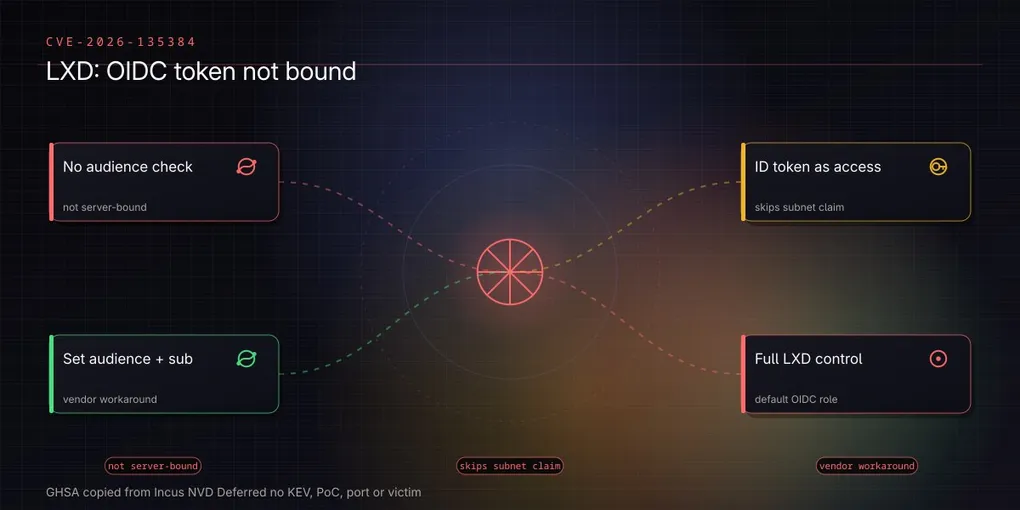
As of November 27, 2026, Canonical LXD installations with OIDC authentication enabled check a bearer token only for issuer, signature, and expiry. Unless oidc.audience is set, the token is not bound to that LXD server: a token the same identity provider issued to another application, a token naming no user, or an ID token presented in place of an access token can be accepted. Below are the Canonical advisory, the NVD API record, fixed releases, and the KEV JSON check; there is no claim of victims, campaigns, or in-the-wild exploitation.
Quick summary
| Field | Value |
|---|---|
| CVE | CVE-2026-135384 |
| Product | Canonical LXD |
| Affected | LXD >= 5.0; NVD: before 5.0.12, 5.21.10, 6.10.2 |
| Fixed | 5.0.12, 5.21.10, 6.10.2 |
| Weakness | CWE-287 improper authentication |
| Condition | OIDC authentication must be configured |
| Impact | Unauthorized LXD API access, user impersonation, subnet restriction bypass |
| CVSS 4.0 | 9.2 CRITICAL, [email protected] CNA source |
| CVSS 3.1 | 8.1 HIGH, reporter metric in the advisory text |
| NVD status | Deferred; no NVD analysis score or SSVC fields |
| GHSA | GHSA-v3m9-p36m-qjqc, November 26, 2026 |
| KEV | No entry in the 2026.11.25 KEV JSON |
| Source note | Advisory copied from the Incus advisory |
Technical view
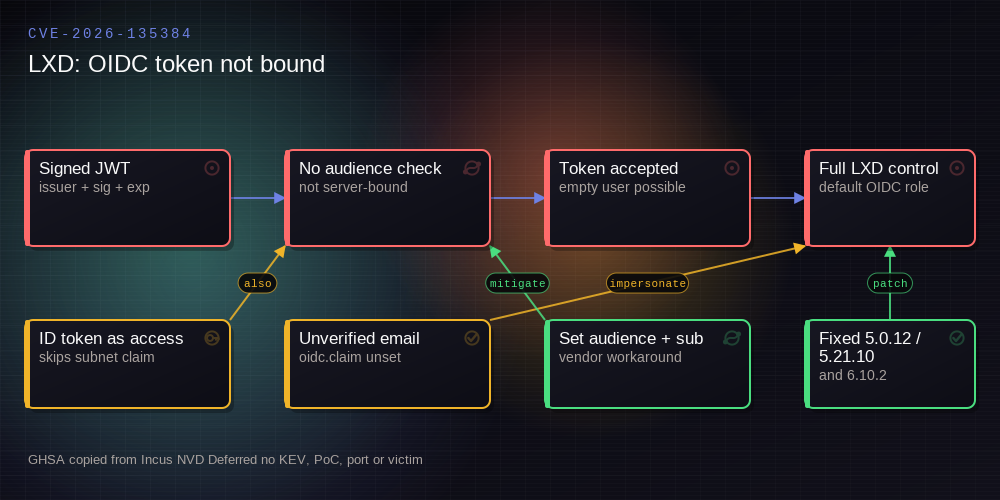
Canonical’s GHSA-v3m9-p36m-qjqc says that when OIDC is configured, a bearer token or web UI cookie is accepted after issuer, signature, and expiry checks. Unless oidc.audience is set, nothing ties the token to that server. That has three consequences: a token issued by the same identity provider to a different application is accepted; a signed token naming no user authenticates with an empty user name; and an ID token can be presented in place of the access token, skipping the checks meant for the access token, including the incus.allowed_subnets claim and its shorter lifetime.
A fourth issue is user-name mapping. When oidc.claim is unset, the user name comes from the token’s email claim, and that claim is used even if the provider marks the address as unverified. In the default configuration, OIDC clients are not sent to OpenFGA or an authorization scriptlet, so any OIDC client that authenticates has full control of the LXD server. On servers that authorize OIDC users through OpenFGA or a scriptlet and identify them by email address, a user who can set an unverified email address on their provider account can be authorized as the owner of that address. A user restricted by incus.allowed_subnets can reach the API from any network.
The advisory text describes the behavior on the Incus side and explicitly states that the Canonical LXD advisory was copied from the Incus advisory. That does not mean the two products share version numbers; the LXD fixed versions are 5.0.12, 5.21.10, and 6.10.2. The NVD record was created on November 27, 2026 at 00:16 UTC and is Deferred. The 9.2 CVSS 4.0 metric comes from [email protected], meaning the Ubuntu/Canonical CNA; the 8.1 CVSS 3.1 score on the GHSA page is the reporter’s metric. There is no NVD analytical score and no SSVC data.
The vendor’s temporary measures are clear: set oidc.audience to a value the provider places only in access tokens issued for LXD, which rejects tokens for other applications and ID tokens sent as access tokens; and set oidc.claim to a claim users cannot edit themselves, such as sub, or configure the provider to release only verified email addresses. These measures do not replace the patch.
The 2026.11.25 CISA KEV JSON contains no entry for this CVE. The records contain no PoC, victim list, actor name, IOC, or LXD API port information. Claims of active exploitation or zero-click behavior are not supported by the sources.
What to do
- Check whether OIDC is enabled. LXD setups using local authentication are outside the condition described by this record.
- Move to fixed releases. Target 5.0.12 on the 5.0 line, 5.21.10 on 5.21, and 6.10.2 on 6.10; the recorded scope is
>= 5.0. - Set an audience. Make
oidc.audiencea value that appears only in access tokens issued for this LXD installation; apply it as the vendor’s temporary measure if patching is delayed. - Review claim selection. Use a claim users cannot change, such as
sub, or make the provider release only verified email addresses. - Check the authorization layer. If you use OpenFGA or a scriptlet, base identity on a verifiable claim rather than email, and do not rely on a token claim alone for network restrictions.
- Review sessions. Look for unexpected OIDC sessions and newly managed virtual machines in logs. This is a local check suggested here, not a vendor IOC.
What not to claim
- Do not say LXD is broadly compromised and every API is open. The condition is OIDC configuration and token infrastructure; local-auth setups are out of scope.
- Do not say NVD assigned 9.2. The metric is CNA-sourced from
[email protected]and NVD isDeferred. - Do not say this is in KEV or actively exploited. The 2026.11.25 KEV JSON has no entry and there is no field evidence.
- Do not say Incus and LXD are the same product with the same patch. The LXD advisory was copied from Incus; its fixed versions are specific to LXD.
- Do not say email verification is always disabled. The effect is limited to use of an unverified
emailclaim whenoidc.claimis unset. - Do not say the audience setting is a permanent fix. The vendor calls it a workaround; the permanent fix is the patched release.
- Do not say a PoC or victims exist. The primary records contain no such information.
Status
As of November 27, 2026, CVE-2026-135384 is verified through the Canonical LXD advisory GHSA-v3m9-p36m-qjqc and the NVD API record. The GHSA was published on November 26 and states that it was copied from the Incus advisory; the NVD record was created on November 27 at 00:16 UTC and is Deferred. Affected and fixed versions, temporary measures, and the impact description were read directly from the GHSA text. The CVSS 4.0 score is Ubuntu/Canonical CNA-sourced and the CVSS 3.1 score is the reporter’s metric in the advisory; there is no NVD analytical score or SSVC data.
The open questions are clear: the records give no PoC, victims, actors, IOCs, or LXD API port; there is no data on whether non-OIDC setups are affected; and Deferred means NVD analysis has not finished. The 2026.11.25 CISA KEV JSON has no entry. This article carries no sensational claim such as broken E2EE, zero-click compromise, or confirmed ransomware.