Juniper Session Smart CVE-2026-103406: root command injection in KEV
JSA112183, AutomatedProvisioner CWE-78, CVSS 9.8, 7.0.5/7.1.7/7.2.3, CISA KEV on November 25, forensic triage requirement.
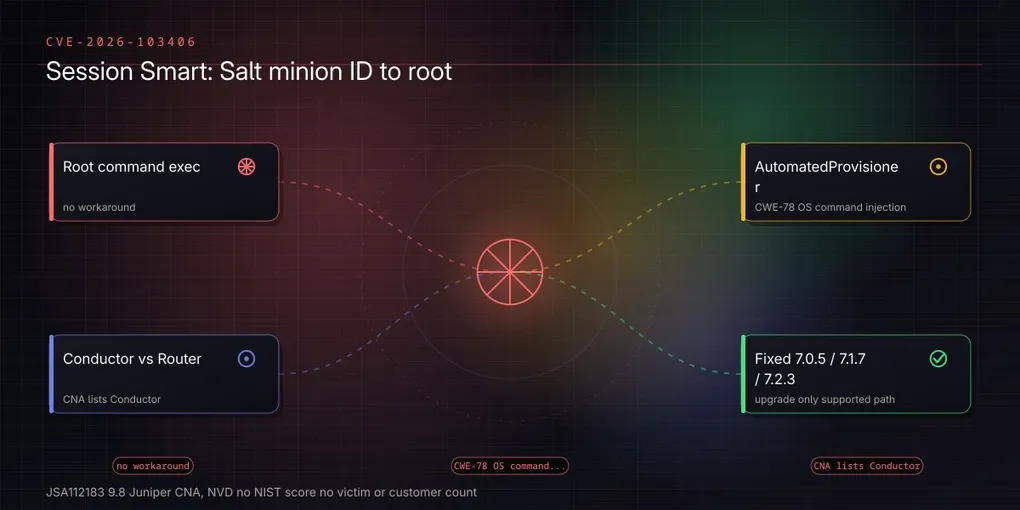
As of November 26, 2026, CVE-2026-103406 is in the CISA Known Exploited Vulnerabilities catalog because of an OS command injection in the AutomatedProvisioner component of Juniper Session Smart Conductor. Juniper published bulletin JSA112183 on October 28; the Juniper CNA container was updated on November 24 with a report of at least one instance of malicious exploitation received by the Juniper SIRT, and the top-level CVE record was last updated on November 26. CISA added the entry on November 25, set a November 28 due date, and marked forensic triage as required. Below are the Juniper CNA record, NVD API, the KEV JSON, catalog, and alert; no actor, victim count, or customer count has been invented.
Quick summary
| Field | Value |
|---|---|
| CVE | CVE-2026-103406 |
| Product | Juniper Session Smart Conductor, AutomatedProvisioner; the KEV entry also names Router |
| Weakness | CWE-78 OS command injection; arbitrary commands as root via a crafted Salt minion ID |
| Advisory | JSA112183, October 28, 2026; CNA container updated November 24 with exploitation note |
| CVSS | 9.8 CRITICAL, CVSS 3.1, assigned by CNA Juniper |
| Vector | CVSS:3.1/AV:N/AC:L/PR:N/UI:N/S:U/C:H/I:H/A:H |
| Affected | Conductor before 7.0.5; 7.1.0 before 7.1.7; 7.2.0 before 7.2.3 |
| Fix | 7.0.5, 7.1.7, 7.2.3 and later releases |
| Workaround | None; the CVE record says No available workarounds exist for this issue |
| NVD status | Analyzed; no NIST score, 9.8 is Juniper-sourced Secondary |
| SSVC | CISA Coordinator: exploitation: active, automatable: yes, technicalImpact: total |
| KEV | Added November 25, 2026; due November 28, 2026; forensic triage Yes; ransomware Unknown |
| Exploitation | At least one instance of malicious exploitation reported to the Juniper SIRT |
| Scope note | The CNA affected-product field lists Conductor; the KEV product name lists Conductor and Router |
Technical view
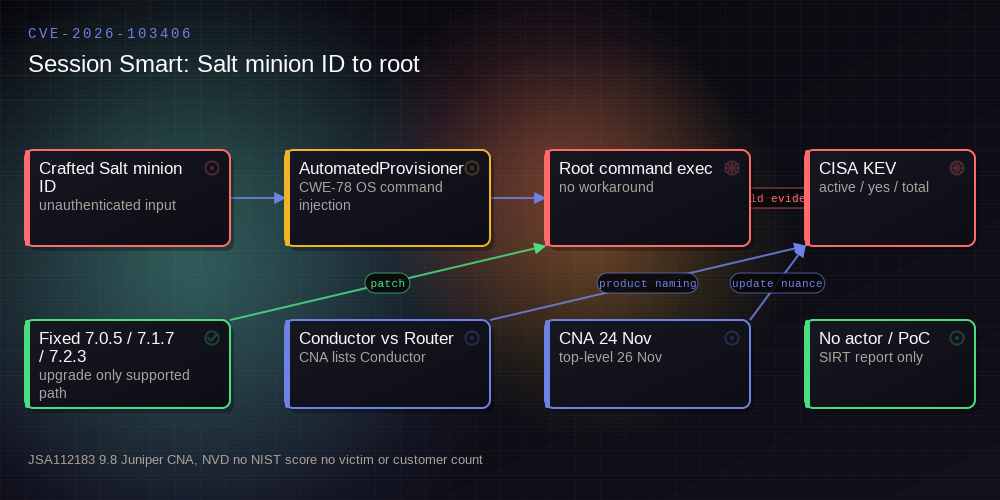
The Juniper CNA record describes the flaw as improper neutralization of special elements used in an OS command in the AutomatedProvisioner component of Session Smart Conductor. A remote attacker can execute arbitrary commands as root through a specially crafted Salt minion ID. The record title points to command execution during key management by an unauthenticated attacker. The weakness is CWE-78, OS Command Injection. Its CVSS 3.1 vector includes PR:N and UI:N, so no account or user interaction is required, while C:H/I:H/A:H describes total impact. Primary records do not publish command text, request flow, or payload; none is invented here.
Juniper’s affected-version list has three ranges: before 7.0.5, from 7.1.0 before 7.1.7, and from 7.2.0 before 7.2.3. The solution list names 7.0.5, 7.1.7, 7.2.3, and all subsequent releases. The record states No available workarounds exist for this issue, so upgrading is the only vendor-supported path. JSA112183 is a broader bulletin published the same day; this article covers only CVE-2026-103406.
Product naming needs care. The CISA KEV entry names the product “Juniper Session Smart Conductor and Session Smart Router”, and the November 25 CISA alert uses the same pairing. Juniper’s CNA record lists only Session Smart Conductor in its affected-product field, with the three affected version ranges attached to Conductor. For that reason, the KEV product name alone is not evidence that the CNA marks Router as affected by this specific CVE. For inventory purposes, checking both product families and verifying their build levels against the bulletin remains prudent, while keeping the two source statements distinct.
Exploitation status is clear in two primary sources. The exploits field of Juniper’s CVE record says at least one instance of malicious exploitation has been reported to the Juniper SIRT and encourages customers to upgrade to a fixed release as soon as possible while taking mitigation steps. CISA added the CVE to KEV on November 25, set a November 28 due date, marked forensic triage as required, and set known ransomware campaign use to Unknown. The NVD record is Analyzed; it has no NIST score of its own, displays Juniper’s 9.8 as Secondary, and carries CISA SSVC values active, yes, and total. Those fields establish exploitation evidence, not the actor, victim, first exploitation date, or number of affected systems.
What to do
- Inventory Conductor builds. Use the 7.0.5, 7.1.7, and 7.2.3 thresholds. Intermediate and earlier builds in those trains should be treated as affected.
- Upgrade immediately. Move to 7.0.5, 7.1.7, 7.2.3, or a later release. Juniper says no workarounds exist and encourages prompt upgrading.
- Check Router inventory too. The CISA KEV product name includes Router, so verify its build level. Do not treat the CNA affected-product field as listing Router for this CVE when it does not.
- Plan forensic triage. The KEV entry marks triage as required under BOD 26-04. The November 28 date binds FCEB agencies; other organizations should treat it as a priority signal.
- Limit management and provisioning reachability as an interim step. Reducing exposure is reasonable, but Juniper does not list it as a workaround for this CVE.
- Review logs back to October 28. Look for unexpected administrative actions, key-management events, and unusual sessions. Start incident response if anything looks wrong.
- Confirm support status for EOL or EOE releases. The CVE record does not evaluate releases past End of Engineering or End of Life; check with Juniper for those systems.
What not to claim
- Do not say there is no exploitation. Juniper SIRT received at least one malicious exploitation report and CISA added the CVE to KEV.
- Do not say the CNA record lists Router as affected. Its affected-product field names Conductor; Router appears in the KEV product name.
- Do not claim a known actor. Juniper and CISA publish no actor, victim, or campaign name.
- Do not quote a customer count. No primary source provides one.
- Do not say a public PoC exists. The CVE record, NVD, and KEV provide no PoC evidence.
- Do not say a workaround exists. The CVE record explicitly says none is available.
- Do not say NVD assigned 9.8. It is Juniper’s CNA score; NVD is
Analyzedwith no NIST score. - Do not say ransomware use is known. KEV marks it
Unknown. - Do not say the November 28 date is legally binding on every organization. BOD 26-04 applies to FCEB agencies.
Status
As of November 26, 2026, CVE-2026-103406 is verified through the Juniper CNA CVE record, NVD API, the CISA KEV JSON, and the CISA alert. Bulletin JSA112183 was published October 28; the Juniper CNA container was updated November 24 with the exploitation note; the top-level record was last updated November 26. The record states root command execution through a crafted Salt minion ID, three affected version ranges, three fixed releases, and the absence of workarounds. NVD is Analyzed, displays Juniper’s score as Secondary, and carries the CISA SSVC fields.
The KEV JSON records the November 25 added date, November 28 due date, forensic triage Yes, and ransomware use Unknown. The CISA product name includes Conductor and Router, while the Juniper CNA affected-product field lists Conductor only; this article preserves that difference rather than merging the two claims. The Juniper support portal required a browser session during research, so the bulletin text was not read directly; the bulletin identifier, versions, and exploitation wording were verified through the Juniper CNA record, NVD, and CISA sources. No primary source provides an actor, victim count, first exploitation date, customer count, or PoC.