Idunno AntiCsrf CVE-2026-131914: one POST to deserialization and unpatched RCE
Idunno.AntiCsrf 0.9.1 Beta unkeyed ObjectStateFormatter deserialization, KEV fields, Mandiant field findings and the permanent fix.
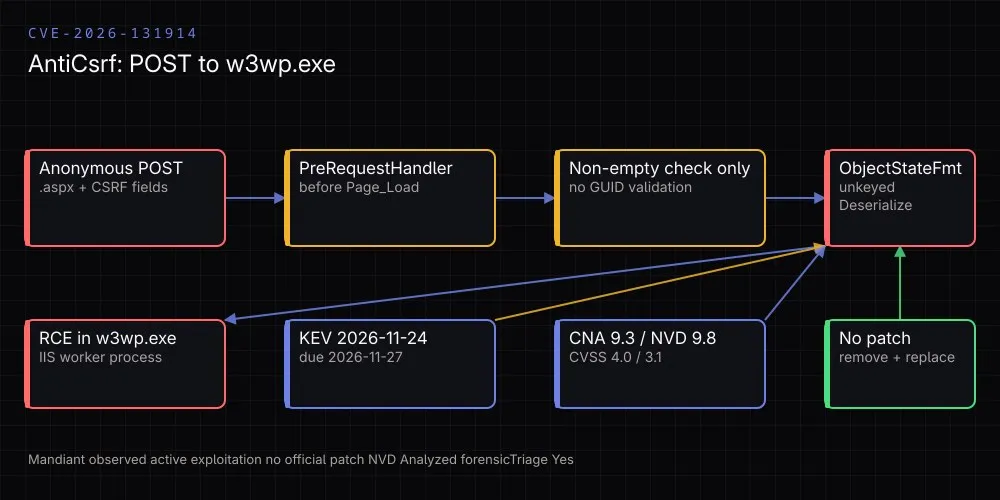
CVE-2026-131914, the item on the November 25, 2026 agenda, shows the cost of an ASP.NET WebForms module that has been unmaintained since 2008 still running in production. CISA added the flaw to KEV on November 24 and Mandiant reports observed exploitation in the wild. The critical point: there is no update, because the project has no maintainer. Below are only the mechanism, the provenance of the scores, and the limits of unverified claims as recorded in primary sources.
Quick summary
| Field | Value |
|---|---|
| CVE | CVE-2026-131914 (MNDT-2026-0048) |
| Product | Idunno.AntiCsrf 0.9.1 Beta / 0.9.1.0 (Idunno.AntiCsrf.dll), ASP.NET WebForms |
| Weakness | CWE-502; unkeyed ObjectStateFormatter.Deserialize() |
| CVSS 4.0 | 9.3 Critical, AV:N/AC:L/AT:N/PR:N/UI:N/VC:H/VI:H/VA:H/SC:N/SI:N/SA:N/E:A — secondary Mandiant CNA metric, E:A (Attacked) |
| CVSS 3.1 | 9.8 Critical, AV:N/AC:L/PR:N/UI:N/S:U/C:H/I:H/A:H — NVD primary analysis |
| NVD status | Analyzed; SSVC exploitation: active, automatable: yes, technicalImpact: total |
| KEV | added 2026-11-24, due 2026-11-27, forensicTriage: Yes, ransomware Unknown |
| Trigger | single unauthenticated HTTP POST; no valid CSRF token required |
| Fix | None; project unmaintained since 2008, migration to a supported mechanism required |
| Attack surface | anonymously reachable .aspx endpoints when the module is registered; no port in the primary record |
Technical view
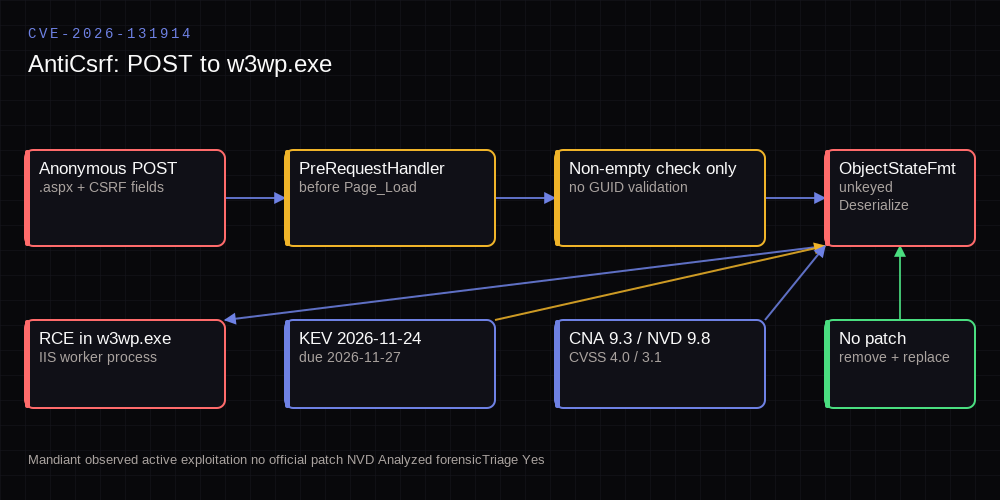
Mandiant’s November 18, 2026 disclosure places the flaw in PreRequestHandlerExecute of Idunno.AntiCsrf.AntiCsrfModule. In the ASP.NET request pipeline this stage runs before the page’s own Page_Load code. For an incoming POST, the module only checks that the configured CSRF cookie (__CSRFCOOKIE) and form field (__CSRFTOKEN) are non-empty; it does not check that the cookie is a GUID. It then creates a parameterless new ObjectStateFormatter() and passes the form field value straight to Deserialize().
The parameterless constructor performs no MAC, signature, encryption or machineKey validation and applies no SerializationBinder restriction. If an attacker puts any non-empty value such as 1 in the cookie and a Base64-encoded .NET gadget chain in the form field, code runs in the context of w3wp.exe, the IIS worker process. Mandiant classifies this as remote code execution. After the request, the module either issues an HTTP 302 redirect or throws PotentialCsrfException, depending on detectionResult. A redirect or a 500 response does not mean exploitation failed.
The access condition matters. Because PreRequestHandlerExecute runs before IHttpHandler.ProcessRequest and the page lifecycle (PreInit, Init, Page_Load), the impact is not limited to login forms: if the module is registered and the page does not implement ISuppressCsrfCheck or carry [SuppressCsrfCheck], even anonymous .aspx pages without a <form runat="server"> expose the sink. That does not support a claim that every ASP.NET site on the internet is affected; the module must be registered under <httpModules> / <modules> in Web.config. The primary record gives no port or listen address.
Mandiant also notes an asymmetry in the rendering path: PagePreRender applies GuidTryParse when generating the cookie, but the PreRequestHandlerExecute path before Deserialize() does not. Producing a strong CSRF token is therefore not the same as validating an incoming token. The break is not a guessable token; it is the conversion of an untrusted form field into an object.
The timeline is in the record: root-cause analysis was completed during incident response on November 4, CNA assignment started on November 11, and the Mandiant advisory was published on November 18. CISA added the entry to KEV on November 24. The advisory states that active exploitation in the wild was observed; it names no victim organizations, no campaign, and includes no PoC code. Mandiant published MD5 and SHA-256 hashes for the official 2008 build and two rebuilds from the retired CodePlex source. Internally recompiled DLLs will have different hashes while retaining the same Deserialize() sink.
What to do
- Remove the module. Delete the
Idunno.AntiCsrf.AntiCsrfModule, Idunno.AntiCsrfentries under<httpModules>and<modules>inWeb.config, the<csrfSettings>section and element, allISuppressCsrfCheck/[SuppressCsrfCheck]code references, and the DLL inbin/. - Move to a supported mechanism. Mandiant lists
System.Web.Helpers.AntiForgery(AntiForgery.GetHtml()/AntiForgery.Validate()), WebFormsPage.ViewStateUserKeywith MAC-verified and encrypted ViewState, or ASP.NET CoreIAntiforgery. - Find the assets. Search every ASP.NET
Web.configandbin/directory forIdunno.AntiCsrf/AntiCsrfModule; include the three known DLL hashes and search by name for in-house rebuilds. - Review logs. Look in IIS logs for POST requests to
.aspxendpoints returning HTTP 302 or 500 with elevatedcs-bytes. Where exploitation is evidenced, rotate<machineKey>keys, encryption keys and database credentials inWeb.configandapplicationHost.config, and inspect the webroot for unauthorized files. - If removal is not immediately possible, use WAF as a temporary measure. That suggestion appears in secondary coverage (SecurityWeek quoting WatchTowr); the primary Mandiant instruction is removal and replacement. A WAF is not a permanent fix.
What not to claim
- Do not use a zero-click RCE headline. The condition is sending a POST to a network-reachable
.aspxendpoint; no user interaction is needed, but the access precondition exists. - Do not say NVD assigned 9.3. The 9.3 is Mandiant CNA’s CVSS 4.0 metric (E:A); NVD’s primary analysis is CVSS 3.1 at 9.8.
- Do not say every ASP.NET site is affected. The module must be registered and a WebForms
Pagehandler present; pages usingISuppressCsrfCheck/[SuppressCsrfCheck]are out of this path. - Do not say a patch was released. The project is unmaintained, there is no official patch, and replacing the module is the only remedy.
- Do not add a ransomware claim; the KEV field is
Unknown. - Do not claim a PoC was published. The primary disclosure describes the mechanism and detection hashes but contains no exploit code; the honeypot probe claim appears only in secondary coverage.
- Do not say a strong CSRF token would have prevented this. The check only asks whether the values are non-empty; GUID parsing happens in the rendering path, not before deserialization.
- Do not invent a port or a victim name. The primary records give neither.
Status
As of November 25, 2026, this flaw is verified in primary records and listed in KEV. The NVD record is Analyzed and carries two distinct scores: Mandiant CNA’s CVSS 4.0 9.3 (E:A) and NVD’s own CVSS 3.1 9.8. The NVD SSVC options are exploitation: active, automatable: yes, technicalImpact: total. The CISA KEV JSON record sets dateAdded: 2026-11-24, dueDate: 2026-11-27, forensicTriage: Yes directly in the field (not inferred from the generic “Forensics Triage Requirements” wording in requiredAction) and knownRansomwareCampaignUse: Unknown. Mandiant’s MNDT-2026-0048 advisory records the mechanism, DLL hashes and root-cause timeline; the field-exploitation observation comes from that record.
Open questions: there is no official patch; affected organizations are not named; no specific port or listen address is given; the primary advisory contains no PoC code; the WatchTowr honeypot probe and WAF suggestion appear only in secondary coverage; CWE-502 is consistent across records. Headlines such as E2EE broken, BitLocker broken, or ransomware confirmed are not supported by these records.