HPE AirWave CVE-2026-133971: web authentication bypass
HPESBNW05186, CVE-2026-133971/133972/133973, CVSS 9.8, AirWave 8.3.0.8 fix, VLAN and firewall mitigation, KEV status.
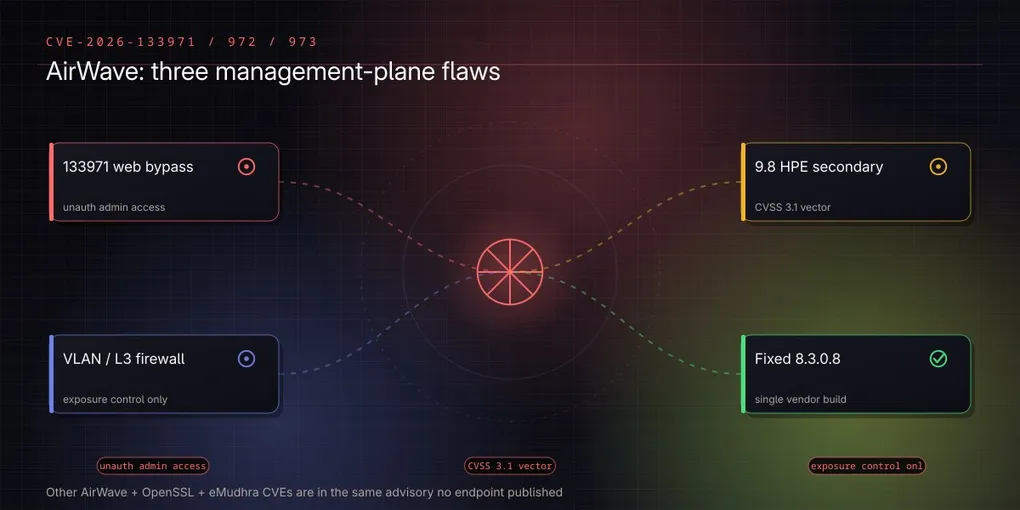
As of November 26, 2026, HPE Networking has published advisory HPESBNW05186 in Final status on November 25 for its AirWave management software. CVE-2026-133971 is an authentication bypass in the web management interface, CVE-2026-133972 is an API authentication bypass, and CVE-2026-133973 is unauthenticated operating system command injection; all three are scored 9.8 in CVSS 3.1. The affected range is AirWave 8.3.0.7 and below, and the fix is 8.3.0.8 and above. Below are the HPE CSAF text, the support bulletin, the NVD API record, and the CISA KEV check; no PoC, payload, victim, or IOC has been invented.
Quick summary
| Field | Value |
|---|---|
| CVE | CVE-2026-133971; same advisory also covers CVE-2026-133972 and CVE-2026-133973 |
| Product | HPE Networking Management Software (AirWave) |
| Advisory | HPESBNW05186, Final, revision 1, November 25, 2026 |
| Affected | AirWave 8.3.0.7 and below; HPE has not assessed EoS versions |
| Fix | AirWave 8.3.0.8 and above |
| 133971 | Web management interface authentication bypass; unauthorized administrative access |
| 133972 | API authentication bypass; network attacker may perform unauthorized actions |
| 133973 | Unauthenticated OS command injection in the web-based management interface |
| CVSS | 9.8 CRITICAL for all three, CVSS 3.1 |
| Vector | CVSS:3.1/AV:N/AC:L/PR:N/UI:N/S:U/C:H/I:H/A:H |
| NVD status | CVE-2026-133971: Received; 9.8 is HPE-sourced Secondary |
| KEV | No entry in the November 26, 2026 KEV JSON and catalog check |
| Discovery | Internal security research at HPE Networking |
| Mitigation | Restrict CLI and web management interfaces to a dedicated L2 VLAN and/or L3+ firewall policies |
| Exploitation | HPE is not aware of exploit code specifically targeting AirWave as of the advisory release date |
Technical view
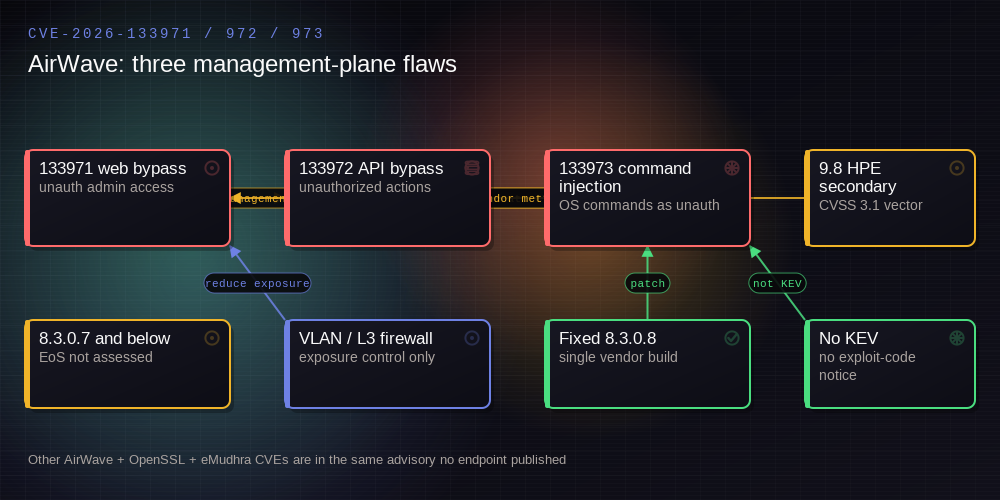
HPESBNW05186 groups three separate critical records in the same product. CVE-2026-133971 is an authentication bypass in the web management interface; successful exploitation could give an unauthenticated remote attacker unauthorized administrative access to the system, affecting confidentiality and integrity. CVE-2026-133972 bypasses authentication on the API side, potentially allowing an attacker with network access to perform unauthorized actions. CVE-2026-133973 is command injection in the web-based management interface that could let an unauthenticated remote attacker execute arbitrary commands on the underlying operating system. All three use the CVSS 3.1 vector AV:N/AC:L/PR:N/UI:N/S:U/C:H/I:H/A:H: network reachable, low complexity, no account or user interaction, with high impact across confidentiality, integrity, and availability. The advisory gives internal reference numbers but does not describe an endpoint, parameter, or payload.
That separation matters. 133971 and 133972 bypass authentication controls, while 133973 exposes a direct command execution surface. Web and API may be part of the same management plane, but these are distinct CVE records; closing one cannot be assumed to cover the others. HPE delivers a single fixed build: AirWave 8.3.0.8 and above. The advisory also lists other AirWave-specific issues (CVE-2026-133974 through 133980 and CVE-2026-95794 through 95798) plus third-party OpenSSL and eMudhra records; those are separate from the three Critical issues covered here.
HPE’s temporary mitigation reduces the exposed surface. The advisory recommends restricting the CLI and web-based management interfaces to a dedicated Layer 2 segment or VLAN, and/or controlling them with firewall policies at Layer 3 and above, with accounting controls for tracking and logging user activity and resource usage. This lowers the likelihood of exploitation but does not remove the vulnerabilities. The advisory’s End of Maintenance and End of Support note is also explicit: versions past EoM are presumed affected unless stated otherwise, and HPE has not assessed exposure for EoS installations, so those systems should be considered potentially impacted.
The NVD API record for CVE-2026-133971 is Received. Its 9.8 score is marked Secondary from HPE ([email protected]), and NVD has no analytical score of its own. There is no CVE-2026-133971 entry in the CISA KEV JSON as of November 26. HPE writes that it is not aware of exploit code specifically targeting AirWave through the listed vulnerabilities as of the advisory release date. That is a dated statement about vendor awareness, not proof that exploitation never occurred. No primary record provides a PoC, IOC, victim, or campaign detail.
What to do
- Verify the installed version. Read the AirWave version from the management interface or CLI. Anything at 8.3.0.7 or below is affected; EoS installs should be treated as potentially affected because HPE has not assessed them.
- Upgrade to 8.3.0.8 or later. The fixed build is available through the HPE Networking Support Portal. HPE strongly urges customers to patch given the complexity, breadth, and impact of the issues.
- Segment management while patching. Put the CLI and web management interfaces on a dedicated L2 VLAN or restrict them with L3+ firewall policies, and enable accounting logs for user activity and resource usage.
- Review network exposure. Check whether the management interface is reachable from untrusted networks, shared segments, or VPNs that effectively widen access to the appliance.
- Review the pre-patch window. Look for new administrator accounts, unexpected configuration changes, and unusual API or CLI activity in logs from before the upgrade.
- Do not keep the mitigation as the endpoint. VLAN and firewall restrictions are a temporary exposure control, not a replacement for 8.3.0.8.
What not to claim
- Do not say AirWave is actively exploited. There is no KEV entry, and HPE only states that it is unaware of specific exploit code as of the release date.
- Do not say a PoC was published. The advisory, NVD record, and KEV contain no PoC or IOCs.
- Do not say NVD confirmed 9.8. The score is HPE-sourced
Secondary; NVD status isReceived. - Do not merge 133971, 133972, and 133973. Web bypass, API bypass, and command injection are separate CVE records.
- Do not say 133973 needs authentication. The vector says
PR:Nand the advisory says unauthenticated. - Do not say 8.3.0.7 is safe. The affected range is 8.3.0.7 and below; the fix is 8.3.0.8.
- Do not say a VLAN replaces the patch. HPE presents segmentation as a way to reduce exploitation likelihood.
- Do not say EoS versions are unaffected. HPE did not assess them, so they should be considered potentially impacted.
Status
As of November 26, 2026, CVE-2026-133971 is verified through HPE Networking’s Final HPESBNW05186 advisory, published November 25, and the NVD API record. The advisory describes web authentication bypass, API authentication bypass, and unauthenticated OS command injection as separate records, gives a CVSS 3.1 base score of 9.8 with the same vector for all three, and lists affected builds at 8.3.0.7 and below with a fix at 8.3.0.8 and above. The NVD record is Received, with the score attributed to HPE as Secondary.
The CISA KEV JSON version 2026.11.25 and the catalog query return no entry for this CVE. HPE’s statement about exploit code is tied to the advisory release date; no primary record provides a victim list, actor, campaign, or IOC. The VLAN and firewall guidance is an exposure control rather than a fix. This article makes no claim of in-the-wild exploitation or of a public PoC.