Flowintel CVE-2026-133648: TLS verification off for MISP and mail
Flowintel before 4.1.0 skips TLS verification on MISP API and SMTP/IMAP connections. CVE-2026-133648, CVSS source, SSVC fields, and the fix commit.
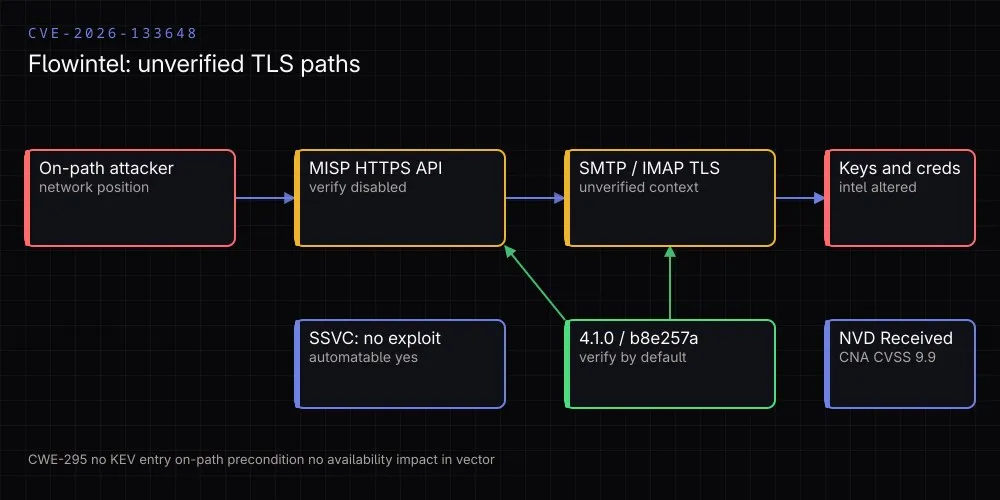
NVD published CVE-2026-133648 for Flowintel on November 20, 2026. The flaw is disabled certificate verification on MISP API calls and missing TLS verification on mail connections. The CVSS v4.0 score is 9.9, not 9.4, but the score comes from the CNA, not an NVD analysis, and the NVD record is still Received.
Quick summary
| Field | Value |
|---|---|
| CVE | CVE-2026-133648 |
| Product | Flowintel before 4.1.0 |
| Weakness | CWE-295 (improper certificate validation) |
| CVSS v4.0 | 9.9 Critical, AV:N/AC:L/AT:N/PR:N/UI:N/VC:H/VI:H/VA:N/SC:H/SI:H/SA:N — CNA source, Secondary at NVD |
| NVD status | Received; no CVSS v3.1 record |
| SSVC | exploitation: none, automatable: yes, technicalImpact: total — Supplier and CISA Coordinator records |
| CISA KEV | This CVE is not in the KEV catalog |
| Fix | Flowintel 4.1.0; commit b8e257a |
Technical view
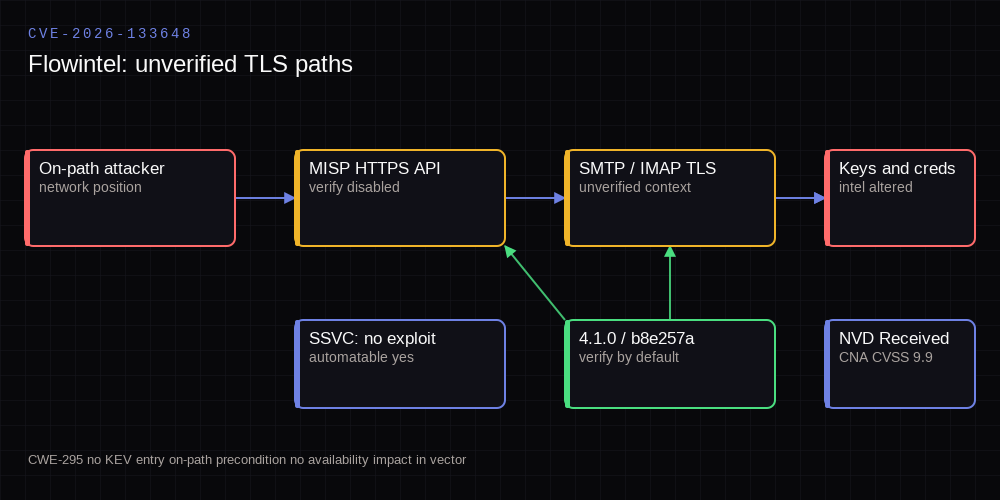
Per the NVD description, Flowintel disables certificate verification for all MISP HTTPS API calls and uses unverified SSL contexts for SMTP STARTTLS and IMAP TLS connections. Affected paths include MISP calls for event retrieval, attribute search, event creation, connectivity checks, and API validation; SMTP for notification email; and IMAP for fetching mail archives and testing connectivity.
The primary record’s scenario: an attacker with a network position between Flowintel and the MISP or mail server can impersonate the remote server, capture MISP API keys and mail credentials, and read or modify threat intelligence data. The attacker needs no authentication and no user interaction, but an on-path position is a precondition. That is not the same as “anyone on the internet can exploit it.” The vector has no availability impact (VA:N); the score comes from confidentiality and integrity impact.
The fix commit (b8e257ab17632eb37c912485cbd78ee7514b764f, “fix: [security] Verify TLS certificates for MISP and mail connections”) adds shared TLS helpers across 11 files; certificate and hostname verification is now the default for MISP and mail connections. Operators can configure private CA bundles or explicitly disable verification, and malformed settings fail closed. The commit also removes MISP warning suppression and documents upgrade requirements.
What to do
- Upgrade to 4.1.0 or later. The record lists affected versions as before 4.1.0 and the fix is this commit.
- Shrink the network position. Keep traffic between Flowintel and MISP/mail servers on a trusted network or an authenticated encrypted tunnel. That does not replace the patch, but it makes the on-path condition harder.
- Rotate credentials. If an installation on an affected version had an untrusted party in a position to observe that traffic, rotate MISP API keys and SMTP/IMAP passwords. The record does not say upgrading undoes past exposure.
- Do not turn verification off. The new code accepts a custom CA bundle; define the CA instead of disabling verification for internal certificate authorities.
- Validate MISP data. The flaw has an integrity impact, so compare events and attributes ingested during the suspect period against the source MISP.
What not to claim
- Do not say “E2EE was broken” or “TLS was cracked.” The flaw is Flowintel turning verification off, not a break in the protocol’s cryptography.
- Do not say NVD assigned 9.9. The score is CNA-sourced and NVD is Received; there is no independent NVD analysis.
- Do not claim active exploitation. SSVC says
exploitation: noneand the CVE is not in KEV.automatable: yesis a different field fromexploitation: active. - Do not say all traffic was intercepted. The primary record lists only MISP API and SMTP/IMAP connections; it makes no claim about other traffic classes.
- Do not add PoC, port, or attack-surface details absent from the primary record.
Status
As of November 22, 2026, this flaw is verified in primary records with a published fix, but NVD analysis is incomplete. The NVD description, CWE-295, CNA CVSS v4.0 score, and fix commit agree. Open questions: NVD is Received with no independent score; the record contains no PoC or field-exploitation evidence; and it gives no concrete port or topology detail for the required network position. Headlines claiming the MISP database was compromised, zero-click exploitation, or ransomware are not supported by these records.