Drupal Core CVE-2026-132165: site takeover through install.php
SA-CORE-2026-017, KEV record, fixed versions and installer lockdown steps for a flaw with field exploitation but no NVD record.
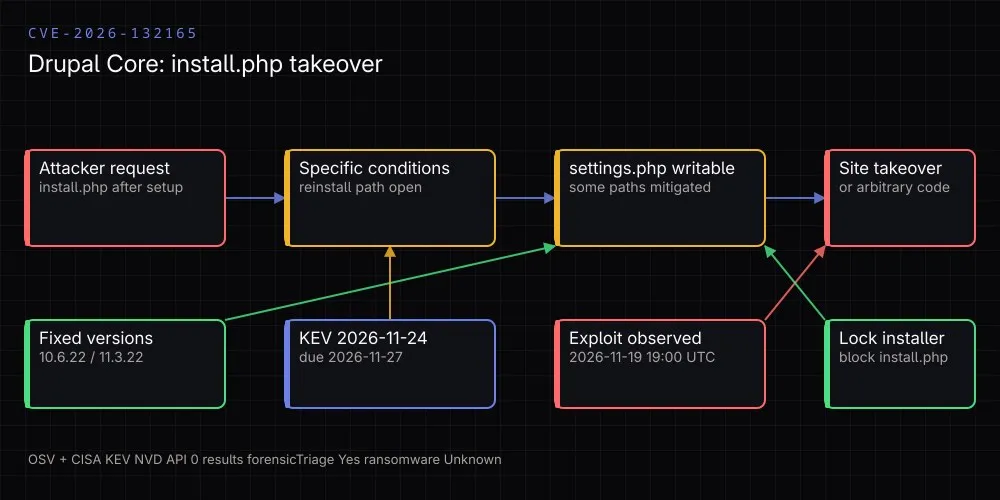
As of November 25, 2026, Drupal Core CVE-2026-132165 is in CISA KEV and the vendor advisory reports exploitation in the wild. The critical point is that install.php, left behind after installation, can be used to attempt a reinstall of the site. Below are the vendor/OSV record and CISA fields; the NVD API returns no record for this CVE, so no NVD score or SSVC data is claimed.
Quick summary
| Field | Value |
|---|---|
| CVE | CVE-2026-132165 / DRUPAL-CORE-2026-017 / SA-CORE-2026-017 |
| Product | Drupal Core, drupal/core (Packagist) |
| Weakness | CWE-636 (not failing securely); KEV text: site takeover or arbitrary code execution via the Drupal installer |
| Affected | <10.6.22, >=11.0.0 <11.3.22, >=11.4.0 <11.4.13 |
| Fix | 10.6.22, 11.3.22, 11.4.13 |
| NVD status | NVD API resultsPerPage: 0; no CVSS/SSVC |
| KEV | added 2026-11-24, due 2026-11-27, forensicTriage: Yes, ransomware Unknown |
| Field status | Vendor note: exploitation on live sites as early as 2026-11-19 19:00 UTC |
| Discovery | Anthropic OSS Scanner, ANT-2026-GMRPK0BU |
| Attack surface | install.php endpoint; specific conditions required, no port in the primary record |
Technical view
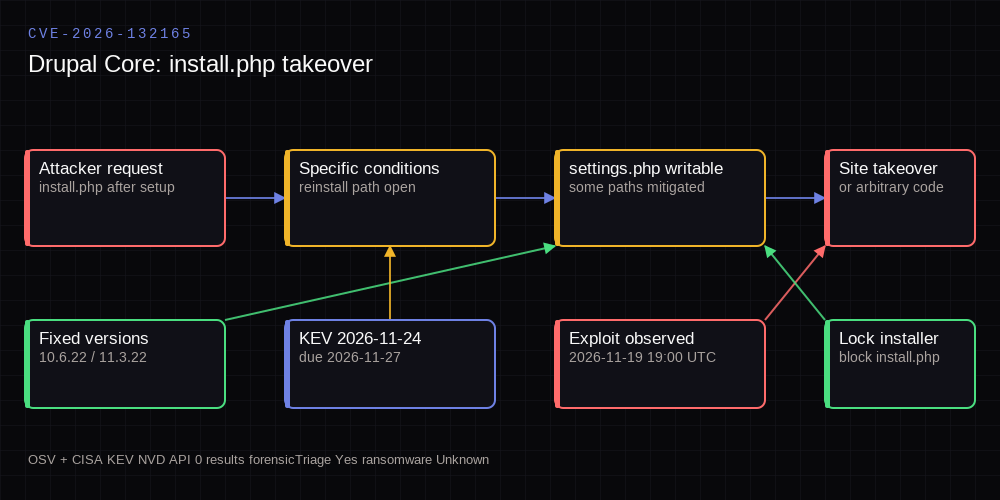
Drupal Core ships with install.php for installation. Under the conditions described in the vendor record, an attacker can use that file to attempt to reinstall Drupal, which can result in site takeover or remote code execution. The OSV record says some exploit paths are mitigated if the web server cannot write to or change permissions on settings.php, but that this does not cover every path.
That means two layers: patching is the actual fix, while tightening settings.php permissions and locking down the installer are additional defenses. Drupal Security Team separately recommends securing the installer after installation. Sites using Drupal Steward are protected against known attack vectors, yet the vendor still asks for an upgrade in the near future in case more vectors are discovered.
The affected ranges span three branches: before 10.6.22 on 10.x, before 11.3.22 on 11.0-11.3, and before 11.4.13 on 11.4. End-of-life branches have no patch, so asset inventory must establish the exact version before calling a site affected or unaffected.
The vendor note’s update says exploitation on live sites was observed as early as November 19, 2026 at 19:00 UTC. The flaw was discovered by Anthropic OSS Scanner as ANT-2026-GMRPK0BU. The primary record contains no PoC code, victim list, campaign name, port or listen address.
What to do
- Patch immediately. Move to
10.6.22,11.3.22or11.4.13as appropriate. For EOL branches, plan a move to a supported branch. - Lock down the installer. Apply Drupal’s “securing the installer” instructions after setup and block
install.phpat the web server layer. - Tighten
settings.phppermissions. Prevent the web server account from writing the file or changing its permissions; this is not a substitute for the patch. - Prioritize from KEV. CISA marks
forensicTriage: Yes; scan internet-facing Drupal sites first and preserve volatile evidence. - Review logs. Look for
install.phprequests after November 19, 2026 19:00 UTC, unexpected installer responses and new files or permission changes. Isolate suspect sites and start incident response.
What not to claim
- Do not say every Drupal site was taken over. The vendor says specific conditions apply; not every installation exposes this path.
- Do not say NVD assigned 9.8. The NVD API returns no record; there is no NVD CVSS or SSVC here.
- Do not claim ransomware was confirmed. The KEV field is
Unknown. - Do not say making
settings.phpread-only is sufficient. The vendor only says some paths are mitigated. - Do not say Drupal Steward removes the need to patch. The record covers known vectors and still requests an upgrade for possible additional vectors.
- Do not invent a PoC or a victim name. The primary records contain neither.
- Do not invent a port or network signature; the vendor record gives none.
Status
As of November 25, 2026, this flaw is verified in the vendor/OSV record and CISA KEV. OSV DRUPAL-CORE-2026-017 maps to CVE-2026-132165, lists affected ranges and fixed versions, and records the in-the-wild exploitation update and the Anthropic OSS Scanner finding. The CISA KEV entry sets dateAdded: 2026-11-24, dueDate: 2026-11-27, forensicTriage: Yes, knownRansomwareCampaignUse: Unknown and CWE-636; its action text calls for vendor instructions and BOD 26-04 forensic triage.
Open questions: the NVD API returned no record, so there is no NVD score, NVD SSVC field or NVD-confirmed impact range. The vendor advisory page returned a Client Challenge and could not be read directly; the technical details above come from the OSV delegated advisory record. The “Highly critical 20/25” wording seen in web search results was not used as evidence. No PoC, victim name, campaign or port appears in the primary records.