Budibase CVE-2026-137498: MongoDB filter erasure via __proto__
Budibase Server before 4.0.0: dynamic __proto__ key in PUBLIC queries, empty MongoDB filter, GHSA PoC scope, and the NVD record.
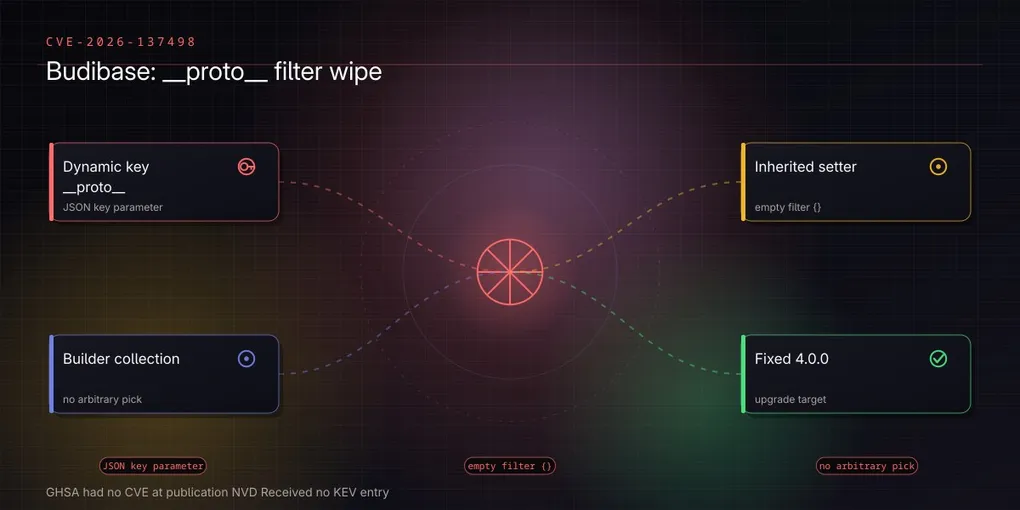
As of November 27, 2026, a PUBLIC Budibase Server MongoDB query can have its filter reduced to {} when a caller supplies __proto__ as a dynamic JSON key. That lets the query read, modify, or delete every document in the collection it addresses. Below are the Budibase advisory, the NVD API record, the scope of the local PoC, and the KEV JSON check; there is no claim of exploitation in production systems.
Quick summary
| Field | Value |
|---|---|
| CVE | CVE-2026-137498 |
| Product | Budibase Server (@budibase/server) |
| Affected | 3.39.18 through 3.44.0 confirmed; NVD: from 3.39.18 before 4.0.0 |
| Fixed | 4.0.0 |
| Weakness | CWE-943; advisory also lists CWE-1321 prototype pollution |
| Preconditions | MongoDB datasource, PUBLIC query, dynamic JSON key |
| Impact | Filter becomes {}; find, updateMany, deleteMany affect every document |
| CVSS 4.0 | 9.9 CRITICAL, VulnCheck secondary source |
| CVSS 3.1 | 10.0 CRITICAL, VulnCheck secondary source; advisory discusses 9.8 and 10.0 |
| NVD status | Received; no NVD analysis score or SSVC fields |
| GHSA | GHSA-x4w8-596q-fmh7, November 10, 2026, Critical |
| KEV | No entry in the 2026.11.25 KEV JSON |
| Reported by | GabrielGomesAL |
Technical view
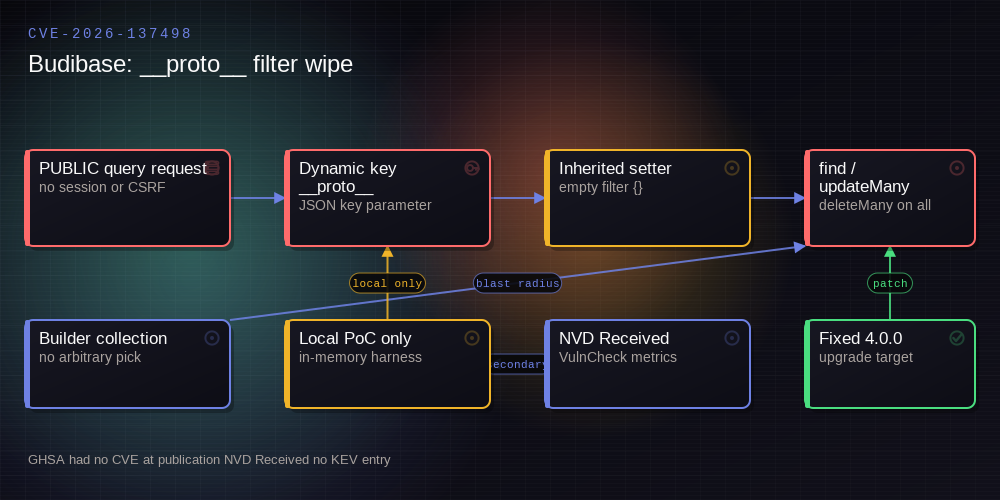
The Budibase advisory describes an unauthenticated caller reaching a PUBLIC MongoDB query and supplying __proto__ as a supported dynamic JSON key. The first template pass uses Object.fromEntries and creates a real own property. In the second pass, packages/server/src/sdk/workspace/queries/queries.ts creates const enrichedQuery = {} and assigns enrichedQuery[enrichedKey] = .... With the key __proto__, that assignment invokes the inherited setter, no own property is created, and the returned filter stays {}. The filter reaches the MongoDB adapter unchanged: find({}) returns every document, updateMany({}, update) updates every document, and deleteMany({}) deletes every document.
The PUBLIC role check in packages/server/src/middleware/authorized.ts returns next() before the session and CSRF checks, so no session or CSRF token is required. The advisory lists the preconditions explicitly: a builder configures a MongoDB datasource; the query is published with PUBLIC execution permission; the query uses a request parameter as a JSON key, for example {"{{ key }}":"fixed"}; the caller knows the published app and query IDs; and recaptcha is disabled or satisfied. The blast radius is the collection chosen by the builder; arbitrary collection selection is not claimed.
The advisory shows a PoC on its own local instance using canary documents: POST /api/v2/queries/<READ_QUERY_ID> with an x-budibase-app-id header and a {"parameters":{"key":"__proto__"}} body returns all documents. It also publishes a network-free Node.js semantic harness result. Both are limited to a temporary self-hosted instance and an in-memory fake collection; the advisory explicitly says no Budibase Cloud, production system, or third-party data was tested. Saying this was exploited in the wild is therefore unsupported.
The flaw was introduced in 3.39.18 by PR #18987 / merge ee39be0, after the fix for CVE-2026-54350. The earlier CVE covered quote-breaking injection in parameter values through 3.39.12; this record concerns dynamic __proto__ in parameter keys. The advisory says current master at a7575af5047529258af7ca6c008194100b087ddd is also affected. The fixed release is 4.0.0.
The NVD record was created on November 26, 2026 at 16:18 UTC and is Received. The 9.9 CVSS 4.0 and 10.0 CVSS 3.1 metrics come from [email protected], a secondary source; the advisory text discusses both a 9.8 vector with S:U and a 10.0 vector with S:C, leaving final scoring to Budibase/CNA. The GHSA said “No known CVE” at publication time; the CVE ID was mapped later through the NVD record. There is no NVD analytical score and no SSVC data.
The 2026.11.25 CISA KEV JSON contains no entry for this CVE. The records give no victim list, actor name, campaign, or IOC; the PoC applies only to an authorized local test environment.
What to do
- Upgrade. Move
@budibase/serverto 4.0.0 or later; the advisory confirmed 3.39.18 through 3.44.0 and master. - Inventory PUBLIC queries. Find MongoDB datasource queries with PUBLIC execution permission, especially those using a request parameter as a JSON key.
- Constrain dynamic keys. Do not use user-controlled values as JSON keys in query templates; limit keys to a fixed allowlist.
- Validate the final filter. Check that the filter is non-empty and contains the expected fields after template processing. This is one of the advisory’s recommended remediation steps.
- Keep recaptcha enabled. An enabled and satisfied recaptcha removes one of the listed conditions, but it is not a security boundary on its own.
- Review data changes. Search logs from before the patch for bulk update or delete operations and unexpected PUBLIC query calls. This is a local check suggested here, not a vendor IOC.
What not to claim
- Do not say Budibase is actively exploited. There is no KEV entry and no production test in the advisory.
- Do not say NVD confirmed a 10.0 score. The metric is VulnCheck-sourced and NVD is
Received. - Do not say every Budibase installation is affected. A MongoDB datasource, PUBLIC query, and dynamic key are required.
- Do not say arbitrary collections can be selected. The advisory limits the impact to the builder’s chosen collection.
- Do not say the PoC was run in production. It was limited to a temporary self-hosted instance and an in-memory harness.
- Do not conflate this with CVE-2026-54350. One is value injection, the other key-based prototype pollution, with different version ranges.
- Do not say the final CVSS is settled at 10.0. The advisory leaves scoring to the CNA and NVD has no analysis.
- Do not say every MongoDB query is affected. PUBLIC permission and a parameter-used-as-JSON-key are conditions.
Status
As of November 27, 2026, CVE-2026-137498 is verified through the Budibase advisory GHSA-x4w8-596q-fmh7 and the NVD API record. The GHSA was published on November 10 and credits GabrielGomesAL; the NVD record was created on November 26 at 16:18 UTC and is Received. Preconditions, the source-to-sink path, the local PoC scope, and recommended remediation were read directly from the GHSA text. The CVSS metrics are VulnCheck-sourced; there is no NVD analytical score or SSVC data.
The open questions are clear: the GHSA did not know the CVE at publication, final scoring was left to the CNA, the PoC is limited to a local test environment, and the records give no victims, actors, IOCs, campaigns, or port information. The 2026.11.25 CISA KEV JSON has no entry. This article avoids the exaggerated conclusion that a database was wholly compromised and keeps the impact within the advisory’s stated conditions.